

Kế hoạch bài dạy minh họa Tiếng Anh Lớp 9 Global Success theo CV5512 - Unit 7: Natural wonders
 42 trang
09/10/2025
4253
42 trang
09/10/2025
4253
Bạn đang xem 30 trang mẫu của tài liệu "Kế hoạch bài dạy minh họa Tiếng Anh Lớp 9 Global Success theo CV5512 - Unit 7: Natural wonders", để tải tài liệu gốc về máy hãy click vào nút Download ở trên.
Tóm tắt nội dung tài liệu: Kế hoạch bài dạy minh họa Tiếng Anh Lớp 9 Global Success theo CV5512 - Unit 7: Natural wonders
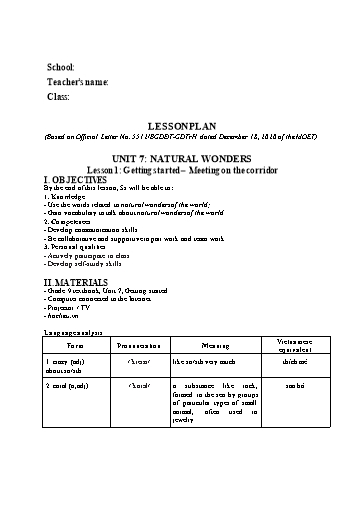
 3. landscape (n) /ˈlổnd.skeɪp/ a view or picture of the phong cảnh
 countryside, or the art of
 making such pictures.
 4. peak (n) /piːk/ the highest point đỉnh, đỉnh nỳi
 5. charming (adj) /ˈtʃɑː.mɪŋ/ pleasant and attractive đẹp
 6. sustainable (adj) /səˈsteɪnəbl/ able to be maintained or bền vững
 continued
 7. location (n) /ləʊˈkeɪʃn/ a place or position địa điểm, nơi chốn
 8. possess (v) /pəˈzes/ to have or own sth cú, sở hữu
 Assumption
 Anticipated difficulties Solutions
 Students may lack experience of group/ - Encourage students to work in groups so that
 teamwork. they can help each other.
 - Give short, clear instructions and help if
 necessary.
 III. PROCEDURES
 1. WARM-UP (5 mins)
 a. Objectives:
 - To activate students’ knowledge on the topic of the unit.
 - To lead in to the unit.
 b. Content:
 - Think!
 - Create a Travel Brochure
 c. Expected outcomes:
 - Students can have some ideas about Natural Wonders.
 d. Organisation:
 TEACHER’S ACTIVITIES STUDENTS’ ACTIVITIES CONTENTS
Option 1: Think! Questions:
- Begin the lesson by talking about - Answer questions Where are the most beautiful
the beauty around us. Ask students places in your country?
to identify/ talk about the most Where are they?
beautiful places in their own Are they natural or man made?
community.
- T introduces the topic natural Pictures:
wonders of the world. Show Ss
some photos of famous natural
wonders, such as Ha Long Bay, - To help Ss read for specific information about Natural Wonders
 - To help Ss learn words and phrases related to Natural Wonders
 - To help students use the words in context.
 b. Content:
 - Task 1: Listen and read.
 - Task 2: Read the conversation again and tick (√) T (True) of F (False) for each sentence.
 - Task 3: Complete each sentence with a word or a phrase from the box
 - Task 4: Underline the correct answer to complete each sentence.
 c. Expected outcomes:
 - Students understand the conversation and topic of the lesson and can complete the tasks
 successfully
 d. Organisation
 TEACHER’S ACTIVITIES STUDENTS’ ACTIVITIES CONTENTS
Task 1: Listen and read. (7 mins)
- To begin with, ask Ss some - Listen and answer questions Questions:
questions: Have you ever been to Ha Long
- Set the context for the listening - Look at the picture Bay?
and reading by asking Ss to look at Do you know that it is a famous
the picture. natural wonder of the world?
- Then ask Ss to look at the title and - Listen and follow instructions. Have you heard of / read about
guess what the conversation other wonders: Mt. Everest, the
between Lan and Tom is about. - Listen and read Dead Sea, ?
- Play the recording for Ss to listen
and read along. Then have some Ss
read the conversation aloud. - Listen and answers
- Ask Ss some questions about the
conversation.
- Confirm the correct answer. (They
are talking about famous natural
wonders.)
- Have Ss say the words in the text
that they think are related to the Questions:
topic of the unit. Have them 1. Which prize did Tom win?
pronounce the words containing the 2. Which natural wonders did
sounds /sl/ and /sn/. Tom talk about?
 3. Which risks did Tom
 mention?
 4. Where will Tom visit?
 The dialogue on page 72
Task 2: Read the conversation again and tick (√) T (True) of F (False) for each sentence.(7 mins)
- Have Ss individually read the - Work independently to do the Answer key:
conversation again. Tell them to activity. 1. T.
read the questions and decide 2. F
whether they are true (T) or false 3. T
(F). 4. F - T and other Ss listen to the answers and comment.
5. CONSOLIDATION
a. Wrap-up
- Ask one or two Ss to tell the class what they have learnt.
- Ask Ss to say aloud some words / phrases and the grammar points they remember from the
lesson. Tell Ss that they will learn these language points in the upcoming lessons.
b. Homework
- Do exercises in the workbook.
- Start preparing for the Project of the unit:
Teacher asks Ss to open their book p.81, look at the picture and say what the topic of the project
 is (poster of a natural wonder of the world). They will design a poster and present it at the end
 of this Unit.
- Explain the project requirements: In groups, Ss will have to design a poster of a natural
 wonder of the world, and then give an oral presentation of their posters in the last lesson of the
 unit. Explain that poster presentations are a way to communicate ideas, research, or
 understanding of a topic in a visual way. Their posters should be clear and engaging, with a
 mixture of text and pictures or tables / graphs. Ss will display their posters around the classroom
 in advance. One representative from each group will stand next to the poster. The rest will walk
 round, study the posters, and talk to group representatives if they want to learn more about
 natural wonders of the world. Then the class will sit down and vote for the best poster.
- Put Ss into groups and have them choose their group leader. Then ask them to assign tasks to
 each group member, making sure that all group members contribute to the project work.
- T may suggest some steps for Ss to follow:
1. Collecting information and pictures (searching the Internet, reading books / magazines,
 brainstorming ideas, etc. about a natural wonder: its location, its special features / attractions,
 threats to its existence, and ways / plans to preserve it
2. Organising ideas and visuals, and designing the posters
3. Practising explaining their posters and answering questions about the content
- Help Ss set a deadline for each task and support them throughout the process.
- In each of the next lessons, spend a few minutes checking Ss’ progress, helping them with
 any topic-related or functional language they need, and solving any other problems that may
 arise with their projects. UNIT 7: NATURAL WONDERS
 Lesson 2: A closer look 1
I. OBJECTIVES
By the end of this lesson, Ss will be able to:
1. Knowledge
- Use the lexical items related to the topic NATURAL WONDERS
- Pronounce the sounds /sl/ and /sn/ in words and sentences correctly.
2. Competences
- Be collaborative and supportive in pair work and teamwork
- Access and consolidate information from a variety of sources
3. Personal qualities
- Actively participate in class and school activities
- Develop self-study skills
II. MATERIALS
- Grade 9 textbook, Unit 7, A closer look 1
- Computer connected to the Internet
- Projector / TV
- hoclieu.vn
Language analysis
 Vietnamese
 Form Pronunciation Meaning
 equivalent
 1. permit (v) /pəˈmɪt/ to allow something cho phộp
 2. paradise (n) /ˈpổrədaɪs/ an amazing place that seems thiờn đường,
 perfect nơi đẹp tuyệt trần
 3. annual (adj) /ˈổnjuəl/ happening once every year (xảy ra) hàng năm
 4. access (n) /ˈổkses/ the method or possibility of tiếp cận, đến được
 getting near to a place or
 person.
 5. urgent (adj) /ˈɜːdʒənt/ very important and needing gấp, cấp bỏch
 attention immediately.
 6. hesitate (v) /ˈhez.ɪ.teɪt/ to pause before you do or say lưỡng lự
 something, often because
 you are uncertain or nervous
 about it. 2. ACTIVITY 1: VOCABULARY (20 mins)
 a. Objectives:
 - To provide students new vocabulary.
 - To revise some vocabulary related to Natural Wonders
 b. Content:
 - Vocabulary pre-teaching
 - Task 1: Match the words in A with their definitions/explanations in B.
 - Task 2: Complete the following table. There is one example.
 - Task 3: Complete the following sentences with the words from the box.
 c. Expected outcomes:
 - Students can identify some vocabulary about Natural Wonders and use them in different
 contexts
 d. Organisation
 TEACHER’S ACTIVITIES STUDENTS’ ACTIVITIES CONTENTS
Vocabulary pre-teaching (5 mins)
- Teacher introduces the vocabulary - Students guess the meaning New words:
by: of words. 1. permit (v)
+ providing explanations of the 2. paradise (n)
words 3. annual (adj)
+ showing pictures illustrating the 4. access (n)
word. 5. urgent (adj)
 6. hesitate (v)
Task 1: Match the words in A with their definitions/explanations in B. (5 mins)
- Tell Ss to read the words given in - Read the words Answer key:
column A, then study their 1. e 2. f 3. a
definitions / explanations in column
B. 4. c 5. b 6.d
- Have Ss work in pairs to do the - Work in pairs to do task 1
matching. Check their answers as a
class.
- Have Ss read the words aloud. - Read aloud.
Correct their pronunciation if
necessary.
Task 2: Complete the following table. There is one example. (5 mins)
- Have Ss work in pairs. Tell them to - Work in pairs to do the task Answer key:
look at the verbs given in the left Verb Noun
column and write their equivalent discover discovery
nouns in the right column. 1. locate location
- Check their answers as a class. - Listen and check 2. hesitate hesitation
- Have Ss read the verbs and nouns - Read aloud 3. explore exploration
aloud. Correct their pronunciation if 4. possess possession
necessary. 5. admire admiration
Task 3: Complete the following sentences with the words from the box. (5 mins)
- Have Ss read the words/ phrases in - Listen and follow Answer key:
the box. 1. diversity 2. urgent
 - Do task 3 3. located 4. hesitation - If there is time, ask Ss to give the - Give the words they know that 3. She sneezed when I gave her
words they know that contain these contain two sounds a slice of pizza.
two sounds. 4. The way down the hill was
 slippery as it was covered in
 snow.
 5. After eating a snack, she felt
 very sleepy
EXTRA ACTIVITY
Ask each student to give at least one - Give one word having sound Suggested answers:
word having sound /sl/ and one word /sl/ and one word having sound (slide, slip, slow, sleeve,
having sound /sn/ /sn/. dislike, mudslide, snake, snail,
 snorkel, snowball, )
 e. Assessment
 - Teacher’s observation and feedback on student’s pronunciation.
 4. CONSOLIDATION (5 mins)
 a. Wrap-up
 - Ask the class what words, phrases and sounds they have learnt.
 - Tell them the grammar points that they will learn in the next lesson.
 b. Homework
 - Do exercises in the workbook.
 - Find 3 more words that have the sounds /sl/ and /sn/ UNIT 7: NATURAL WONDERS
 Lesson 3: A closer look 2
I. OBJECTIVES
By the end of this lesson, Ss will be able to:
1. Knowledge
- Change Yes / No questions into reported speech
2. Competences
- Develop communication skills
- Be collaborative and supportive in pair work and teamwork
3. Personal qualities
- Compare living place
- Develop self-study skills
- Actively join in class activities
II. MATERIALS
- Grade 9 textbook, Unit 7, A closer look 2
- Computer connected to the Internet
- Projector / TV
- hoclieu.vn
Language analysis
 Reported speech (Yes/No questions)
 Structure Example
 Anna: “Do you plan to climb any mountains
 this summer, Joe?”
 S + ask/want to know + if/whether + clause
 → Anna asked Joe if / whether he planned
 to climb any mountains that summer.
Assumption
 Anticipated difficulties Solutions
 Students may find it confusing when to use Give short and clear explanations with legible
 the grammar points. examples for each case.
 Students may have underdeveloped co- - Give clear instructions, give examples before
 operating skills. letting students work in groups.
 - Provide feedback and help if necessary.
III. PROCEDURES
1. WARM-UP (7 mins)
a. Objectives:
- To create an active atmosphere in the class before the lesson
– To lead Ss into the new unit.
b. Content:
File đính kèm:
- ke_hoach_bai_day_minh_hoa_tieng_anh_lop_9_global_success_the.docx
