

Kế hoạch bài dạy Tiếng Anh Lớp 10 Global Success theo CV5512 - Unit 2: Humans and the environment
 69 trang
28/10/2025
3271
69 trang
28/10/2025
3271
Bạn đang xem 30 trang mẫu của tài liệu "Kế hoạch bài dạy Tiếng Anh Lớp 10 Global Success theo CV5512 - Unit 2: Humans and the environment", để tải tài liệu gốc về máy hãy click vào nút Download ở trên.
Tóm tắt nội dung tài liệu: Kế hoạch bài dạy Tiếng Anh Lớp 10 Global Success theo CV5512 - Unit 2: Humans and the environment
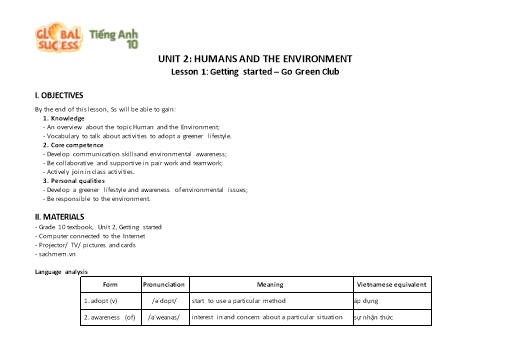
 (n) or area of interest
 3. carbon /ˌkɑːbən a measure of the amount of carbon dioxide that is lượng khí thải cacbon,
 footprint (n) ˈfʊtprɪnt/ produced by the activities of a person or company dấu chân cacbon
Assumptions
 Anticipated difficulties Solutions
 - Students may not know the causes of carbon footprint. - Use pictures/ photos or videos of some activities which
 cause and increase the carbon footprint to show them in
 the class.
 - Students may not know how to work in teams. - Give short, clear instructions and help if necessary.
Board Plan
 Date of teaching
 Unit 2: HUMANS AND THE ENVIRONMENT
 Lesson 1: Getting started – Go Green Club
 * WARM-UP: Watch the clip and write down the causes of air pollution
 Vocabulary
 1. adopt (v) /əˈdɒpt/: áp dụng
 2. awareness (of) (n) /əˈweənəs/: sự nhận thức
 3. carbon footprint (n) /ˌkɑːbən ˈfʊtprɪnt/: lượng khí thải cacbon, dấu chân cacbon
 Task 1: Listen and read.
 Task 2: Read and answer the questions.
 Task 3: Match the verbs or phrasal verbs in A with suitable ones in B.
 Task 4: Complete the sentences.
 classroom. **** Teacher:
 - To lead into the new - checks and corrects if there are any spelling mistakes T-S
 unit. - confirms the winner.
 Leads in the lesson: Our environment is being seriously destroyed, at your
 age you can take some simple actions to help save the environment. One of
 them is taking part in Go Green clubs.
 (Video link: https://www.youtube.com/watch?v=WfGMYdalClU)
PRESENTATION To help students use * T asks Ss to look at the explanation and the photos to guess the meaning T-S 4 mins
 key language more of new words.
 appropriately before ** Ss say the Vietnamese meanings of the words. S
 they read and listen. 1. adopt (v) /əˈdɒpt/: start to use a particular method
 2. awareness (of) (n) /əˈweənəs/: interest in and concern about a
 particular situation or area of interest
 3. carbon footprint (n) /ˌkɑːbən ˈfʊtprɪnt/: a measure of the amount
 of carbon dioxide that is produced by the activities of a person or
 company
 *** Other Ss correct if the previous answers are incorrect.
 **** T shows the meanings, says the words aloud and asks Ss to repeat S-S
 them.
 PRACTICE - To get students TASK 1. LISTEN AND READ (p.18) 6 mins
 interested in the topic. * T asks Ss to look at the picture (p.18) and answer the following questions: T-S
 - To get students to
 learn some vocabulary
 to be learnt in the unit.
 + What are the students doing?
 + Is cleaning up the school/ the street/ public places a way to adopt a
 for each the question with the partner who sits behind them. S-S
 ** Ss do the task in pairs. T-S
 **** T divides the class into two big teams, and has Ss in each team take
 turns to choose a number in the game Lucky number to check the answers.
 Key:
 1. The Youth Union in Nam’s school set it up.
 2. The club wants to improve the environment and encourage people to
 adopt a greener lifestyle.
 3. He thinks the club will organize more activities to raise people’s
 awareness of environmental issues.
 4. It is cleaning up the school right after the ceremony
 5. He is keen to reduce his carbon footprint.
 6. Nam will tell Mike the time and the place of the club meeting.
- To help students TASK 3: MATCH THE VERBS OR PHRASAL VERBS IN A WITH SUITABLE 4 mins
 revive some NOUNS OR NOUN PHRASES IN B. (p.19)
 collocations for the * T has Ss locate the verbs or phrasal verbs in the conversation, find the T-S
 environment so that nouns or noun phrases after each verb/ phrasal verb to do the matching.
 they can use them in ** Ss work individually. S
 the following lessons. *** Ss share their answers with a partner. S-S
- To help students **** T checks and gives the correct answers with the whole class, and has T-S
 practise scanning. them say the meaning of each collocation.
 Answers:
 1 - c: raise awareness: nâng cao nhận thức
 2 - d: reduce your carbon footprint: giảm lượng khí thải cacbon của bạn
 3 - e: clean up the school: vệ sinh trường học
 4 - b: adopt a greener lifestyle: áp dụng lối sống xanh hơn
 5 - a. set up a club: thành lập câu lạc bộ
To help students TASK 4: COMPLETE THE FOLLOWING SENTENCES BASED ON THE 4 mins
 - T chooses some useful or excellent words/ phrases/ expressions/ word
 choices Ss have used to give suggestions to other students.
 - T chooses some typical errors and correct as a whole class without
 nominating the students’ names.
CONSOLIDATION - To help Ss memorise WRAP-UP T-S 4 mins
 the target language * T asks Ss: What have you learnt today?
 and skills that they - Some lexical items about humans and the environment
 have learned. - Reading for specific information
 - To inform students - Scanning
 what the final product HOMEWORK
 of the project should 1. Exercises in the workbook
 be and how students 2. Project preparation
 can prepare for it. * Teacher:
 - Has Ss look at the last page of Unit 2, the Project lesson and asks them
 what topic of the project is.
 - Tells them the project requirements: Ss will have to make a plan for a Go
 Green Weekend in which they will:
 + suggest activities for the event, provide the reasons and expected
 results of the activities;
 + include information as stated in the table on page 27 in the Student’s
 Book.
 + present their plans in the last lesson of the unit.
 - Reminds Ss that beside brainstorming Go Green Weekend activities, they:
 + can search for ideas on the Internet, in the newspapers, etc. for
 reference.
 + should use photos/pictures to illustrate their ideas.
 - Puts Ss into groups and has them choose their group leader; Asks them to
 assign tasks for each member, making sure that all group members
 contributes to the project work.
 UNIT 2: HUMANS AND THE ENVIRONMENT
 Lesson 2: Language
I. OBJECTIVES
By the end of this lesson, Ss will be able to :
 1. Knowledge
 - Pronounce the consonant blends /kl/, /pl/, /gr/, and /pr/ correctly in isolation and in sentences;
 - Understand and use some lexical items about humans and the environment;
 - Distinguish and use will and be going to to talk about the future;
 - Use the passive voice correctly.
 2. Core competence
 - Be collaborative and supportive in pair work and team work;
 - Access and consolidate information from a variety of sources;
 - Actively join in class activities.
 3. Personal qualities
 - Adopt greener lifestyle and awareness of environmental issues;
 - Be responsible for environment protection.
II. MATERIALS
- Grade 10 textbook, Unit 2, Language
- Computer connected to the Internet
- Projector/ TV/ pictures and cards
- sachmem.vn
Language analysis
 Will Be going to
 1. Form (+) S + will + V (+) S + am/is/ are going to + V
 (-) S + will not/ won’t + V (-) S + am/is/ are + not (‘m not/ isn’t/ aren’t) + going to +
 (?) Will + S + V? V
Assumptions
 Anticipated difficulties Solutions
 - Students may be confused when using will or be going to to - Give short and clear explanations with legible examples for
 talk about the future. each case.
 - Students may be confused about the position of adverbs of - Remind them and give some legible examples.
 place and time in the passive voice.
Board Plan
 Date of teaching
 Unit 2: HUMANS AND THE ENVIRONMENT
 Lesson 2: Language
 * WARM-UP: Guessing game
 I. Pronunciation
 Task 1: Listen and repeat.
 Task 2: Listen and practise saying the sentences.
 Task 3: Make sentences.
 II. Vocabulary
 Task 1: Match the words and phrases to their meanings.
 Task 2: Complete the sentences.
 III. Grammar
 * The future with will and be going to
 Task 1: Complete the sentences.
 * Passive voice
 Task 2: Rewrite the sentences.
 IV. Extra activity
 Game: Chain memory
 * CONSOLIDATION
III. PROCEDURES
Notes:
gift green clean
place protect
- T has Ss work in pairs to categorize those pictures.
** Ss do as instructed.
*** Ss share their ideas with a partner.
**** T confirms the correct answers and leads in the task.
* Teacher:
- plays the recording and asks Ss to listen to the words and repeat; tells S-S
them to pay attention to the consonant blends. (Teacher can play the S-S
recording as many times as necessary) T-S
- makes sure Ss know the meaning of each word. T-S
** Ss do as instructed.
**** T checks whether Ss have improved their pronunciation by randomly
calling on individual Ss to read the words aloud.
 S-S
 T-S
 To give students TASK 2: COMPLETE THE SENTENCES USING THE WORDS OR PHRASES IN 1. 4 mins
 practice in using the (p.20) T-S
 words/phrases in * Teacher:
 meaningful contexts. - has Ss read the sentences carefully to decide which word/phrase in 1 can
 be used to complete each of the sentences.
 - explains that they should use the context clues to decide on the word/
 phrase, e.g. in the first sentence, the gapped word is an adjective (eco-
 friendly)
 ** Ss work in pairs to discuss and find the answers. S-S
 *** Ss share the answers with the whole class. S-S
 **** T confirms the correct answers and asks Ss to give the reasons why T-S
 they have chosen the word/phrase for each sentence.
 Key:
 1. Eco-friendly
 2. household appliances
 3. carbon footprint
 4. energy
 5. litter
 To help students TASK 3: MAKE SENTENCES, USING THE WORDS/PHRASES IN TASK 1. 4 mins
 memorize the * T divides the class into teams, asks Ss to write as many sentences as they T-S
 words/phrases they can in 2 minutes, using the words/phrases in 1. T reminds them to make at
 have learnt. least one sentence with each word/ phrase.
 ** Ss works in small teams and do as instructed. S-S
 *** The teams with the most sentences take turns to read aloud their S-S
 sentences.
 **** T gives comments, collects common mistakes to correct. T-S
GRAMMAR - To give students an THE FUTURE WITH WILL AND BE GOING TO 6 mins
 opportunity to revise Complete the following sentences with will or the correct forms of be
 the use of will and be going to. (p.20)
 going to to talk * Teacher: T-S
 about future actions. - tells Ss to read the explanations in the Remember! box on page 20 and
File đính kèm:
- ke_hoach_bai_day_tieng_anh_lop_10_global_success_unit_2_huma.docx
