

Kế hoạch bài dạy Tiếng Anh Lớp 10 Global Success theo CV5512 - Unit 5: Inventions
 56 trang
28/10/2025
4623
56 trang
28/10/2025
4623
Bạn đang xem 30 trang mẫu của tài liệu "Kế hoạch bài dạy Tiếng Anh Lớp 10 Global Success theo CV5512 - Unit 5: Inventions", để tải tài liệu gốc về máy hãy click vào nút Download ở trên.
Tóm tắt nội dung tài liệu: Kế hoạch bài dạy Tiếng Anh Lớp 10 Global Success theo CV5512 - Unit 5: Inventions
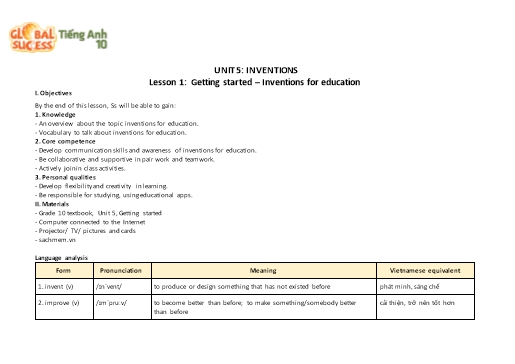
 3. suitable (a) /ˈsuːtəbl/ or right or appropriate for a particular purpose or occasion phự hợp
 /ˈsjuːtəbl/
 4. app (n) /ổp/ a piece of software that you can download to a device such as a ứng dụng
 smartphone or tablet
 5. convenient (a) /kənˈviːniənt/ useful, easy or quick to do; not causing problems tiện lợi, thuận lợi
Assumptions
 Anticipated difficulties Solutions
 - Students may not know the meanings of some words in the - Provide students with some lexical items before listening and reading
 conversation. the conversation.
 - Students may not know how to work in teams. - Give short, clear instructions and help if necessary.
Board Plan
 Date of teaching
 UNIT 5: INVENTIONS
 Lesson 1: Getting started – Inventions for education
 * Warm-up: Game: Guessing
 I. Vocabulary
 1. invent (v) /ɪnˈvent/: phỏt minh, sỏng chế
 2. improve (v) /ɪmˈpruːv/: cải thiện, trở nờn tốt hơn
 3. suitable (a) /ˈsuːtəbl/ or /ˈsjuːtəbl/: phự hợp
 4. app (n) /ổp/: ứng dụng
 5. convenient (a) /kənˈviːniənt/: tiện lợi, thuận lợi
 II. Practice
 Activity 1: Listen and read
 Activity 2: Read the conversation again and answer the following questions.
 Activity 3: Find three nouns and three adjectives in the conversation in activity 1 to talk about inventions. Follow the example. T leads in the lesson: Technological inventions have brought a lot of benefits
 to our lives. We are going to find out more about these inventions: what
 they are and how they facilitate your studies.
Vocabulary - * T asks Ss to look at the explanation and the photos to guess the meaning T-Ss 4 mins
 pre-teach of new words.
 ** Ss say the Vietnamese meaning of the word.
 1. invent (v) /ɪnˈvent/: phỏt minh, sỏng chế
 To help students use key
 2. improve (v) /ɪmˈpruːv/: cải thiện, trở nờn tốt hơn
 language more
 3. suitable (a) /ˈsuːtəbl/ or /ˈsjuːtəbl/: phự hợp
 appropriately before they
 4. app (n) /ổp/: ứng dụng
 read and listen.
 5. convenient (a) /kənˈviːniənt/: tiện lợi, thuận lợi
 *** Other Ss correct if the previous answers are incorrect.
 **** Teacher shows the Vietnamese meaning, says the words aloud and
 asks Ss to repeat them. for education. *** Ss share and discuss with their partners about the key words
 **** Teacher corrects their answers as a class. T-Ss
 1. What inventions are Phong and his dad talking about?
 2. How useful are laptops?
 3. Why is it fun and convenient to learn with educational apps on
 smartphones?
 * T asks Ss scan the conversation, locate the key words to find the answer T-Ss
 for each the question with the partner who sits behind them.
 ** Ss do the task in pairs. S-Ss
 **** Teacher divides the class into two big teams, has Ss in each team take T-Ss
 turns to choose a number in the game Lucky number to check the answers.
 1. They are (talking about) laptops/ computers and smartphones.
 2. (Since they were invented,) Laptops have allowed us to study better
 and work faster.
 3. Because you can use educational apps that allow you to
 communicate and learn at the same time.
- To help Ss revise some Activity 3: (p.53). Find three nouns and three adjectives in the 4 mins
 collocations for conversation in activity 1 to talk about inventions. Follow the example.
 inventions so that they * Teacher has sts find three nouns and three adjectives from the T-Ss
 can use them in the conversation in Getting Started.
 following lessons. ** Ss work individually. Ss
- To practise scanning. *** Ss share their answers with a partner. S-Ss
 **** Teacher checks and gives the correct answers with the whole class, T-Ss
 elicits the meaning of any words Ss don’t know or find hard to understand.
 Answers: - Tell Ss about the Project requirements: Ss will have to think of a useful
 invention for the classroom and then give an oral presentation of their ideas
 in the last lesson of the unit. The invention can be either real or imaginary. –
 - Alternatively, ask Ss to prepare a poster presenting their ideas. In a poster
 presentation, Ss will display their inventions on posters and hang them
 around the classroom. One representative from each group will stand next
 to the poster. The rest will walk around, study the posters and talk to any
 representative of a group if they want to learn more about an invention.
 Then the class will sit down and vote for the best invention.
 - Suggest the steps Ss should follow: 1. Collecting information (searching the
 Internet, reading newspapers, etc.); 2. Illustrate their inventions on
 computer or on posters, etc; 3. Rehearse for the oral or poster presentation.
 - Put Ss into groups and have them choose their group leader. Then ask
 them to assign tasks for each group member, making sure that all group
 members contribute to the project work.
 ** Ss do as instructed S-Ss
 **** Teacher helps Ss set deadlines for each task. T-Ss
 Wrap up To help Ss memorise the - Some lexical items about Inventions. T-Ss 1min
Homework target language and - Reading for specific information.
 skills that they have - Scanning.
 learned. Homework:
 - talk about one invention for education and it usefulness (for a minute).
 - Exercises in the workbook. Example: They have lived here for a year.
 Have/ has + S + VPII+  ? - Something that was completed in the very recent past
 (often used with just or recently).
 Example: He has just finished his homework.
 We use gerunds:
 - after verbs such as avoid, enjoy, finish
 Gerunds: Verb + -ing
 Example: I enjoy cooking.
 - as subjects of sentences.
 Example: Learning English is fun.
 We use to-infinitives:
 - after verbs such as want, decide, allow
 Gerunds and infinitives Example: My parents don’t allow me to use a smartphone.
 - after adjectives to give opinions, starting with it’s
 Example: It’s fun to learn English.
 To-infinitives: to + Verb
 - as subjects of sentences.
 Example: To learn English is fun.
 Note: Some verbs such as like, love, and hate can be followed
 by either gerunds or to-infinitives.
 Example: I like playing/ to play computer games.
Assumptions
 Anticipated difficulties Solutions
 - Students may be confused when using gerunds and to-infinitives. Give clear explanations with examples for each case.
 - Students may have underdeveloped speaking and co-operating skills. Give clear instructions, give examples before letting students work in
 groups.
 Provide feedback and help if necessary.
Board Plan vocabulary related to the bulb), (checks that everybody knows what each word means), and asks
 topic. students to compile a list of the inventions in chronological order (the most
 - To enhance students’ recent invention must be the first in the list). The winning group is the one
 skills of cooperating with having the largest number of correct answers.
 teammates. ** Students listen to the instructions. S-S
 - To lead into the new *** Students work in teams, discuss, and compile a list of the inventions in
 unit. chronological order.
 **** Teacher checks and corrects if Ss spell or pronounce the words/ T-S
 phrases incorrectly.
 Suggested answer:
 The Internet (1969)
 light bulb (1906)
 telephone (1876)
 refrigerator (1850)
 paper (100)
 T leads in the new lesson of Language.
Presentation To help Ss understand the PRONUNCIATION 5 mins
(Pre-teach stress patterns in some * Teacher introduces the rules of stress in three-syllable nouns, then gives T-Ss
the stress in common three-syllable Ss relevant examples.
three- nouns. Teacher asks students to give some examples of three-syllable nouns and
syllable asks them to put stress on each word.
nouns) ** Students give some examples and put stress on each word. Ss
 *** Other Ss correct if the previous answers are incorrect. Ss
 **** Teacher draws students’ attention to the stress patterns in some T- Ss
 common three-syllable nouns.
 Practice To help Ss recognise the Activity 1: Listen and repeat. Pay attention to the stressed syllable in each 10 mins
 stress patterns in some word (p.53).
 common three-syllable * Teacher asks Ss to look at the words, explains what the big and small dots T-Ss
 nouns. mean, then asks Ss to listen and repeat after the recording.
 ** Ss listen and repeat after the recording, paying attention to the stressed Ss
 syllable in each word. 2. laboratory b. a scientific test that is done in order to study what
 happens and to gain new knowledge
 3. experiment c. the programs used by a computer for doing particular
 jobs
 4. equipment d. a room or building used for scientific research,
 experiments, testing, etc.
 5. software e. the things that are needed for a particular purpose or
 activity
 6. hardware f. a piece of computer equipment, especially a small one
 such as a smartphone
 Ss
 ** Ss do the task in pairs. Ss
 *** Some pairs share their answers with the whole class. T-Ss
 **** T gives feedback and corrections (if necessary).
 Answers:
 1. f 2.d 3. b 4. e 5. c 6. a
Practice Unscramble the underlined letters in these words. Use the pictures below 5 mins
 To give Ss practice in
 and the glossary (page 127) to help you (p.54).
 identifying the words.
 * Teacher asks Ss to unscramble the underlined letters in the given words, T-S
 using picture and the glossary if they need help.
 ** Students work independently and unscramble the underlined letters. S-S
 *** Students share their answers in pairs before discussing as a class. T-S
 **** Teacher checks answers as a class by asking individual Ss to call out T-S
 and write the words on the board, then gives feedback.
 Answers:
 1. experiment
 2. devices
 3. laboratory
 4. hardware
 5. software
 6. equipment
File đính kèm:
- ke_hoach_bai_day_tieng_anh_lop_10_global_success_theo_cv5512.docx
