

Kế hoạch bài dạy Tiếng Anh Lớp 10 Global Success theo CV5512 - Unit 6: Gender equality
 45 trang
28/10/2025
2931
45 trang
28/10/2025
2931
Bạn đang xem 30 trang mẫu của tài liệu "Kế hoạch bài dạy Tiếng Anh Lớp 10 Global Success theo CV5512 - Unit 6: Gender equality", để tải tài liệu gốc về máy hãy click vào nút Download ở trên.
Tóm tắt nội dung tài liệu: Kế hoạch bài dạy Tiếng Anh Lớp 10 Global Success theo CV5512 - Unit 6: Gender equality
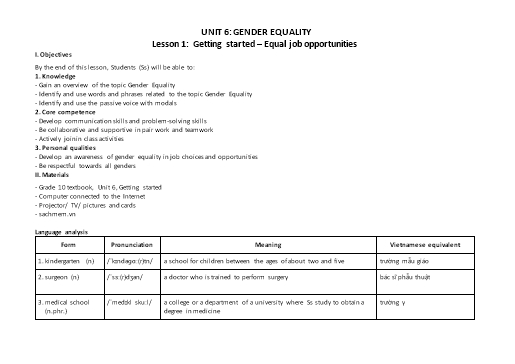
 4. pilot (n) /ˈpaɪlət/ a person who operates the controls of an aircraft, especially as a job phi công
Assumptions
 Anticipated difficulties Solutions
 - Ss may not know the meaning of job names presented in English - Use pictures/ photos or some activities involved in the job to show
 - Ss may not know how to work in teams. them in the class.
 - Give short, clear instructions and help if necessary.
Board Plan
 Date of teaching
 Unit 6: GENDER EQUALITY
 Lesson 1: Getting started – Equal job opportunities
 * Warm-up: Charades
 I. Vocabulary
 1. kindergarten (n) /ˈkɪndəɡɑː(r)tn/: trường mẫu giáo
 2. surgeon (n) /ˈsɜː(r)dʒən/: bác sĩ phẫu thuật
 3. medical school (n.phr) /ˈmedɪkl skuːl/: trường y
 4. pilot (n) /ˈpaɪlət/: phi công
 II. Practice
 Task 1: Listen and read
 Task 2: Read the conversation again and decide whether the following statements are true (T) or false (F).
 Task 3: Match the words to make meaningful phrases in Task 1.
 Task 4: Complete the summary using the verb phrases from the conversation in Task 1.
 * Homework
Procedures
Notes
In each activity, each step will be represented as following
* Deliver the task
** Implement the task
*** Discuss
**** Giving comments or feedback Listen and - To get Ss interested in Task 1. (p.66) Listen and read: 7 mins
 read the topic * T asks Ss to look at the pictures (p.66) and answer the questions: T-S
 - To get Ss to learn some What are their jobs? Are these jobs traditionally done by men or women?
 vocabulary to be learnt in T focuses Ss’ attention on the conversation, and elicit who the speakers are
 the unit and what Ss think they are talking about.
 T plays the recording twice for Ss to listen and read along. Ss underline
 words and phrases describing gender equality while they are listening and
 reading.
 ** Ss do the task individually. S
 *** Ss share their answers with a partner. S-S
 **** T checks their answers with the whole class. T-S
 Suggested answers: treated equally, same job opportunities
 * T has the Ss read the conversation in pairs. T-S
 ** Ss read the conversation and practice with their partner. S-S
 *** T asks one pair to read aloud to the class. S-S
 **** T collects common mistakes and gives comments. T-S
Controlled - To practise reading for Task 2: (p.67) Read the conversation again. Decide whether the following 10 mins
 practice specific information statements are true (T) or false (F):
 - To practise scanning * T asks Ss to work individually first and decide whether the statements are T-S
 - To check Ss’ true or false.
 comprehension of the ** Ss do Task 2 individually.
 conversation *** Ss work in pairs and compare their answer. S-S
 **** T checks the answers with the class. T asks Ss to provide evidence T-S
 from the conversation and correct the false statements.
 Key:
 1. F
 2. F
 3. T
 To help Ss revise job- Task 3: (p.67) Match the words to make meaningful phrases in 1. 4 mins
 related words and phrases * T asks Ss to locate the phrases in the conversation to do the matching. T-S
 ** Ss work individually. S
 *** Ss share their answers with a partner. S-S
 **** T checks and shares the correct answers with the whole class, asking T-S the structure of the presentation, decide how the results will be presented:
 raw data in a table, bar graphs, pie charts or infographics.
 *** T calls the group representatives to report their plans. T-S
 The groups discuss and decide on the class they want to survey, so that
 there is no overlap.
 **** Teacher gives feedback on the groups’ plans and help Ss set deadlines
 for each task.
 Wrap-up To help Ss memorise the - Some lexical items about Gender equality T-S 1 min
Homework target language and skills - Reading for specific information
 that they have learned - Scanning
 Homework:
 - Exercises in the workbook
 - Project preparation Rule Modal verbs Use
 can, could Express ability
 should, ought to Express advice or duty
 must Express duty
 Modal + be + past participle can, could, may Express permission
 can, could, may, might Express possibility
 can’t, mustn’t, may not Express prohibition
 may, will, would Express request
2. Assumptions
 Anticipated difficulties Solutions
 - Ss may be confused between the active voice and the passive voice. - Give short and clear explanations with detailed examples for each
 - Ss may not know how to work in teams. case.
 - Give short, clear instructions and help if necessary. Warm-up - To get Ss interested in the topic Game: Tag team T - S 5 mins
 - To activate Ss’ knowledge of * T divides the class into two teams. S – S
 the lesson ** Each round, both teams have 1 minute to write on the
 board as many three-syllable words of a given topic as
 possible. The team that could write more words wins that
 round.
 Round 1 topic: Adjectives
 Round 2 topic: Verbs S – S
 *** Ss discuss how the written words are pronounced,
 emphasizing the stress position of each word. T - S
 **** T calls some Ss to pronounce the words, gives feedback
 if necessary, then introduces the lesson.
Presentation To help Ss understand the PRONUNCIATION T - S 5 mins
(Pre-teach the concept and identify the stress * Teacher introduces the stress in three-syllable adjectives
stress in in three-syllable words and verbs to Ss and lets them watch a video about how to
three-syllable pronounce these words.
adjectives and https://www.youtube.com/watch?v=nh3GZHf1GuA
verbs) ** Ss watch the video and repeat after the speaker. S
 *** Teacher asks Ss to give some three-syllable words and T - S
 point out their stress.
 **** T gives feedback and comments if necessary.
Practice To help Ss recognise and Task 1: Listen and repeat. Pay attention to the stressed T - S 5 mins
 practise stress patterns in three- syllable in each word
 syllable adjectives and verbs in * T focuses Ss’ attention on the words in the table and asks Ss
 isolation. if they know the words and elicit their meanings if necessary.
 ** T plays the recording and has Ss listen and pay attention to
 the stress patterns. S
 T plays it again pausing after each word for Ss to repeat
 chorally.
 • Ss focus on the stress patterns. T elicits that some are
 stressed on the first syllable while others on the second
 syllable. 4. Equal opportunities in education bring im'portant changes
 in society.
Presentation To make sure that Ss understand Vocabulary: Gender equality 4 mins
(Vocab – the meanings of some topic- Task 1: Match the words with their meanings.
pre-teach) related words introduced in * T asks Ss to match the words with their suitable meanings. T-S
 Getting Started. ** S first works on the exercise individually.
 *** T puts Ss in pairs to compare their answers and discuss S
 the meaning of each word. S-S
 • T encourages Ss to find the words in the conversation and
 use the context clues there to work out their meanings.
 **** T checks answers with the class.
 T-S
 KEY
 1. e
 2. a
 3. b
 4. c
 5. d
Practice To give Ss practice in using the Task 2: Complete the following sentences with the words in T-S 5 mins
 words in meaningful contexts. Task 1.
 * T reminds Ss to use the context clues to help them decide
 on each word, e.g. The word teachers in sentence 1 suggests
 that the answer is related to schools (1. kindergarten).
 ** Ss work individually to complete the sentences. S
 *** Ss work in pairs to compare their answers with a partner. S-S
 • Ss may look up the words in the glossary if necessary.
 **** T checks answers with the class. T-S
 Key:
 1. kindergarten
 2. surgeon
 3. treat Remember! box and gives more examples if necessary.
 ** Ss study the sentences individually or in pairs. S/S-S
 T explains that some sentences are in active voice, some in
 passive voice. T asks Ss to pay attention to who does the
 To help Ss understand the use of action in each sentence.
 the passive voice with modal *** T encourages Ss to choose the answers and compare S-S
 verbs their answers with a partner.
 **** T checks answers with the class. T invites individual Ss to
 read the sentences aloud. T-S
 Key:
 1. shouldn’t be allowed
 2. can work
 3. may be offered
 4. could join
 5. must be prepared
 Task 2: Rewrite the following sentences using the passive
 voice
 * T asks Ss to read the sentences and check their T-S
 To give Ss more practice in using understanding.
Practice the passive voice with modals. • T reminds Ss of the use of the preposition by mentioning 5 mins
 the doer of the action. If the subject in the active voice is they
 or we, they don’t need to indicate who does the action in the
 passive voice.
 ** Ss work individually first. S
 *** Ss work in pairs and have them compare their answers. S-S
 **** T checks answers with the class. T-S
 Key:
 1. The report on gender equality may be completed by April.
 2. More jobs for girls and women can be created (by
 businesses).
File đính kèm:
- ke_hoach_bai_day_tieng_anh_lop_10_global_success_theo_cv5512.docx
