

Kế hoạch bài dạy Tiếng Anh Lớp 10 Global Success theo CV5512 - Unit 7: Viet Nam and international organisations
 45 trang
28/10/2025
2794
45 trang
28/10/2025
2794
Bạn đang xem 30 trang mẫu của tài liệu "Kế hoạch bài dạy Tiếng Anh Lớp 10 Global Success theo CV5512 - Unit 7: Viet Nam and international organisations", để tải tài liệu gốc về máy hãy click vào nút Download ở trên.
Tóm tắt nội dung tài liệu: Kế hoạch bài dạy Tiếng Anh Lớp 10 Global Success theo CV5512 - Unit 7: Viet Nam and international organisations
 Assumptions
 Anticipated difficulties Solutions
 - Ss may not know the meaning of certain words in the reading text. - T explains and shows some photos to Ss in the class.
 - Ss may not know how to work in teams. - Give short, clear instructions and help if necessary.
Board Plan
 Date of teaching
 UNIT 7: VIET NAM AND INTERNATIONAL ORGANISATIONS
 Lesson 1: Getting started – Viet Nam and international organisations
 * Warm-up: Trivia – Guess the logo
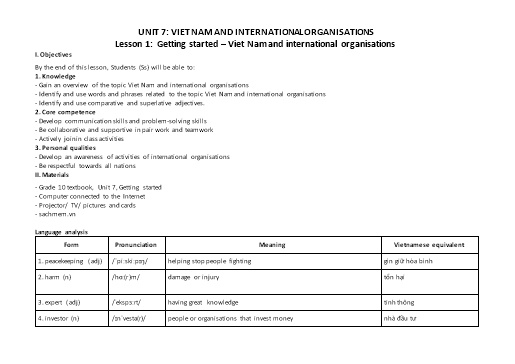
 I. Vocabulary
 1. peacekeeping (adj) /ˈpiːskiːpɪŋ/: gỡn giữ hũa bỡnh
 2. harm (n) /hɑː(r)m/: tổn hại
 3. expert (adj) /ˈekspɜːrt/: tinh thụng
 4. investor (n) /ɪnˈvestə(r)/: nhà đầu tư
 II. Practice
 Task 1: Listen and read.
 Task 2: Read the text again and choose the correct answers.
 Task 3: Find words in the texts (A, B, C, or D) that mean the following.
 Task 4: Complete the sentences with the words and phrases from Task 1.
 * Homework
Procedures
Notes
In each activity, each step will be represented as following
* Deliver the task
** Implement the task
*** Discuss
**** Giving comments or feedback in the unit.
 Reading To check Ss’ Task 2: Read the text again and choose the correct answers. 7 mins
comprehensio comprehension of * T asks Ss to work in pairs. T-S
 n the texts. ** Ss read each question carefully to choose the best answer, S
 then find evidence to support the answers.
 *** T asks Ss share their answers with the class. S-S
 *** T confirms the correct answers. T-S
 Key: 1. A
 2. B
 3.C
 Getting To introduce or Task 3: Find words in the texts (A, B, C, or D) that mean the 4 mins
 started: revise words following. S
 Vocabulary related to activities * T asks Ss to scan the four texts (A, B, C and D) to find the words
 of international matching the meanings given.
 organisations. ** If necessary, T goes through the definitions and elicit the parts T-S
 of speech Ss need to look for in the texts. S-S
 *** Ss compare their answers in pairs. T-S
 **** T confirms the correct words and shows all the definitions
 on the slides.
 Key:
 1. peacekeeping (adj) /ˈpiːskiːpɪŋ/: gỡn giữ hũa bỡnh
 2. harm (n/v) /hɑː(r)m/: tổn hại
 3. expert (adj/n) /ˈekspɜːrt/: tinh thụng
 4. investor (n) /ɪnˈvestə(r)/: nhà đầu tư
Getting To help Ss Task 4: Complete the sentences with the words and phrases from 10
started: recognise Task 1. T-S mins preparing slides for PPT presentation / Poster presentation,
 rehearsing).
 Wrap-up To help Ss Consolidation T-S 2 min
Homework memorise the - Some lexical items about International organisations
 target language - Reading for specific information
 and skills that they - Comparative and superlative adjectives
 have learned Homework:
 - Exercises in the workbook
 - Project preparation Use Example
 - To compare a person or thing with another The European markets are usually more
 person or thing. competitive than the Asian markets.
 The Asian markets are less competitive than
 comparative adjectives the European markets.
 - To show changes Since then, our country has become more
 active.
 to compare a person or thing with the whole This trade organisation includes two of the
 group of which that person or thing is a largest economies in the world: the United
 superlative adjectives member States and China.
 UNICEF supports the most disadvantaged
 children all over the world.
2. Assumptions
 Anticipated difficulties Solutions
 - Ss may be confused between long and short adjectives. - Give short and clear explanations with detailed examples for each
 case, along with some exceptions.
 - Ss may not know how to work in teams. - Give short, clear instructions and help if necessary. Stage Stage aim Procedure Interaction Time
Warm-up - To get Ss interested in the topic Game: I dare you! 5 mins
 - To activate Ss’ knowledge of * T asks Ss to split into two teams. T - S
 the lesson ** Each round a representative from one team (e.g. Team 1) S – S
 rolls a dice and gets a number (1-6).
 The opposing team (e.g. Team 2) will find a word with that
 number of syllables (in the dictionary, on the Internet) and
 “dare” Team 1 to guess the correct stress position. Each
 correct answer equals 1 point.
 *** Ss discuss the given words and whether there is a rule for S – S
 the position of word stress.
 **** T comments and leads in the lesson. T - S
Presentation To help Ss understand the PRONUNCIATION T - S 5 mins
(Pre-teach the concept and identify the stress * T asks Ss to read the Tips box in the textbook and explains
stress in in words with more than three more if necessary.
words with syllables Some long words have a secondary stress which is much
more than weaker than the primary stress. Example: ˌecoˈnomic
three In dictionaries, primary stress is marked with a raised vertical
syllables) line and secondary stress is marked with a lowered vertical
 line at the beginning of the stressed syllable.
 ** Ss watch a tutorial video and repeat after the speaker. S
 Link: https://www.youtube.com/watch?v=65wx9_zmuqQ S – S
 *** Ss discuss more tips to identify the stress in words with
 more than three syllables. T - S
 **** T gives feedback and comments if necessary.
Pronunciation To help Ss recognise and Task 1: Listen and repeat. Pay attention to the syllable with 5 mins
Practice practise stress patterns in words the primary stress.
 with more than three syllables. * T plays the recording and ask Ss to listen and repeat. T - S
 ** Ss pay attention to the syllable with the primary stress. S
 *** Ss practice pronouncing the words in pairs. T plays the S - S sentences.
 T reminds Ss to use the context clues to help them decide on
 the word.
 *** T asks individual Ss to call out the words they have used T - S
 in each sentence first.
 **** T confirms the correct answers.
 T asks Ss to give reasons why they have chosen the word for
 each sentence
 e.g. In sentence 1, economic growth is a positive result, so the
 word to fill in here must be promote.
 Key: 1. promote 2. welcomes 3. commit 4. aims 5. enter
Grammar To give Ss an opportunity to Grammar: Comparative and superlative adjectives 6 mins
review revise comparative and Task 1: Choose the best answers.
 superlative adjectives * T tells Ss to look at the sentences in 4 in Getting Started and T - S
 asks them how comparative and superlative adjectives are
 used in these sentences.
 - T asks Ss to look at the Remember! box and carefully study
 the rules for using comparative and superlative adjectives.
 - T asks Ss to look at sentence 3 and check understanding, e.g.
 What are ‘less’ and ‘least’? (the irregular comparative and
 superlative forms of little), How are they used? (used with
 long adjectives: less / least interesting).
 ** Ss work in pairs or individually to choose the correct form S – S
 of the adjective in each sentence.
 *** T ask Ss to explain their choices, e.g. In sentence 1, the T - S
 context clues (WTO rules, smaller member countries) suggest
 the correct choice here must be a comparative form (easier).
 **** T checks the answer with the class.
 Key: 1. easier
 2. more attractive
 3. less competitive
 4. the most popular Homework To consolidate what they have T asks Ss to talk about what they have learnt in the lesson. T-S 1 min
 learnt and prepare for the next Homework:
 lesson: - Workbook exercises
 Reading. - Project preparation Anticipated difficulties Solutions
 - Ss may lack knowledge about some lexical items - Provide Ss with the meaning and pronunciation of words.
 - Ss may have underdeveloped reading, speaking and co-operating - Let Ss read the text again (if necessary).
 skills. - Create a comfortable and encouraging environment for Ss to speak.
 - Encourage Ss to work in pairs, in groups so that they can help each
 other.
 - Provide feedback and help if necessary.
Board plan
 UNIT 7: VIET NAM AND INTERNATIONAL ORGANISATIONS
 Lesson 3: READING - UNICEF’s support for Viet Nam’s education
 *Warm-up: Abbreviation game
 *READING
 Task 1: Work in pairs. Which of the following do you think UNICEF does to support Viet Nam’s education?
 Task 2: Read the text and circle the correct meaning of the highlighted words.
 Vocabulary
 1. create (v) /kriˈeɪt/: tạo ra
 2. essential (adj) /ɪˈsenʃl/: cần thiết
 3. respect (v/n) /rɪˈspekt/: tụn trọng
 4. practical (adj) /ˈprổktɪkl/: thực tiễn
 Task 3: Read the text again and answer the following questions.
 Task 4: Work in groups. Discuss the following questions. Which of the UNICEF’s education programmes mentioned in the text do you think can be
 the most useful for your local community? Why?
 *Homework
Procedures
Notes practise * T tells Ss to pay attention to the context of each highlighted word, then look at the T - S mins
 guessing the multiple-choice exercise.
 meanings of ** Ss work individually to read the text and guess the meaning of each of the words, S
 word in based on the context.
 context *** Ss work in groups to discuss the clues for each correct option and compare answers. T - S
 **** T checks answers by having individual Ss call out the correct option.
 Key:
 1. a
 2. b
 3. a
 4. c
 Task 3: Read the text again and answer the following questions
 To help Ss * T asks Ss to read the questions and underline the key words in each of them. T - S
 practise - T checks the key words Ss have underlined, e.g.
 reading for 1. UNICEF, particularly, aim to do, children, Viet Nam;
 specific 2. programme, helps, disadvantaged teenagers, continue, education;
 information 3. programme, supports, disabled teenagers;
 4. aim, Improving Learning Achievements programme.
 ** Ss work individually to read through the text to locate the information that can help S
 them answer these questions.
 *** Ss work in pairs or groups to compare answers. S - S
 **** T checks answers as a class. T - S
 Key: 1. To create opportunities for them to attend school, learn and succeed.
 2. Education for Disadvantaged Young People.
 3. Providing Education Opportunities for Children with Disabilities.
 4. To better prepare children for the challenges in the future
Post-reading To help Ss use Task 4: Work in groups. Discuss the following questions: Which of the UNICEF’s 13
 the ideas and education programmes mentioned in the text do you think can be the most useful for mins
 language in your local community? Why?
 the reading to Discussion forum:
 talk about * T asks Ss to read the text again and focus on the UNICEF’s programmes mentioned in T - S
File đính kèm:
- ke_hoach_bai_day_tieng_anh_lop_10_global_success_theo_cv5512.docx
