

Kế hoạch bài dạy Tiếng Anh Lớp 10 Global Success theo CV5512 - Unit 9: Protecting the environment
 65 trang
28/10/2025
2841
65 trang
28/10/2025
2841
Bạn đang xem 30 trang mẫu của tài liệu "Kế hoạch bài dạy Tiếng Anh Lớp 10 Global Success theo CV5512 - Unit 9: Protecting the environment", để tải tài liệu gốc về máy hãy click vào nút Download ở trên.
Tóm tắt nội dung tài liệu: Kế hoạch bài dạy Tiếng Anh Lớp 10 Global Success theo CV5512 - Unit 9: Protecting the environment
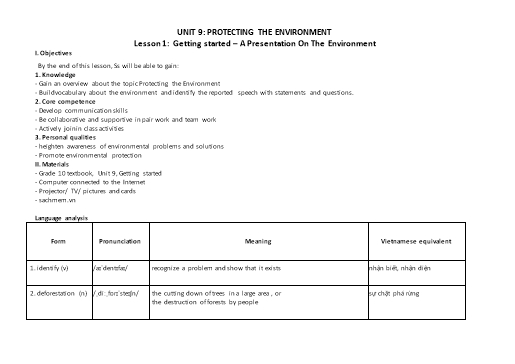
 3. endangered (a) /ɪnˈdeɪndʒəd/ in danger of being harmed, lost, unsuccessful, etc. có nguy cơ tuyệt chủng
 Assumptions
 Anticipated difficulties Solutions
 - Students may not know the environmental problems and solutions. - Use a mindmap and images of some major environmental issues and
 solutions to show in the class.
 - Students may not know how to make an efective presentation on - Give short, clear instructions and help if necessary.
 environmental protection.
 Board Plan
 Date of teaching
 Unit 9: PROTECTING THE ENVIRONMENT
 Lesson 1: Getting started – A Presentation on the Environment
 * Warm-up: Play the crossword puzzle to get to know the topic the lesson
 I. Vocabulary
 1. identify (v) /aɪˈdentɪfaɪ/: nhận biết, nhận diện
 2. deforestation (n) /ˌdiːˌfɒrɪˈsteɪʃn/ : sự chặt phá rừng
 3. endangered (a) /ɪnˈdeɪndʒəd/ : có nguy cơ tuyệt chủng
 II. Practice
 Task 1: Listen and read
 Task 2: Read the conversation again and answer the following questions.
 Task 3: Match the words in A with the words in B to form phrases in 1.
 Task 4: Complete the following sentences based on the conversation.
 * Homework
 Procedures *** Other Ss correct if the previous answers are incorrect.
 **** Teacher shows the Vietnamese meaning, says the words aloud and
 asks Ss to repeat them.
Read and - To get students Task 1. Listen and read (p.100): 8 mins
 listen interested in the topic * Teacher draws Ss’ attention on the conversation between Nam and his T-S
 - To get students to learn father and asks:
 some vocabulary to be
 +Who are the speakers?
 learnt in the unit
 + What are they talking about?
 * T plays the recording twice, has sts listen to the conversation, read T-S
 along and underline words and phrases in the conversation which
 are related to the environment.
 ** Ss do the task individually S
 *** Ss compare the words and phrases they have underlined and S-S
 discuss their meaning with a partner.
 **** T checks their answers with the whole class.
 T-S
 Suggested answers
 T-S
 * T has Ss read the conversation in pairs.
 ** Sts read the conversation S-S
 S-S
 *** One pair read aloud.
 T-S
 **** Teacher collects common mistakes and give comments.
Controlled - To practise reading for Task 2: (p.101) Read the conversation again and answer the following 5 mins
 practice specific information questions.
 - To practise scanning * Teacher asks Ss to work individually to read the questions and underline T-S
 - To develop Ss' knowledge the key words, then share their ideas with a partner who sits next to them. ** T has Ss read the conversation quickly again, find these words and S
 phrases, and underline them. Then ask Ss to do the matching. S-S
 *** Ss share their answers in groups of 4.
 **** T checks answers as a class, write the adjectives on the board and call T-S
 on individual Ss to write the correct noun next to each adjective.
 Alternatively, ask one student to read an adjective and another
 student to say the noun that goes with it.
 Answers:
 1-d: global warming
 2-c: practical actions
 3-b: environmental issues
 4-a: endangered animals
 To help Ss identify Task 4: (p. 101) Complete the following sentences based on the 4mins
 reported speech with conversation.
 statements and * T has sts read each sentence, try to think of a verb that will complete the T-S
 questions. gap
 ** Ss do the task individually S
 *** Ss share the answers with a peer. S-S
 **** T asks the whole class about the verb forms first, then the kind of verbs T-S
 used in the very sentences, i.e. reporting verbs. T call on individual students
 to read the complete sentences.
 Answers:
 1. asked
 2. advised
 3. said
 Less Task 5: Role play the following situation 10 mins
controlled - To practise pair working SITUATION:
 practice and conversational skill - Student A: You’re Minh, a student of Thang Long High School in Hanoi. You
 in the form of role play. are preparing a presentation on Environmental Protection. You meet Greta
 - To give students Thunberg, a famous Swedish environmental activist. Ask for her advice on • Tell Ss about the project requirements: Ss will have to do research about a
local or an international environmental organisation. They will have to find
out information about the organisation such as when it started working, its
aims and activities, and prepare an oral presentation, which they deliver in
the last lesson of the unit.
• Suggest some organisations that Ss may know or hear of. Encourage Ss to
search for information from different sources.
• To make their presentation more interesting, Ss should also prepare some
visuals to illustrate the information.
• Put Ss into groups, and have them choose their group leaders. Ask groups
to make a list of tasks they need to accomplish before each lesson, and assign
them to different students, making sure that all group members contribute to
the project work.
• Help Ss set deadlines for each task.
LESSON 2. direct indirect reported clause
 statement ‘I’m tired,’ I said. I told them (that) I was tired. that-clause
 ‘Are you ready?’ the nurse asked The nurse asked Joel if/whether he was
 if-clause/whether-clause
 question Joel. ready.
 wh-clause
 ‘Who are you?’ she asked. She asked me who I was.
 command ‘Leave at once!’ they ordered. They ordered us to leave at once. to-infinitive clause
Assumptions
 Anticipated difficulties Solutions
 1. Students may be confused when identifying stressed words in Give short and clear explanations with relevant examples for each case.
 sentences and stressed syllables in words.
 2. Students may be confused when changing direct speech into Give short and clear explanations with relevant examples for each case.
 reported speech.
Board Plan
 Date of teaching Warm-up - To activate Handout completion and video watching
 students’ *Teacher divides Ss into 8 groups, delivers the handouts, and asks Ss to Groupwork 5 mins
 knowledge on the complete.
 topic of the unit. **Ss fill in each blank ONE word with its given initial to complete Mr. Earth
 - To create a lively story.
 atmosphere in the *** Ss exchange their handouts to check the correct answers.
 classroom ****Teacher gives relevant comments on the students’ answers and shows
 - To lead into the new the key on the screen.
 unit 1.resources 2.destroyed 3.dumped
 4. thrown 5. Chemical 6.deforestation
 7.energy 8. material 9. Awareness 10.recycle
 PRONUNCIATION
Presentation
(Pre-teach *Explain what rhythm of speech is and that different languages or families T-S 4 mins
 To help students
Rhythm) of languages have different rhythm. For example, Vietnamese is a tonal
 understand the
 language with no system of word stress and every word is stressed. On the
 concept and identify
 other hand, the rhythm of English is based on the contrast between
 sentence stress
 stressed and unstressed syllables or words in regular intervals. To sound like
 a native speaker and be more fluent, Ss will also need to learn the language
 rhythm.
 - Sentence stress is the pattern of stressed and unstressed words across a
 sentence. Normally this emphasis is on words that carry important
 information, although this can change significantly, depending on the
 specific meaning the speaker wants to communicate.
 - Example: “She bought a new car.” has main stress on “bought”, “new”
 and “car”.
 Further links:
 https://www.teachingenglish.org.uk/article/english-sentence-stress VOCABULARY
 Presentation To make sure that Ss Task 1: Match the words or phrases to their meanings Pairwork 4 mins
(Vocab - pre- understand the *Teacher asks Ss to work independently or in pairs and asks them to read T-S
 teach) meanings of the the words and phrases carefully and match them to their meanings.
 words / phrases that ** Ss look at the conversation, and find the context where the words /
 have been phrases are used, if necessary.
 introduced in Getting *** Ss discuss in pairs, then teacher calls on one student to read aloud a
 Started or will be word / phrase and another student to read its definition.
 learnt in the unit. **** Check answers as a class.
 KEY:
 1.a 2.d 3.e 4.b 5.c
 Practice To give Ss an Task 2: Complete the sentences using the correct form of the words and Pairwork 4 mins
 opportunity to phrases in 1 T-S
 practise using the *Teacher asks Ss to work in pairs using the correct form of the words and
 words / phrases they phrases in 1.
 have learnt in **Ss read the sentences carefully to decide which word / phrase in 1
 meaningful contexts. can be used to complete each of the sentences and explain that they can
 use the context clues to help
 them decide on the word / phrase.
 ***Teacher ask Ss work in pairs. Ss call out the word / phrase they have
 used in each sentence first.
 **** Teacher asks Ss to give the answers as well as the reasons why they
 have chosen the word / phrase for each sentence. Teacher checks answers
 as a class and confirm the correct answers
 Key:
 1. Biodiversity
 2. wildlife
 3. habitats
 4. climate change
 5. ecosystem Present simple Past simple
 Present continuous Past continuous
 Present perfect Past perfect
 Past simple Past perfect
 Present perfect continuous Past perfect continuous
 Past continuous Past perfect continuous
• Changes of pronouns
 Direct speech Reported speech
 Pronouns I he/ she
 You I/ We/ They
 We We/ They
 Objects Me him/ her
 You me/ us/ them
 Us us/ them
Possessive My his/ her
 Adjs
 Your my/ our/ their
 Our our/ their
 Mine his/ hers - To give Ss an Task 2: Change these sentences into reported speech. T-S 4 mins
 opportunity to *Teacher asks Ss to work independently and rewrite the sentences using
 practise the use of reported speech. T also reminds Ss of the changes needed: personal
 reported speech. pronouns, tenses of verbs, and adverbs of time.
 ** Teacher lets Ss work individually.
 *** T has Ss work in pairs to compare answers.
 **** Check answers as a class. Confirm the correct answers.
 Key:
 1. Mrs Le explained that the burning of coal led / leads to air pollution.
 2. Nam said he had to present his paper on endangered animals the
 following week.
 3. Linda asked the speaker if human activities had / have an impact on the
 environment.
 4. Nam asked Mai what environmental projects her school did.
 5. Tom said to / told Nam that he would read more articles before writing
 the essay.
Production To give Ss a chance to Revision game T-S 4mins
 revise what they * Teacher introduces 7 questions and shows them one by one on the
 have leant. screen.
 **Ss read the questions and choose the correct answers.
 *** Ss can share their answers in pairs.
 **** T checks with the whole class and confirms the correct answers.
 Wrap up To help Ss consolidate T asks Ss to talk about what they have learnt in the lesson T-S 3 mins
 what they have learnt
 in the lesson.
Homework To revise the lesson - Do exercises in the workbook. T-S 1 min
 and prepare for the
 next lesson:
 Reading.
File đính kèm:
- ke_hoach_bai_day_tieng_anh_lop_10_global_success_theo_cv5512.docx
