

Kế hoạch bài dạy Tiếng Anh Lớp 11 Global Success theo CV5512 - Review 2
 17 trang
10/10/2025
2552
17 trang
10/10/2025
2552
Bạn đang xem tài liệu "Kế hoạch bài dạy Tiếng Anh Lớp 11 Global Success theo CV5512 - Review 2", để tải tài liệu gốc về máy hãy click vào nút Download ở trên.
Tóm tắt nội dung tài liệu: Kế hoạch bài dạy Tiếng Anh Lớp 11 Global Success theo CV5512 - Review 2
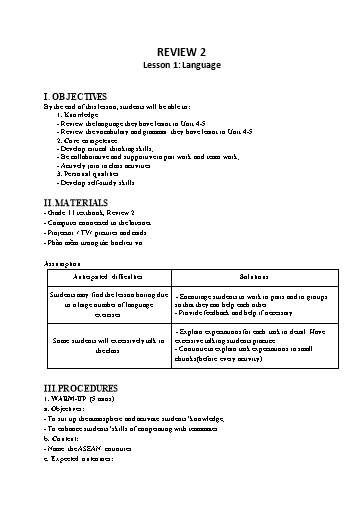
 - Students can recall the previous knowledge and develop interest in the new lesson
 d. Organisation
 TEACHER’S AND STUDENTS’ CONTENTS
 ACTIVITIES
Name the ASEAN countries
- Teacher asks Ss to work in 4 big groups.
- Teacher gives each group a set of pictures
about ASEAN countries’ flags
- Students work in group and write the name of
the countries
- The fastest group with correct answers will be
the winner.
 e. Assessment
 - Teacher observes the groups, listens to Ss’ answers and gives feedback.
 2. ACTIVITY 1: PRONUNCIATION (10 mins)
 a. Objectives:
 - To check if Ss can identify word stress and sentence stress, and provide further
 pronunciation practice;
 - To check if Ss can identify words with elision and provide further pronunciation practice.
 b. Content:
 - Task 1: Read the following sentences. Underline the stressed words in each one. Then mark
 the stressed syllables in these words. Listen and check.
 - Task 2: Underline words with elisions in the following sentences. Listen and check.
 c. Expected outcomes:
 - Students can revise different aspects of pronunciation learnt in Unit 4 and 5.
 d. Organisation:
 TEACHER’S AND STUDENTS’ ACTIVITIES CONTENTS d. Organisation
TEACHER’S AND STUDENTS’ ACTIVITIES CONTENTS
Task 1. What are the missing letters? Complete the sentences using the pictures to help you.
The first sentence is done for you. (5 mins)
- Teacher asks Ss to work individually, then Answer key:
 2.emissions, deforestation
 compare answers in pairs. Encourage them to use
 3. fossil fuels, greenhouse gases
 the pictures as clues.
- Teacher checks answers as a class. Call on
 individual Ss to spell the words or write them on
 the board.
- Extension: Play a game to revise other key words
 Ss have learnt in Unit 5, e.g., coal, waste, carbon,
 global warming. Have a volunteer come to the
 front. Whisper one of the words into his / her ear
 and have the student draw the word on the board
 or mime it. In weaker classes, ask the student to
 write the first two or three letters on the board.
 Ask the rest of the class to make guesses. Give a
 point to the first student who correctly calls out
 the word. Continue with other words until all Ss
 have a go. The winner is the student with most
 points.
Task 2. Complete the sentences using these words and phrases. (5 mins)
- Teacher has Ss work in pairs. Tell them to read
 Answer key:
 the sentences carefully and decide which word or
 1. current issues
 phrase can be used to complete each of the
 2. greenhouse gas
 sentences. Explain that they have to use context
 3. leadership skills
 clues to decide on the suitable word or phrase.
 4. contribute
- Teacher reminds Ss that they have learnt these 5. heat-trapping pollutants
 words or phrases in Units 4 and 5
- Teacher checks answers as a class and has Ss call
 out the word or phrase they have chosen for each
 sentence first.
- Teacher then asks individual Ss to read the whole
 sentences. Confirm the correct answers.
 e. Assessment
 - Teacher observation on Ss’ performance. - Teacher has Ss work individually. Tell them to read Answer key:
 1.C => collecting
 each sentence carefully and decide which option is
 2. C => injuring
 incorrect.
 3. A => Embarrassed
- Teacher calls on Ss to share their answers in pairs.
 4. B => getting
- Teacher checks as a class and confirm the correct
 5. B => cheered
 answers. For weaker classes, ask Ss to correct the
 mistake in each sentence.
 e. Assessment
 - Teacher observation on Ss’ performance.
 - Teacher’s feedback and peers’ feedback.
 4. CONSOLIDATION (3 mins)
 a. Wrap-up
 - T asks Ss to talk about what they have learnt in the lesson.
 b. Homework
 - Prepare for the next lesson: Review 2_ skill 1
 Board Plan
 Date of teaching
 Review 2
 Lesson 1: Language
 * Warm-up: Name the ASEAN countries
 Pronunciation
 Task 1: Read the following sentences. Underline the stressed words in each one. Then
 mark the stressed syllables in these words. Listen and check.
 Task 2: Underline words with elision in the following sentences. Listen and check.
 Vocabulary
 Task 1: What are the missing letters? Complete the sentences using the pictures to help
 you. The first sentence is done for you.
 Task 2: Complete the sentences using these words and phrases.
 Grammar
 Task 1: Put the verbs in brackets in the correct forms.
 Task 2: Rewrite the sentences using gerunds or participle clauses.
 Task 3: Circle the underlined part that is incorrect in each of the following sentences.
 Then correct it.
 * Homework - Teacher asks Ss to watch a short video and try to 1. Global warning and abnormal
remember the information in the video. weather such as torrential rain and
- After the Ss listen, teacher shows each question, one drought.
by one.
- Ss raise their hands to grab the chance to answers. 2. (One of the main causes of global
- T checks if the answers are correct or incorrect and warming is) CO2
leads in the lesson. 3. Three main ways:
 +. Fully mastering combustion
Questions: technology to completely burn fuel
 1. Which environmental problems are mentioned in
 +. Convert unused energy into
 the video?
 2. What is one of the main causes of global electricity
 warming? +. Optimize thermal control
 3. What can be done to reduce CO2 emissions?
 e. Assessment
 - Teacher observes the students and give feedback.
 2. ACTIVITY 1: LISTENING (18 mins)
 a. Objectives:
 - To practise listening for main ideas
 - To practise listening for specific information
 b. Content:
 - Task 1. Listen to a conversation between Nick and Ann. What are they talking about?
 - Task 2. Listen again. Decide whether the following statements are true (T) or false (F).
 c. Expected outcomes:
 - Students can understand the main ideas of the listening passage and reorder the key
 information.
 d. Organisation
 TEACHER’S AND STUDENTS’ ACTIVITIES CONTENTS
Task 1. Listen to a conversation between Nick and Ann. What are they talking about? (8 mins)
- Teacher focuses Ss’ attention on the picture and ask them Answer keys:
 B
what it shows, e.g., it shows that people can reduce CO2
emissions by recycling and using green energy such as
solar and wind power.
- Teacher tells Ss that they are going to hear a conversation
between Nick and Ann. Ask Ss to look through the list of
topics and guess what the two friends are going to talk
about. Encourage them to note down their guesses in their
notebooks.
- Teacher calls on some Ss to share their predictions. Ann: Yep, our planet is getting warmer because of the increasing amount of greenhouse
 gases such as carbon dioxide and methane.
 Nick: I read in an article that cows release a large amount of methane in the atmostphere.
 Ann: You’re right. That’s why some companies have applied a new technology to collect
 methane emissions from cows and turn them into usable energy.
 Nick: It’d be good if methane is put to good use since there is more of it. As the world
 population is increasing, more beef and dairy products will be needed. As a result, more
 methane will be released.
 Ann: Scientists are also looking for a way to make the oceans greener because they think
 plants could help take in more CO2 and produce more oxygen.
 Nick: Interesting! I heard about this. Yesterday, I watched a programme about a new project
 called NZT. It aims to collect CO2 from industrial areas and transport it to storage sites
 beneath the North Sea.
 Ann: That’s amazing! I really hope these technologies can help reduce the greenhouse gas
 emissions.
 e. Assessment
 - Teacher checks students’ work and gives feedback.
 - Students in class listen and give feedback on their friends’ performance.
 3. ACTIVITY 2: SPEAKING (20 mins)
 a. Objectives:
 - To help Ss develop ideas for the speaking task.
 - To give Ss an opportunity to use the ideas and language from the Listening in a group
 discussion and practise problem-solving skills.
 b. Content:
 - Work in groups. Discuss the technologies can be used in Vietnam.
 c. Expected outcomes:
 - Students come up with good ideas and are able to decide on the most important thing that
 will help people to live a long and healthy life in the cities of the future.
 d. Organisation
 TEACHER’S AND STUDENTS’ ACTIVITIES CONTENTS
Task 1. Work in groups. Discuss if the following technologies mentioned in the Listening can be used in
Viet Nam. Think about how they can help slow global warming. (9 mins) - Task 2. Listen again. Decide whether the following statements are true (T) or false
(F).
- Task 3. Extra activity
* Speaking
- Task 1: Work in groups. Discuss the technologies can be used in Vietnam.
*Homework - Teacher asks Ss some question: Suggested answers:
+ What can you do to go green? - cycling or going to school or work by
 Ss’ answer and delivers the task.? public transport
- Teacher asks each group to report their ideas. - planting trees
- Teacher corrects the answers and gives feedback. - organising clean-up events in the
 community
 - recycling plastic products
 - turning off the devices when not in use
 - reducing the use of fossil fuels
 e. Assessment
 - Teacher observes the students and give feedback.
 2. ACTIVITY 1: READING (16 mins)
 a. Objectives:
 - To help Ss practise reading for main ideas.
 - To help Ss practise reading for specific information.
 b. Content:
 - Task 1. Read the text and choose the best title for it.
 - Task 2. Read the text again and answer each question below with no more than three words.
 c. Expected outcomes:
 - Students can understand the main ideas as well as specific information of the reading
 passage.
 d. Organisation
 TEACHER’S AND STUDENTS’ ACTIVITIES CONTENTS
Task 1. Read the text and choose the best title for it. (1-3) (6 mins)
- Teacher has Ss read the three options first. Answer keys:
 B
- Teacher then asks Ss to read the whole text once to get
an overall idea.
- Teacher puts Ss into pairs to do the activity. Remind
them to pay attention to the first sentences of two
paragraph, which help them to find the answer. (ASEAN
Youth Forum (AYF) is a programme for young people in
ASEAN; AYF has had meetings in all ASEAN
countries) d. Organisation
 TEACHER’S AND STUDENTS’ ACTIVITIES CONTENTS
Write a proposal (120–150 words) to Youth: Open Space for a youth event to slow climate change in
ASEAN countries.
- Teacher explains the context: Ss are going to submit a Sample answer:
proposal to the organisation that they have read about in
the reading text above.
- Teacher tells Ss that they can use the suggested ideas and
outline in the box. Remind them to pay attention to word
choice, linking words, sentence structures and punctuation.
- Teacher gives Ss enough time to complete their
proposals. Walk around the class and offer help.
- In stronger classes, encourage them to use their own
ideas. In weaker classes, read the sample answer below and
write some key words from it as prompts on the board.
- Teacher calls on some Ss to read their paragraphs to the
class. Encourage the rest of the class to ask questions or
make comments.
- Teacher collects Ss’ proposals to mark and provide
written feedback in the next lessons.
 Sample answer:
Title: ASEAN GREEN WEEK
To: Youth – Open Space
Time: The first week of August/ every year
Prepared by: Students from Chu Van An High school
Introduction: Climate change is a serious problem in ASEAN because it is one of the
 regions most affected by it. We’d like to organise an ASEAN Green Week
 to help limit climate change in ASEAN countries.
Event summary: The event will take place in all ASEAN member countries during the first
 week of August. The young people in ASEAN will be the main participants
 in this event. They will take part in activities such as cycling or going to
 school or work by public transport, planting trees and organising clean-up
 events in the community.
Goals and benefits This event aims at reducing the amount of carbon dioxide, which is the
 main cause of global warning, and raising young people’s awareness of
 environmental protection in ASEAN. It will help ASEAN countries adopt
 healthier lifestyles and live in a cleaner environment.
Conclusion
File đính kèm:
- ke_hoach_bai_day_tieng_anh_lop_11_global_success_review_2.docx
