

Kế hoạch bài dạy Tiếng Anh Lớp 11 Global Success theo CV5512 - Review 4
 16 trang
10/10/2025
3741
16 trang
10/10/2025
3741
Bạn đang xem tài liệu "Kế hoạch bài dạy Tiếng Anh Lớp 11 Global Success theo CV5512 - Review 4", để tải tài liệu gốc về máy hãy click vào nút Download ở trên.
Tóm tắt nội dung tài liệu: Kế hoạch bài dạy Tiếng Anh Lớp 11 Global Success theo CV5512 - Review 4
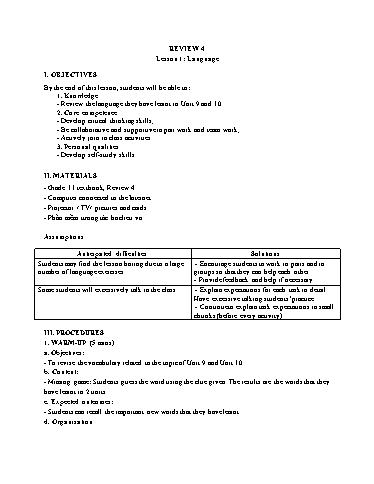
TEACHER’S AND STUDENTS’ ACTIVITIES CONTENTS MINI GAME: CATCH A WORD Answers: - Divide 2 teams and tell students the rules of the game Depression, national park, ecosystem, - T shows the pictures to students crime, food chain, pressure - Introduces the lesson e. Assessment - Teacher observes the groups and give feedback. 2. ACTIVITY 1: PRONUNCIATION (12 mins) a. Objectives: - To check if Ss can identify intonation in tag and choice questions and provide further pronunciation practice. b. Content: - Mark the intonation, using (falling intonation) or (rising intonation). Then listen and check. Practise saying the sentences in pairs. (p.120) c. Expected outcomes: - Students can express intonation in tag and choice questions. d. Organisation TEACHER’S AND STUDENTS’ ACTIVITIES CONTENTS Mark the intonation, using (falling intonation) or (rising intonation). Then listen and check. Practise saying the sentences in pairs. (12 mins) - Ask students to study the questions. Encourage them to identify the type of questions (i.e. tag or choice questions). - Briefly review intonation in tag and choice questions on the board. - Ask Ss to mark the intonation in these questions. Then play the recording for them to check their answers. - Ask Ss to practise saying the questions in pairs, using the correct intonations. - Ask some Ss to say these questions out loud in front of the whole class. Extension: Ask Ss to work in pairs and change the tag questions into choice questions, and vice versa, e.g., 1. This is an example of negative peer pressure, isn’t it? 6. Have you been to Cuc Phuong or U Minh National Park? Ask Ss to practise saying the new questions in pairs. Invite some Ss to say their sentences in front of the class. - In weaker classes, put Ss in pairs to work on the activity. - Check answers as a class by asking individual Ss to spell the words on the board Extension: Play a game to revise other key words Ss have learnt in Unit 9 and Unit 10. Have a volunteer come to the front. Whisper one of the words into his / her ear and have the student draw the word on the board or mime it. In stronger classes, ask the student to write the first two or three letters. Ask the rest of the class to make guesses. Give a point to the first student who correctly calls out the word. Continue with other words until all Ss have a go. The winner is the student with most points. e. Assessment - Teacher observation on Ss’ performance. - Teacher’s feedback and peers’ feedback. 4. ACTIVITY 3: GRAMMAR (13 mins) a. Objectives: - To check if Ss can use linking words and phrases. - To check if Ss can use the compound nouns correctly. b. Content: - Task 1. Write one sentence using the linking words and phrases in brackets. Do not change the meaning of the original sentences. (p.121) - Task 2. Circle the correct answer. (p.121) c. Expected outcomes: - Students know how to adapt linking words/ phrases and compound nouns for real life conversations. d. Organisation TEACHER’S AND STUDENTS’ ACTIVITIES CONTENTS Task 1. Write one sentence using the linking words and phrases in brackets. Do not change the meaning of the original sentences. (7 mins) - Ask Ss to read the sentences and check understanding. Suggested answers: - Have Ss study the linking words and phrases and try to 1. Because of cyberbullying, many teenagers become depressed. / Many recall how they are used (i.e. whether they are followed by a teenagers become depressed because of noun/gerund or by a clause; whether they are used to add cyberbullying. information or show reasons). In weaker classes, review the 2. As people pollute the environment, rules on the board. ecosystems are damaged. / Ecosystems are damaged as people pollute the environment. Date of teaching REVIEW 4 Lesson 1: Language *Warm-up Mini game * Pronunciation - Mark the intonation, using ↘ (falling intonation) or ↗ (rising intonation). Then listen and check. Practise saying the sentences in pairs. (p.120) * Vocabulary - What are the missing letters? Complete the sentences using the pictures to help you. (p. 120) * Grammar - Task 1. Write one sentence using the linking words and phrases in brackets. Do not change the meaning of the original sentences. (p.121) - Task 2. Circle the correct answer. (p.121) *Homework TEACHER’S AND STUDENTS’ ACTIVITIES CONTENTS Watch a video. Suggested answers: https://www.youtube.com/watch?v=D9OOXCu5XMg The message is that it’s good to be yourself. The film’s goal is to empower children of all - Teacher asks Ss to watch a short video and try to ages to find the courage to look inside and remember the information in the video. love themselves as they are. - After the Ss listen, teacher shows the question. - Ss raise their hands to grab the chance to answers. - T checks if the answers are correct or incorrect and leads in the lesson. Question: “What message does the video convey?” e. Assessment - Teacher observes the students and give feedback. 2. ACTIVITY 1: LISTENING (18 mins) a. Objectives: - To practise listening for main ideas - To practise listening for specific information b. Content: - Task 1. Listen to a talk show. Put the main points in the order they are mentioned. There is one extra choice. (p.121) - Task 2. Listen to the talk show again. Choose the correct answers A, B, or C. (p.122) c. Expected outcomes: - Students can understand the main ideas of the listening passage and solve the exercises successfully. d. Organisation TEACHER’S AND STUDENTS’ ACTIVITIES CONTENTS Task 1. Listen to a talk show. Put the main points in the order they are mentioned. There is one extra choice. (9 mins) - Ask Ss if they remember what body-shaming is. Tell Answer keys: them that they are going to listen to a talk show about 1.A 2. D 3. B body-shaming. - Ask Ss to read the ideas (A-D) and put them in the order that they appear on the recording. Remind them that there is ONE extra option. - Play the recording for Ss to listen and number the points. - Check answers as a class. - Task 1: Work in pairs. Which of the ways below do you think is the best way to deal with body shaming? give your reasons. (p.122) - Task 2. Work in groups. Read the situations below and think of some possible responses. Provide reasons for each answer. Report to the class and vote for the best response. (p.122) c. Expected outcomes: - Students come up with good ideas and good ways to deal with body shaming. d. Organisation TEACHER’S AND STUDENTS’ ACTIVITIES CONTENTS Task 1. Work in pairs. Which of the ways below do you think is the best way to deal with body shaming? give your reasons. (9 mins) - Put Ss in pairs. Ask them to discuss which they think is the best way to deal with body-shaming. - Before they start, quickly review different techniques for Students’ performance starting, maintaining, and concluding a conversation or discussion by writing on the board some key communication strategies and eliciting useful expressions, e.g. Can you tell me one way to start a conversation? When we end a conversation, what should we do? - Encourage Ss to use the expressions when they discuss the questions in pairs. - Go through each point and ask Ss how each point will help victims of body shaming. e.g., 1) People should ignore negative comments especially online and pretend that they don’t even hear them. Responding to rude comments will only give the other person more attention and more opportunities to be rude and offensive. - Walk around and provide help if necessary. Task 2. Work in groups. Read the situations below and think of some possible responses. Provide reasons for each answer. Report to the class and vote for the best response. (10 mins) - Ask Ss to read the situations carefully. - Tell Ss that they are going to work in groups to discuss Students’ performance each situation and provide a suitable response. Encourage them to continue using the communication strategies for starting, maintaining and concluding a discussion. - Put Ss in groups and assign one person to be the group note taker to take notes of their ideas. Ss can use the notes to formulate the final response that most group members agree on. - Set a time limit for the activity. - Have some Ss present their ideas the whole class. - Ask other Ss to vote for the best idea. Announce and praise the winners. REVIEW 4 Lesson 3: Skills (2) - Reading and Writing I. OBJECTIVES By the end of this lesson, students will be able to: 1. Knowledge - Review the Reading and Writing skills they have learnt in Unit 9 and 10. 2. Core competence - Develop critical thinking skills; - Be collaborative and supportive in pair work and team work; - Actively join in class activities. 3. Personal qualities - Develop self-study skills. II. MATERIALS - Grade 11 textbook - Computer connected to the internet - Pictures, A0 paper - Projector/ TV - sachmem.vn Assumptions Anticipated difficulties Solutions Students may find the lesson boring due to a - Encourage students to work in pairs and in large number of language exercises. groups so that they can help each other. - Provide feedback and help if necessary. Some students will excessively talk in the - Explain expectations for each task in class. detail. Have excessive talking students practise. - Continue to explain task expectations in small chunks (before every activity). III. PROCEDURES 1. WARM-UP (5 mins) a. Objectives: - To give excitement to students and lead in the lesson. b. Content: - Watch 2 videos about national parks and answer the questions. c. Expected outcomes: - Students understand what is inside a national park. d. Organisation Task 2. Read the article again. Which paragraph contains the following information? Write A, B, or C. (6 mins) - Ask Ss to read the five points and check understanding. Answer keys: - In stronger classes, have them do the activity first, then 1 B 2A 3 C 4 B 5 C read the text to check their answers. In weaker classes, do the first one as an example and have Ss read the text again to locate the information. - Check answers as a class. - Ask Ss to provide evidence from the text to support each answer, e.g. 1 B (attracts many nature lovers, very popular). Extension: (6 mins) Put Ss into teams. Ask them to study the numbers in the text for one minute, then close their books. Write a number on the board, e.g. 400, 2000, 3,000. The first group to say what the number refers to, e.g. 400 species of butterflies, 2000 kinds of plants, 3000 bird species wins a point The winner is the team with most points. e. Assessment - Teacher checks students’ work and gives feedback. - Students in class listen and give feedback on their friends’ performance. 3. ACTIVITY 2: WRITING (19 mins) a. Objectives: - To help Ss generate ideas for a proposal. - To help Ss practise writing a proposal. b. Content: - Task 1: Work in pairs. Discuss the advert and the questions below. Add more details. (p. 123) - Task 2: Write your proposal (150–180 words). Use the idea in 1 and the outline below to help you. (p. 123) c. Expected outcomes: - Students develop writing skills on the given topic. They can complete a proposal for protecting Cuc Phuong National Park. d. Organisation TEACHER’S AND STUDENTS’ ACTIVITIES CONTENTS Task 1: Work in pairs. Discuss the advert and the questions below. Add more details. (9 mins) - Ask Ss to read the advert in the box and check Students’ performance understanding. Encourage them to underline key words to - Teacher’s feedback and peers’ feedback. 4. CONSOLIDATION (3 mins) a. Wrap-up - T asks Ss to talk about what they have learnt in the lesson. b. Homework - Do exercises on workbook. Board Plan Date of teaching REVIEW 4 Lesson 3: Skills (2) – Reading and Writing *Warm-up Watch videos. * Reading - Task 1. Read the article. Choose the best heading for each section. There are TWO extra headings. (p.122) - Task 2. Read the article again. Which paragraph contains the following information? Write A, B, or C (p.123) - Extension. * Writing - Task 1: Work in pairs. Discuss the advert and the questions below. Add more details. (p. 123) - Task 2: Write your proposal (150–180 words). Use the idea in 1 and the outline below to help you. (p. 123) *Homework
File đính kèm:
- ke_hoach_bai_day_tieng_anh_lop_11_global_success_review_4.docx
