

Kế hoạch bài dạy Tiếng Anh Lớp 11 Global Success theo CV5512 - Unit 10: The ecosystem
 56 trang
10/10/2025
1914
56 trang
10/10/2025
1914
Bạn đang xem 30 trang mẫu của tài liệu "Kế hoạch bài dạy Tiếng Anh Lớp 11 Global Success theo CV5512 - Unit 10: The ecosystem", để tải tài liệu gốc về máy hãy click vào nút Download ở trên.
Tóm tắt nội dung tài liệu: Kế hoạch bài dạy Tiếng Anh Lớp 11 Global Success theo CV5512 - Unit 10: The ecosystem
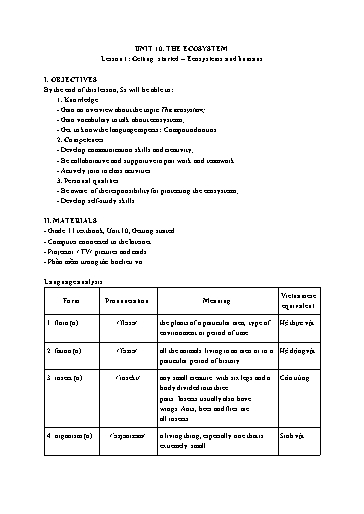
 5. biodiversity /ˌbaɪəʊdaɪˈvɜːsəti/ the existence of a large number of Đa dạng
 (n) different kinds of animals and plants sinh học
 which make a balanced environment
 Assumption
 Anticipated difficulties Solutions
 - Encourage students to work in pairs and in groups so
 Students are reluctant to work in
 that they can help each other.
 groups.
 - Provide feedback and help if necessary.
 - Explain expectations for each task in detail.
 - Continue to explain task expectations in small
 chunks (before every activity).
 Students may lack vocabulary to deliver
 - Provide vocabulary and useful language before
 a speech
 assigning tasks
 - Encourage students to work in groups so that they
 can help each other.
 III. PROCEDURES
 1. WARM-UP (5 mins)
 a. Objectives:
 - To stir up the atmosphere and activate students’ knowledge on the topic of ecosystems;
 - To set the context for the listening and reading part;
 - To enhance students’ skills of cooperating with teammates.
 b. Content:
 - Game: Guess the place.
 c. Expected outcomes:
 - Students can name the targeted place which is the topic of the lesson.
 d. Organisation
 TEACHER’S AND STUDENTS’ ACTIVITIES CONTENTS
GAME: GUESS THE PLACE Clues:
- Teacher divides class into 2 teams and explains the 1. This landscape forms the habitat for
 rules of the games. some of Asia’s rarest animal and plant
- There are three clues for Ss to guess the place. species.
- Teacher shows each clue, one by one. 2. Visitors in April and May have the
- If one team: chance to see thousands of vibrant
 + gets the correct answer after the 1st clue they get butterflies.
 3 points. 3. This place is located 120 km southwest
 of Hanoi, and nestled between the - Task 2. Read the conversation and decide whether these statements are True or False
 (p.111)
 - Task 3. Complete the diagram with words and phrases in Task 1 (p.111)
 - Task 4. Use the words in the box to form compound nouns mentioned in Task 1. Match
 them with the meaning below (p.111)
 c. Expected outcomes:
 - Students can thoroughly understand the content of the text and complete the tasks
 successfully.
 d. Organisation
TEACHER’S AND STUDENTS’ ACTIVITIES CONTENTS
Task 1. Listen and read. (5 mins)
- Teacher sets the context of the conversation. Have
 Suggested answers:
Ss look at the picture. Ask Ss questions about it,
 1. Cuc Phuong National Park
e.g.
 2. Cuc Phuong National Park is situated in Ninh
+ What can you see in the picture 1? Binh province. This park is known as the first
 national park and the largest nature reserve in the
+ Can you tell your friends what you know about
 country.
this place?
 3. The hands are holding different kinds of
+ What can you see in picture 2? animals.
+ How do you understand the picture? 4. We should protect the wildlife.
- Teacher encourages Ss to use their imagination
and accept all answers. Then explain that Ms Hoa,
Nam, and Mai are in class and they are talking
about the ecosystem.
- Teacher plays the recording twice for Ss to listen
and read along. Have Ss underline words/phrases
related to the ecosystem in the conversation.
- Teacher has Ss compare the words they have
underlined in pairs and discuss their meaning. Then
check comprehension as a class.
- Teacher calls on three Ss to read the conversation
aloud. e. Assessment
 - Teacher observation on Ss’ performance.
 - Teacher’s feedback and peers’ feedback.
 4. ACTIVITY 3: PRODUCTION (10 mins)
 a. Objectives:
 - To help Ss practice speaking skills;
 - To help Ss memorize the information about ecosystems that they have learnt in the lesson.
 b. Content:
 - Role play
 c. Expected outcomes:
 - Students can give a short presentation about ecosystems.
 d. Organisation
 TEACHER’S AND STUDENTS’ ACTIVITIES CONTENTS
Task 5. Role play
- Teacher asks Ss to work in groups. In each group, one Students’ own creativity.
student will play the role of the teacher and others are
students.
- The teacher and the students are going to discuss what
an ecosystem is and how important ecosystems are to
our planet.
- Ss have 3 minutes to prepare for the role play.
- Teacher invites one or two groups to come to the stage
and do the role play.
- Teacher asks other groups to listen and gives
comments.
- Teacher gives feedback and gives marks to the best
group.
 e. Assessment
 - Teacher observation on Ss’ performance.
 - Teacher’s feedback and peers’ feedback.
 4. CONSOLIDATION (3 mins)
 a. Wrap-up
 - T asks Ss to talk about what they have learnt in the lesson.
 b. Homework
 - Do exercises in workbook.
 - Prepare for the project in Lesson 8 UNIT 10: THE ECOSYSTEM
 Lesson 2: Language
I. OBJECTIVES
By the end of this lesson, Ss will be able to:
 1. Knowledge
 - Use the lexical items related to the topic Plants and animals;
 - Revise intonation in question tags;
 - Review and practise the use of compound nouns.
 2. Core competence
 - Be collaborative and supportive in pair work and team work;
 - Access and consolidate information from a variety of sources;
 - Actively join in class activities.
 3. Personal qualities
 - Be aware of the importance of protecting the ecosystem;
 - Develop self-study skills.
II. MATERIALS
- Grade 11 textbook, Unit 10, Language
- Computer connected to the Internet
- Projector / TV/ pictures and cards
- Phần mềm tương tác hoclieu.vn
Language analysis
 A compound noun is a noun that is made with two or more words. It is usually
 formed by:
1. noun + noun E.g: bus stop
2. adj + noun E.g: wildlife
3. V-ing + noun E.g: washing machine
4. noun + V-ing E.g: film-making
5. verb + preposition E.g: break-out
Assumption
 Anticipated difficulties Solutions
 - Encourage students to work in pairs and in groups so
 Students are reluctant to work in that they can help each other.
 groups.
 - Provide feedback and help if necessary.
 Students may lack vocabulary to deliver
 - Explain expectations for each task in detail.
 a speech - Task 1: Listen to these conversations. Pay attention to the intonation of the question tags.
 Then practise saying them in pairs (p.111)
 - Task 2: Mark the intonation in the question tags, using falling intonation or rising
 intonation. Then practise saying the conversations in pairs. (p.111)
 c. Expected outcomes:
 - Students can put correct intonation in question tags.
 d. Organisation
 TEACHER’S AND STUDENTS’ ACTIVITIES CONTENTS
Task 1: Listen to these conversations. Pay attention to the intonation of the question tags. Then
practise saying them in pairs (5 mins)
- Teacher writes the first sentence on the board and calls Audio script:
 1. So we need to protect local
on one or two Ss to read it. Check if Ss are familiar with ecosystems, don’t we? ↘
question tags. If necessary, explain how these questions Yes, we do.
 2. You’ll take the books back to the
are formed, e.g. We add question tags to statements to
 library, won’t you? ↗
invite a response from the listener. When the statement is OK, I’ll do that tomorrow.
positive, we use a negative question tag. If the statement 3. We don’t want our planet to lose
 biodiversity, do we? ↘
is negative, we use a positive question tag.
 No, we don’t.
- Teacher reads the question and asks questions to elicit 4. An ecosystem is a community of
 living things, isn’t it? ↗
the intonation, e.g. Did I raise or lower my voice on the No, it isn’t. It’s a community of both
question tag? What do you think this means? living and non-living things.
 5. You went to Cuc Phuong National
- Teacher focuses Ss’ attention on the Remember! box and Park last weekend, didn’t you? ↘
has Ss read the explanation and examples.
 Yes. I did.
- Teacher plays the recording of the first exchange and ask
Ss to listen and repeat, paying attention to the intonation
of question tag. Have Ss say what intonation the speaker
uses and why, e.g. The speaker uses falling intonation
because he/she is sure of the answer.
- Teacher plays the recording of the second exchange and
ask Ss to listen and repeat, paying attention to the
intonation of the question tag. Have Ss say what
intonation the speaker uses and why, e.g. The speaker uses
rising intonation because he/she is not sure of the answer. - Students understand the meaning of words, memorise them and are able to use them in
 meaningful context.
 d. Organisation
 TEACHER’S AND STUDENTS’ ACTIVITIES CONTENTS
Task 1. Match the words and phrases with their meanings (6 mins)
- Teacher reads the words on the left and makes sure Ss Answer key:
 1.e
understand the abbreviations in brackets (n, np, adj).
 2.d
- In weaker classes, teacher reads each word and elicits the part 3.a
 4.b
of speech students need to look for in the definitions, e.g., What
 5.c
part of speech do you need to look for in the definition of
‘native’’? Which definition contains verbs?
- Teacher asks Ss to work in pairs to do the matching.
- Teacher checks answers as a class. Call on one student to read
aloud a word and on another student to read its definition.
Task 2. Complete the sentences using the words and phrases in Task 1 (6 mins)
- Teacher has Ss work in pairs. Tell them to read the sentences
 Answer key:
carefully to decide which word in 1 can be used to complete
 1. Tropical forests
each of the sentences. Remind them to use the contextual clues
to decide on the word/phrase. 2. conservation
- Teacher checks answers as a class. Have individual Ss call out 3. native
the word they have used for each sentence first. 4. species
- Teacher confirms the correct answers. 5. mammals
- In stronger classes, ask Ss to explain why they have chosen
the word for each sentence (the clues in the context), e.g. The
first sentence needs a noun and it refers to a place with different
kinds of plants and animals. The second sentence needs a noun
to go with “wildlife”, and the words ‘conservation’ is the best
choice.
- Teacher asks individual Ss to read the whole sentences. of each compound word by giving examples or making
sentences with them, e.g. The tiger is an endangered species.
Women have a longer life expectancy than men.
Task 2. Work in pairs. Use the words in the box to make compound nouns. Then make sentences
with them. (7 mins)
- Teacher has Ss read the instruction and check to make sure Suggested answers:
they all understand what they have to do. Point to the example 2. wildlife
in the first sentence and the two words that have been crossed 3. sea level
out in the box. Ask questions, e.g. Can we make a compound
 4. swimming pools
from ‘globe’ and ‘warm’? What do we need to change?
 5. mobile phone
- Teacher asks Ss to look at the words in the box and form the
other four compound nouns.
- Teacher puts Ss in pairs to compare their answers use the
compound nouns to make sentences.
- Teacher checks answers as a class.
 e. Assessment
 - Teacher observation on Ss’ performance.
 - Teacher’s feedback and peers’ feedback.
 4. CONSOLIDATION (3 mins)
 a. Wrap-up
 - T asks Ss to talk about what they have learnt in the lesson.
 b. Homework
 - Do exercises on workbook.
 - Prepare for Lesson 3. Reading.
 Board Plan
 Date of teaching
 Unit 10: The ecosystem
 Lesson 2: Language
 *Warm-up
 Categorizing game
 * Pronunciation UNIT 10: THE ECOSYSTEM
 Lesson 3: Reading – U Minh Thuong – A unique national park
I. OBJECTIVES
By the end of this lesson, Ss will be able to:
 1. Knowledge
 - Develop reading skills for general ideas and for specific information about U Minh
Thuong National Park.
 2. Competences
 - Develop communication skills and creativity;
 - Be collaborative and supportive in pair work and teamwork;
 - Develop presentation skills;
 - Actively join in class activities.
 3. Personal qualities
 - Be aware of the values of U Minh Thuong National Park and ready to protect it;
 - Develop self-study skills.
II. MATERIALS
- Grade 11 textbook, Unit 10, Reading
- Computer connected to the Internet
- Projector / TV/ pictures and cards
- Phần mềm tương tác hoclieu.vn
Language analysis
 Vietnamese
 Form Pronunciation Meaning
 equivalent
1. unique (adj) /juˈniːk/ being the only one of its kind Độc đáo
2. mangrove (n) /ˈmỉŋɡrəʊv/ a tropical tree that grows in mud or at Cây đước
 the edge of rivers and has roots that
 are above ground
3. delta (n) /ˈdeltə/ an area of land, like a triangle in Đồng bằng
 shape, where a river has split into
 several smaller rivers before entering
 the sea
4. pangolin (n) /pỉŋˈɡəʊlɪn/ a small animal from Africa or Asia Con tê tê
 that eats insects, and has a long nose,
 tongue and tail, and hard scales on its
 body
File đính kèm:
- ke_hoach_bai_day_tieng_anh_lop_11_global_success_unit_10_the.docx
