

Kế hoạch bài dạy Tiếng Anh Lớp 11 Global Success theo CV5512 - Unit 2: The generation gap
 52 trang
10/10/2025
2403
52 trang
10/10/2025
2403
Bạn đang xem 30 trang mẫu của tài liệu "Kế hoạch bài dạy Tiếng Anh Lớp 11 Global Success theo CV5512 - Unit 2: The generation gap", để tải tài liệu gốc về máy hãy click vào nút Download ở trên.
Tóm tắt nội dung tài liệu: Kế hoạch bài dạy Tiếng Anh Lớp 11 Global Success theo CV5512 - Unit 2: The generation gap
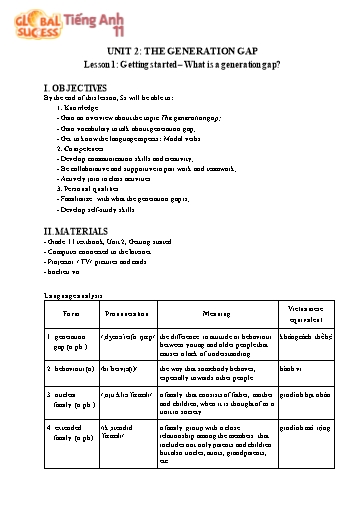
 5. follow in to do the same job, have the same nối nghiệp/ kế
 somebody’s style of life, etc. as somebody else, nghiệp ai
 footsteps especially somebody in your family
 (idiom)
 Assumption
 Anticipated difficulties Solutions
 - Encourage students to work in pairs and in groups so
 Students are reluctant to work in groups. that they can help each other.
 - Provide feedback and help if necessary.
 - Explain expectations for each task in detail.
 - Continue to explain task expectations in small
 chunks (before every activity).
 Students may lack vocabulary to deliver
 - Provide vocabulary and useful language before
 a speech
 assigning tasks
 - Encourage students to work in groups so that they
 can help each other.
 III. PROCEDURES
 1. WARM-UP (5 mins)
 a. Objectives:
 - To stir up the atmosphere and activate students’ knowledge on the topic of the generation
 gap;
 - To set the context for the listening and reading part;
 - To enhance students’ skills of cooperating with teammates.
 b. Content:
 - Listing game: List as many words related to the topic A long and healthy life as possible.
 c. Expected outcomes:
 - Students can recall the previous knowledge and develop interest in the new lesson.
 d. Organisation
 TEACHER’S AND STUDENTS’ ACTIVITIES CONTENTS
Listing game Lists of questions:
- Teacher divides the class into two teams and the board How many generations are there in your
in two halves and gives a board pen to one of the Ss in family?
each team.
 Do you and your parents like the same
 music/ types of clothes/ TV programmes? - To help Ss learn modal verbs.
 b. Content:
 - Task 1: Listen and read (p.18)
 - Task 2. Read the conversation again. Tick (✓) the true information about Mark and Mai.
 (p.19)
 - Task 3. Find words or phrases in Task 1 that have the following meanings. (p.19)
 - Task 4. Choose the modal verbs used in Task 1 to complete the sentences. (p.19)
 c. Expected outcomes:
 - Students can thoroughly understand the content of the text and complete the tasks
 successfully.
 d. Organisation
TEACHER’S AND STUDENTS’ ACTIVITIES CONTENTS
Task 1. Listen and read. (5 mins)
- Teacher asks Ss to look at the pictures in the
book as well as the dialogue and answer the
questions.
- Ss answer the questions in pairs.
- Teacher plays the recording twice. Ss listen and
read.
- Teacher checks Ss’ prediction. T calls 2 Ss to
read the conversation aloud.
 Questions:
 - What can you see in each picture?
 - Who are the speakers?
 - What do you think they are discussing?
 Suggested answers:
 - I can see a teacher and two students in the
 picture.
 - Ms Hoa, Mark and Mai are the speakers.
 - They are discussing the generation gap.
Task 2. Read the conversation again. Tick (✓) the true information about Mark and Mai. (5 mins)
- Teacher tells Ss to read the conversation again Answer key:
and work independently to find the answers. Mark Mai
Remind Ss to underline the information. 1. has some arguments over √
- Ss work independently to find the answers. small things with family
 members
- Teacher has Ss compare the answers in pairs
 2. lives with grandparents √
before checking with the whole class. who have traditional
- Teacher checks the answers as a class and gives views
feedback. 3. lives in a nuclear family √ TEACHER’S AND STUDENTS’ ACTIVITIES CONTENTS
Task 5. Role-play Students’ own creativity.
- Teacher asks Ss to work in groups.
- In each group, students play the role of grandparent(s),
parent(s) and children.
- Each group thinks about a situation (clothes choice/
music taste, etc.) that shows the differences among
generations and creates a short role-play about the
differences with suitable solutions.
- Ss have 3 minutes to prepare for the role-play.
- Teacher invites 1 or 2 groups to come to the stage and
do the role-play.
- Teacher asks other groups to listen and give
comments.
- Teacher gives feedback and gives marks to the best
group.
 e. Assessment
 - Teacher observation on Ss’ performance.
 - Teacher’s feedback and peers’ feedback.
 4. CONSOLIDATION (3 mins)
 a. Wrap-up
 - T asks Ss to talk about what they have learnt in the lesson.
 b. Homework
 - Write a short paragraph about how the generation gap manifests in your family.
 - Prepare for the project in Lesson 8
 Board Plan
 Date of teaching
 UNIT 2: THE GENERATION GAP
 Lesson 1: Getting started – What is a generation gap?
 *Warm-up
 * Vocabulary
 1. generation gap (n.ph.)
 2. behaviour (n)
 3. nuclear family (n.ph.)
 4. extended family (n.ph) UNIT 2: THE GENERATION GAP
 Lesson 2: Language
I. OBJECTIVES
By the end of this lesson, Ss will be able to:
 1. Knowledge
 - Use the lexical items related to the topic The generation gap;
 - Recognise and practise contracted forms;
 - Review the use of Modal verbs: must, have to, and should.
 2. Core competence
 - Be collaborative and supportive in pair work and team work;
 - Access and consolidate information from a variety of sources;
 - Actively join in class activities.
 3. Personal qualities
 - Understand about the generation gap;
 - Develop self-study skills.
II. MATERIALS
- Grade 11 textbook, Unit 2, Language
- Computer connected to the Internet
- Projector / TV/ pictures and cards
- hoclieu.vn
Language analysis
• We use must and have to to say it is necessary to do something at present.
Example: Oh, it’s 10 p.m. I must go home now.
 I have to go home now.
• We use have to to talk about the past or future.
Example: My grandmother had to do all household chores.
 We will have to accept these generational differences.
• When the speaker decides what is necessary, we use must. When someone else makes
the decision, we use have to.
Example: I must clean my room before my friend comes to stay with me.
 I have to clean my room every day. (My mother forces me to do it.)
• We use mustn’t to express something we are not allowed to do.
Example: You mustn’t behave rudely towards other people.
• We use don’t have to to say that something is not necessary.
Example: They don’t have to wear uniforms at the weekend.
• We use should or shouldn’t to give advice, make a recommendation, or offer an
opinion about what is right or wrong.
Example: I think parents should limit their children’s screen time.
Assumptions - Task 1: Listen and repeat. Pay attention to the contracted forms in the following sentences.
 What are their full forms? (p.19)
 - Task 2: Listen and circle what you hear: contracted or full forms. Then practice saying these
 conversations in pairs. (p.19)
 c. Expected outcomes:
 - Students can pronounce the contracted forms correctly.
 d. Organisation
 TEACHER’S AND STUDENTS’ ACTIVITIES CONTENTS
Task 1: Listen and repeat. Pay attention to the contracted forms in the following sentences. What
are their full forms? (5 mins)
- Teacher asks Ss to listen to the recording. Have them pay attention Answer key:
to the contracted forms. 1. we will
- Teacher asks Ss to circle the words in contracted forms. 2. You are
- Teacher asks Ss to work in pairs and take turns to read the sentences 3. cannot
in full form. 4. That is
- Teacher checks the answers as a class. 5. do not
 6. let us
Task 2: Listen and circle what you hear: contracted or full forms. Then practice saying these
conversations in pairs. (7 mins)
- Teacher asks Ss to read quickly through the questions and answers. Answer key:
Check understanding. 1. A: What’s
- Teacher plays the recording twice, if necessary, pausing after each B: We’ll
sentence and asks Ss to repeat as a class.
 2. A: Don’t you
- Students circle the forms they hear. B: don’t
- Teacher has Ss work in pairs to take turns to read each sentence 3. A: who’ll
aloud.
- Teacher checks as a class. B: I will
Extension: In stronger classes, Teacher writes down some sentences
or short conversations using the full forms on the board or pieces of
paper. Put Ss in pairs and have them write the contracted forms, e.g.
A: You should not make so much noise. (shouldn’t)
B: I do not make any noise. I am as quiet as a mouse. (don’t; I’m)
Teacher asks Ss to practise them in pairs. Then invite some pairs to
read them in front of the class.
 e. Assessment
 - Teacher checks students’ pronunciation and gives feedback.
 - Students in class listen and give feedback on their friends’ performance. 4. ACTIVITY 3: GRAMMAR (13 mins)
 a. Objectives:
 - To help Ss recognise the difference between Modal verbs: must, have to, and should.
 - To help Ss practise Modal verbs: must, have to, and should.
 b. Content:
 - Task 1. Circle the correct answers to complete the sentences. (p.20)
 - Task 2. Work in pairs. Are there any rules in your family or things that you or your parents
 think are necessary? Share them with your partner. Use must, have to, and should. (p.21)
 c. Expected outcomes:
 - Students know how to use the past simple or the present perfect and can apply it to give a
 short talk on the given topic.
 d. Organisation
 TEACHER’S AND STUDENTS’ ACTIVITIES CONTENTS
Task 1. Circle the correct answers to complete the sentences. (6 mins)
- Teacher asks Ss to read the notes in the Remember box to Answer key:
review the differences between Modal verbs: must, have to,
 1. must
and should. Give more explanation and examples if
necessary. 2. have to
- Teacher gives Ss time to complete the task.
- Teacher checks answers as a class by having individual Ss 3. should
write the answers on the board. Go through each sentence and
ask Ss to explain why they have used that modal verb. 4. had to
- Extension: Teacher writes some phrases expressing things
that are required, necessary or a good idea to do. Make sure
that each one can be used with a modal verb. For example,
stop at the red light (must), show your passport to get on the
plane (have to), rest when you have a cold (should), use your
mobile phone during an exam (mustn’t).
Teacher writes the modal verbs on the board and has Ss put
the phrases under one of them, and make sentences, e.g.
Drivers must stop at the red light. You have to show your
passport to get on the plane. You should rest when you have
a cold. You mustn’t use your mobile phone during an exam.
Task 2. Work in pairs. Are there any rules in your family or things that you or your parents
think are necessary? Share them with your partner. Use must, have to, and should. (7 mins)
- Teacher lets Ss work in pairs. Example:
- Teacher asks Ss to talk to their partner and share about rules A: I have to be back home by 9 p.m.
in your family or things that they or their parents think are B: Really? I don't have to. But my
necessary
 parents think I shouldn't stay out after
- Teacher requires Ss to use the correct modal verbs. UNIT 2: THE GENERATION GAP
 Lesson 3: Reading – Different generations
I. OBJECTIVES
By the end of this lesson, Ss will be able to:
 1. Knowledge
 - Develop reading skills for general ideas and for specific information about different
generations.
 2. Competences
 - Develop communication skills and creativity;
 - Be collaborative and supportive in pair work and teamwork;
 - Develop presentation skills;
 - Actively join in class activities.
 3. Personal qualities
 - Acknowledge and understand characteristics of different generations;
 - Develop self-study skills.
II. MATERIALS
- Grade 11 textbook, Unit 2, Reading
- Computer connected to the Internet
- Projector / TV/ pictures and cards
- hoclieu.vn
Language analysis
 Vietnamese
 Form Pronunciation Meaning
 equivalent
1. characteristic /ˌkổrəktəˈrɪstɪk/ a typical feature or quality that đặc điểm
 (n) something/somebody has
2. critical (adj) /ˈkrɪtɪkl/ making careful judgements cú tớnh phản
 biện
3. creative (adj) /kriˈeɪtɪv/ involving the use of skill and the sỏng tạo
 imagination to produce something
 new or a work of art
4. platform (n) /ˈplổtfɔːm/ the type of computer system or the nền tảng
 software that is used
Assumption 2. ACTIVITY 1: PRE-READING (9 mins)
 a. Objectives:
 - To get students learn vocabulary related to the topic;
 - To activate prior knowledge about the topic and get Ss involved in the lesson.
 b. Content:
 - Lead students in the reading passage;
 - Pre-teach vocabulary related to the content of the reading passage.
 c. Expected outcomes:
 - Students can use key language more appropriately before they read.
 d. Organisation
 TEACHER’S AND STUDENTS’ ACTIVITIES CONTENTS
Task 1. Work in pairs. Look at the photos. Discuss what you know about the generation in each
picture (e.g. age, characteristics, interests, life experiences). (4 mins)
 Suggested answers:
- Teacher asks Ss to work in pairs and look at the pictures.
 Generation X refers to the generation born
- They should discuss what they know about the between 1965 and 1980. Gen Xers are also
generation in each picture. known as critical thinkers because they
 achieved higher levels of education than
- Teacher has some Ss share their answers with the whole previous generations.
class. Generation Y, also known as Millennials,
- Teacher introduces the topic of the reading text. refers to those born between the early 1980s
 and late 1990s. They are curious and ready
 to accept changes.
 Generation Z includes people born between
 the late 1990s and early 2010s, a time of
 great technological developments and
 Generation X
 changes.
 Generation Y
 Generation Z
Vocabulary pre-teaching (5 mins)
- Teacher introduces the vocabulary. New words:
File đính kèm:
- ke_hoach_bai_day_tieng_anh_lop_11_global_success_unit_2_the.docx
