

Kế hoạch bài dạy Tiếng Anh Lớp 11 Global Success theo CV5512 - Unit 4: Asean and Vietnam
 47 trang
10/10/2025
3644
47 trang
10/10/2025
3644
Bạn đang xem 30 trang mẫu của tài liệu "Kế hoạch bài dạy Tiếng Anh Lớp 11 Global Success theo CV5512 - Unit 4: Asean and Vietnam", để tải tài liệu gốc về máy hãy click vào nút Download ở trên.
Tóm tắt nội dung tài liệu: Kế hoạch bài dạy Tiếng Anh Lớp 11 Global Success theo CV5512 - Unit 4: Asean and Vietnam
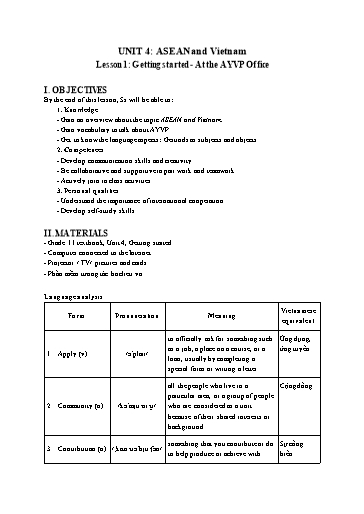
 other people, or to help make
 something successful
 to do something that you do not Tình nguyện
 have to do, often without having
 4. Volunteer (v) /ˌvɒl.ənˈtɪər/
 been asked to do it and/or without
 expecting payment
 Assumption
 Anticipated difficulties Solutions
 - Encourage students to work in pairs and in groups so
 Students are reluctant to work in
 that they can help each other.
 groups.
 - Provide feedback and help if necessary.
 - Explain expectations for each task in detail.
 - Continue to explain task expectations in small
 chunks (before every activity).
 Students may lack vocabulary to deliver
 - Provide vocabulary and useful language before
 a speech
 assigning tasks
 - Encourage students to work in groups so that they
 can help each other.
 III. PROCEDURES
 1. WARM-UP (5 mins)
 a. Objectives:
 - To stir up the atmosphere and activate students’ knowledge on the topic of ASEAN.
 - To set the context for the listening and reading part.
 - To enhance students’ skills of cooperating with teammates.
 b. Content:
 - Quiz: Guessing the countries.
 c. Expected outcomes:
 - Students can have an overview of ASEAN.
 d. Organisation
 TEACHER’S AND STUDENTS’ ACTIVITIES CONTENTS
GUESSING GAME Lists of countries:
- Teacher shows the shape of the countries. • Vietnam
 • Brunei - Task 2. Read the conversation again and write T (True) or F (False). (p.43)
 - Task 3. Match each word with the definition. (p.43)
 - Task 4. Complete the sentences using words and phrases from exercise 1. (p.43)
 c. Expected outcomes:
 - Students can thoroughly understand the content of the text and complete the tasks
 successfully.
 d. Organisation
TEACHER’S AND STUDENTS’ ACTIVITIES CONTENTS
Task 1. Listen and read. (5 mins)
- Teacher asks Ss to look at the pictures in the
book as well as the dialogue and answer the
questions.
- Ss answer the questions in pairs.
- Teacher plays the recording twice. Ss listen and
read. Questions:
- Teacher checks Ss’ prediction. T calls 2 Ss to - What can you see in each picture?
read the conversation aloud. - Who are the speakers?
 - What do you think they are discussing?
 Suggested answers:
 - Girls, books, photos, AVVP, ASEAN logo
 - The girls are the speakers.
 - They are discussing about ASEAN.
Task 2. Read the conversation again and write T (True) or F (False). (5 mins)
- Teacher tells Ss to read the conversation again
and work independently to find the answers. Answer key:
Remind Ss to underline the information and 1. F (It was her cousin.)
correct the false statements. 2. T
- Ss work independently to find the answers. 3. T
- Teacher has Ss compare the answers in pairs 4. F (She should be over 18)
before checking with the whole class.
- Teacher checks the answers as a class and gives
feedback.
Task 3. Match each word with its definition. (5 mins)
- Teacher has Ss look at the box 1-4, a-d.
- Ss works in pairs and solve Task 3 using Answer key:
background knowledge. 1. c
- Check answers as a class. 2. d
 3. b
 4. a 4. CONSOLIDATION (3 mins)
a. Wrap-up
- T asks Ss to talk about what they have learnt in the lesson.
b. Homework
- Prepare for the next lesson
 Board Plan
 Date of teaching
 Unit 4: ASEAN and Vietnam
 Lesson 1: Getting started
 *Warm-up
 * Vocabulary
 1. Apply (v)
 2. Community (n)
 3. Contribution (n)
 4. Volunteer (v)
 - Task 1: Listen and read (p.42)
 - Task 2. Read the conversation again and write T (True) or F (False). (p.43)
 - Task 3. Match each word with the definition. (p.43)
 - Task 4. Complete the sentences using words and phrases from exercise 1. (p.43)
 - Task 5: Role play
 *Homework - Provide vocabulary and useful language before
 assigning tasks
 - Encourage students to work in groups so that they
 can help each other.
 III. PROCEDURES
 1. WARM-UP (5 mins)
 a. Objectives:
 - To stir up the atmosphere and activate students’ knowledge on the elision of vowels.
 - To enhance students’ skills of cooperating with teammates.
 b. Content:
 - Matching game
 c. Expected outcomes:
 - Students can have an overview of elision.
 d. Organisation
 TEACHER’S AND STUDENTS’ ACTIVITIES CONTENTS
Matching game Suggested answers:
- Ss work in 4 groups. Each group is given a big-sized Tonight /tˈnaɪt/
piece of paper and markers. Police /pˈliːs/
- Teacher shows the board with separate vocabulary and Potato /pˈteɪtoʊ/
pronunciations History /ˈhɪstri/
- All teams look at the board and do the matching. Every /ˈevri/
- Teacher checks answers of each group.
- The group that has the most correct answers is the
winner.
 e. Assessment
 - Teacher observes the groups and give feedback.
 2. ACTIVITY 1: PRONUNCIATION (12 mins)
 a. Objectives:
 - To help Ss recognise and practise elision of the vowels.
 b. Content:
 - Task 1: Listen and repeat. Pay attention to the elision of the vowels in the words in the
 second column. (p.43)
 - Task 2: Listen and repeat. Pay attention to the words with elision. (p.43)
 c. Expected outcomes:
 - Students can identify and omit weak vowels correctly.
 d. Organisation
 TEACHER’S AND STUDENTS’ ACTIVITIES CONTENTS - Teacher tells Ss to read the sentences carefully and decide
which word in Task 1 can be used to complete each of the Answer key:
sentences. 1. leadership skills
- Teacher checks answers as a class. Have Ss call out the word 2. contribution
they have used in each sentence first. 3. cultural exchange
- Teacher confirms the correct answers. Ask Ss to explain the 4. current issues
meaning of each word using the definitions in Activity 1.
- Teacher asks some Ss to read the complete sentences.
 e. Assessment
 - Teacher observation on Ss’ performance.
 - Teacher’s feedback and peers’ feedback.
 4. ACTIVITY 3: GRAMMAR (13 mins)
 a. Objectives:
 - To help Ss recognise gerunds as subjects and objects.
 - To help Ss practise using gerunds in sentences.
 b. Content:
 - Task 1. Rewrite the following sentences using gerunds. (p.44)
 - Task 2. Work in pairs. Take turns to make sentences about your partner, using gerunds. He
 or she should tell you if they are true. (p.44)
 c. Expected outcomes:
 - Students know how to use gerunds.
 d. Organisation
 TEACHER’S AND STUDENTS’ ACTIVITIES CONTENTS
Task 1. Put the verbs in brackets in either the past simple or the present perfect. (6 mins)
- Have Ss read the complete sentences and understanding. Answer key:
 1. Applying for ASEAN scholarship
- In weaker classes, do the first sentence as an example online
 focusing on the gerund. If necessary, highlight the verb 2. listening to music
 phrase in each sentence that Ss need to change to gerunds 3. helping me translate the documents
 in the second sentences. (e.g., to apply for => applying 4. in starting a youth programme
 for)
 5. Participating in the conference last
- Have Ss do the activity individually, then work in pairs to year
 compare answers.
- Check answers as a class. Confirm the correct answers by
 asking individual Ss to write them on the board.
Task 2. Work in pairs. Take turns to make sentences about your partner, using gerunds. He or
she should tell you if they are true. (7 mins)
- Teacher lets Ss work in pairs. Suggested answer:
- Teacher asks Ss to talk to their partner and share about A: You enjoy travelling around the
daily objects. It can be a conversation between two people or region.
two separate talks from the pair. B: Sorry, that's not true. Your dream UNIT 4: ASEAN AND VIETNAM
 Lesson 3: Reading – ASEAN news
I. OBJECTIVES
By the end of this lesson, Ss will be able to:
 1. Knowledge
 - Develop reading skills for general ideas and for specific information in news items
about ASEAN countries
 2. Competences
 - Develop communication skills and creativity;
 - Be collaborative and supportive in pair work and teamwork;
 - Develop presentation skills;
 - Actively join in class activities.
 3. Personal qualities
 - Acknowledge and understand more about ASEAN countries
 - Develop self-study skills.
II. MATERIALS
- Grade 11 textbook, Unit 4, Reading
- Computer connected to the Internet
- Projector / TV/ pictures and cards
- Phần mềm tương tác hoclieu.vn
Language analysis
 Form Pronunciation Meaning
1. Relation (n) /rɪˈleɪ.ʃən/ Relations are the connections between people, groups,
 organizations, or countries
2. eye-opening (adj) /ˈaɪˌəʊ.pən.ɪŋ/ surprising, and teaching you new facts about life,
 people, etc
3. Represent (v) /ˌrep.rɪˈzent/ to speak, act, or be present officially for another
 person or people
4. live stream (n) /ˈlaɪv.striːm/ a broadcast of the video and sound of an event over
 the internet as it happens
Assumption
 Anticipated difficulties Solutions c. Expected outcomes:
 - Students can use key language more appropriately before they read.
 d. Organisation
 TEACHER’S AND STUDENTS’ ACTIVITIES CONTENTS
Task 1. Work in pairs. Discuss the questions. (5 mins)
 Student’s practice
Questions:
1. where do you most often read the news?
2. what is your favourite news section: politics,
education, sports, or Culture?
- Ask Ss to work in pairs to discuss the questions.
- Tell Ss that there are no right or wrong answers and
encourage Ss to answer the questions based on their own
experiences.
- To help Ss answer the second question, bring a
newspaper, and show the different sections in class.
- Focus Ss’ attention on a short piece of news in a
newspaper or online and elicit the text type of the reading
Vocabulary pre-teaching (5 mins)
- Teacher introduces the vocabulary. New words:
- Teacher explains the meaning of the new vocabulary 1. Relation (n)
by pictures. 2. eye-opening (adj)
- Teacher checks students’ understanding with the “Rub 3. Represent (v)
out and remember” technique. 4. live stream (n)
- Teacher reveals that these five words will appear in the
reading text and asks students to open their textbook to
discover further.
 e. Assessment
 - Teacher checks students’ pronunciation and gives feedback.
 - Teacher observes Ss’ writing of vocabulary on their notebooks.
 3. ACTIVITY 2: WHILE-READING (20 mins)
 a. Objectives:
 - To help Ss practise skimming texts to choose the best title
 - To help Ss practise the skill of guessing the meaning of words from context.
 - To develop reading skills for general information;
 - To develop reading skills for specific information.
 b. Content: - Have Ss work in pairs or groups to compare answers.
- Check answers as a class by asking individual Ss to write
them on the board.
 e. Assessment
 - Teacher observation on Ss’ performance.
 - Teacher’s feedback and peers’ feedback.
 4. ACTIVITY 3: POST-READING (7 mins)
 a. Objectives:
 - To check students’ understanding about the reading passage;
 - To help some students enhance presentation skills;
 - To practise team working;
 - To give students authentic practice in using target language.
 b. Content:
 - Discussion: Do you find the advice in the article useful? Have you tried following any of the
 suggestions above?
 - Task 5: Discussion (p.46)
 c. Expected outcomes:
 - Students can use the ideas and language in the reading to talk about their opinions and give
 reasons
 d. Organisation
 TEACHER’S AND STUDENTS’ ACTIVITIES CONTENTS
Task 5. Discussion
- Ask Ss to discuss about the news itesm they want to
explore more and their reasons. Students’ own ideas.
- Have Ss work in groups to discuss the question.
- For weaker classes, T may suggest Ss choose one
piece of news from Activity 2 and work out the
interesting information from that news individually.
Then they work in pairs and share their ideas.
 e. Assessment
 - Teacher observation on Ss’ performance.
 - Teacher’s feedback and peers’ feedback.
 4. CONSOLIDATION (3 mins)
 a. Wrap-up
 - T asks Ss to talk about what they have learnt in the lesson.
 b. Homework UNIT 4: ASEAN AND VIETNAM
 Lesson 4: Speaking – Discussing necessary qualifications for joining a programme
I. OBJECTIVES
By the end of this lesson, Ss will be able to:
 1. Knowledge
 - Gain an overview about necessary skills and experience to join a programme.
 - Memorize vocabulary to talk about joining a programme.
 2. Competences
 - Gain some language expressions to ask for and give opinions.
 - Talk about the steps to ask for and give opinions.
 - Be collaborative and supportive in pair work and teamwork;
 - Develop presentation skills;
 3. Personal qualities
 - Acknowledge and be able to know what it may take to join a programme.
 - Develop self-study skills.
 - Actively join in class activities.
II. MATERIALS
- Grade 11 textbook, Unit 4, Speaking
- Computer connected to the Internet
- Projector / TV/ pictures and cards
- Phần mềm tương tác hoclieu.vn
Language analysis
 Form Pronunciation Meaning
1. Current (adj) /ˈkʌr.ənt/ of the present time
2. Issue (n) /ˈɪʃ.uː/ a subject or problem
3. Solution (n) /səˈluː.ʃən/ the answer to a problem
4. Skill (n) /skɪl/ an ability to do an activity or job well
Assumption
 Anticipated difficulties Solutions
 Students may lack more vocabulary to - Provide vocabulary and useful language before
 deliver a speech. assigning tasks.
 - Encourage students to work in groups so that they
 can help each other.
File đính kèm:
- ke_hoach_bai_day_tieng_anh_lop_11_global_success_unit_4_asea.docx
