

Kế hoạch bài dạy Tiếng Anh Lớp 11 Global Success theo CV5512 - Unit 5: Global warming
 48 trang
10/10/2025
2978
48 trang
10/10/2025
2978
Bạn đang xem 30 trang mẫu của tài liệu "Kế hoạch bài dạy Tiếng Anh Lớp 11 Global Success theo CV5512 - Unit 5: Global warming", để tải tài liệu gốc về máy hãy click vào nút Download ở trên.
Tóm tắt nội dung tài liệu: Kế hoạch bài dạy Tiếng Anh Lớp 11 Global Success theo CV5512 - Unit 5: Global warming
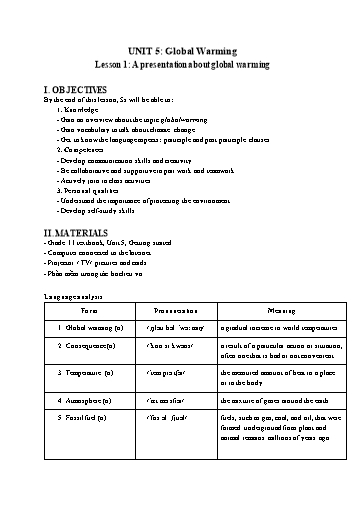
 6. Carbon dioxide (n) /ˌkɑː.bən daɪˈɒk.saɪd/ the gas formed when carbon is burned, or
 when people or animals breathe out
 Assumption
 Anticipated difficulties Solutions
 - Encourage students to work in pairs and in groups so
 Students are reluctant to work in
 that they can help each other.
 groups.
 - Provide feedback and help if necessary.
 - Explain expectations for each task in detail.
 - Continue to explain task expectations in small
 chunks (before every activity).
 Students may lack vocabulary to deliver
 - Provide vocabulary and useful language before
 a speech
 assigning tasks
 - Encourage students to work in groups so that they
 can help each other.
 III. PROCEDURES
 1. WARM-UP (5 mins)
 a. Objectives:
 - To stir up the atmosphere and activate students’ knowledge on the topic of global warming.
 - To set the context for the listening and reading part.
 - To enhance students’ skills of cooperating with teammates.
 b. Content:
 - Quiz: Multiple choice.
 c. Expected outcomes:
 - Students can have an overview of global warming.
 d. Organisation
 TEACHER’S AND STUDENTS’ ACTIVITIES CONTENTS
GUESSING GAME List of answers:
- Teacher shows the quiz. 1. True
- Ss work in 4 groups. Each group raise hands to take 2. In the Northern latitudes
turn and answer the multiple-choice questions. The team 3. All of the above
gains bonus with every correct answer. 4. Nitrogen
- The team with highest points is the winner. 5. Average rainfall increases
 6. Carbon Dioxide TEACHER’S AND STUDENTS’ ACTIVITIES CONTENTS
Task 1. Listen and read. (5 mins)
- Teacher asks Ss to look at the pictures in the
book as well as the conversation and answer the
questions.
- Ss answer the questions in pairs.
- Teacher plays the recording twice. Ss listen and
read.
- Teacher checks Ss’ prediction. T calls 2 Ss to
read the conversation aloud.
 Questions:
 - What can you see in the picture?
 - How many people are there in the
 conversation?
 - What do you think they are discussing?
 Suggested answers:
 - the Earth, the Sun
 - 3 people.
 - They are discussing about global warming.
Task 2. . Read the conversation again and complete the diagram, using the following phrases. (5
mins)
- Ask Ss to work individually first and complete
the diagram with the phrases. Encourage them to Answer key:
read the conversation again. 1. c
- Then put them in pairs to compare their answers. 2. a
- Check answers as a class. Encourage Ss to 3. d
provide evidence from the conversation for their 4. b
answers, e. g. Number 1 goes with choice c
because Nam says, ‘burnt for energy, fossil fuels
release large amounts of carbon dioxide’. Number
2 goes with choice a, and the evidence is in Mai
explanation ‘they act like the glass in a
greenhouse. Trapping too much of the sun’s heat,
they stop it from escaping back into space’.
Task 3. Match each word with its definition. (5 mins)
- Have Ss look at the words in the two columns.
Explain that these words are used to make phrases Answer key:
mentioned in the conversation in Activity 1. 1c 2e 3b 4a 5d
- Ask Ss to match the words individually.
- Check answers as a class. Board Plan
 Date of teaching
 UNIT 5: Global Warming
 Lesson 1: A presentation about global warming
*Warm-up
* Vocabulary
1. Global warming (n)
2. Consequence (n)
3. Temperature (n)
4. Atmosphere (n)
5. Fossil fuel (n)
6. Carbon dioxide (n)
- Task 1: Listen and read (p.52)
- Task 2. Read the conversation again and complete the diagram, using the following
phrases. (p.53)
- Task 3. Match each word with the definition. (p.53)
- Task 4. Complete the sentences using words and phrases from exercise 1. (p.53)
- Task 5: Discussion
*Homework 4. Renewable (adj) /rɪˈnjuː.ə.bəl/ Renewable forms of energy can be produced as quickly
 as they are used
 Assumption
 Anticipated difficulties Solutions
 - Encourage students to work in pairs and in groups so
 Students are reluctant to work in that they can help each other.
 groups.
 - Provide feedback and help if necessary.
 - Explain expectations for each task in detail.
 - Continue to explain task expectations in small
 chunks (before every activity).
 Students may lack vocabulary to deliver
 a speech - Provide vocabulary and useful language before
 assigning tasks
 - Encourage students to work in groups so that they
 can help each other.
 III. PROCEDURES
 1. WARM-UP (5 mins)
 a. Objectives:
 - To stir up the atmosphere and activate students’ knowledge on the global warming.
 - To enhance students’ skills of cooperating with teammates.
 b. Content:
 - Q-A game
 c. Expected outcomes:
 - Students can have an overview of global warming.
 d. Organisation
 TEACHER’S AND STUDENTS’ ACTIVITIES CONTENTS
Question & Answer Suggested questions and answers:
- Ss work in 4 groups. 1. Which game was mentioned?
- Teacher shows a video about causes and effects of - the Tetris game
global warming. 2. What else do we call Carbon Dioxide?
- All teams watch the video and answer questions. - the Greenhouse gas
- Teacher checks answers of each group. 3. Why do people cut down trees?
- The group that has the most correct answers is the - to make room for agriculture
winner. 4. How much have the amount of CO2
 increased in the atmosphere since 1750?
 - by 40%
 e. Assessment - Students in class listen and give feedback on their friends’ performance.
 3. ACTIVITY 2: VOCABULARY (12 mins)
 a. Objectives:
 - To introduce words and phrases related to global warming.
 - To help Ss practise the words in meaningful contexts.
 b. Content:
 - Task 1: Match each word with its meaning (p.54.)
 - Task 2. Complete the sentences using the words and phrases in task 1(p.54)
 c. Expected outcomes:
 - Students understand the meaning of words, memorise them and are able to use them in
 meaningful context.
 d. Organisation
 TEACHER’S AND STUDENTS’ ACTIVITIES CONTENTS
 Vocabulary pre-teaching 1. Coal (n)
 - Teacher introduces the vocabulary. 2. Waste (n)
 - Teacher explains the meaning of the new vocabulary by 3. Release (v)
 pictures. 4. Renewable (adj)
 - Teacher checks students’ understanding.
 - Teacher reveals that these words will appear in the reading
 text and asks students to open their textbook to discover
 further.
 Task 1. Match each word with its meaning (6 mins)
 - Teacher tells Ss that the words / phrases in the activity are Answer key:
 related to ASEAN. 1. E
 - Teacher has Ss match each word with its meaning. 2. C
 - In weaker classes, do the first one as an example before asking 3. D
 Ss to match the rest individually or in pairs. 4. A
 - Check answers as a class. 5. B
 Task 2. Complete the sentences using the words and phrases in task 1 (6 mins)
➢ - Tell Ss to read the sentences carefully and decide which word Answer key:
 in Activity 1 can be used to complete each of the sentences. Tell 1 renewable, 2 waste, 3 released, 4
 them to change the forms of some words if necessary. coal, 5 fossil fuels
➢ - Ask Ss to work individually to complete the sentences.
 Remind them to use the context clues to help them decide on
 each word. Then put Ss into pairs to compare their answers with
 a partner.
➢ - In weaker classes, have Ss look up the words in the glossary if
 necessary.
➢ - Check answers as a class by having Ss call out the missing
 word first, then read the whole sentence.
 e. Assessment
 - Teacher observation on Ss’ performance. ➢ - In weaker classes, have Ss write the sentences on the board
 and explain the paraphrases.
 e. Assessment
 - Teacher observation on Ss’ performance.
 - Teacher’s feedback and peers’ feedback.
 4. CONSOLIDATION (3 mins)
 a. Wrap-up
 - T asks Ss to talk about what they have learnt in the lesson.
 b. Homework
 - Do exercises on workbook.
 - Prepare for Lesson 3. Reading.
 Board Plan
 Date of teaching
 UNIT 5: GLOBAL WARMING
 Lesson 2: Language
 *Warm-up
 Q&A game
 * Pronunciation
 - Task 1: Listen and repeat. Pay attention to the sentence stress and rhythm. (p.53)
 - Task 2: Underline the stressed words in the sentences. Listen and check. Then
 practise saying the sentences with a natural rhythm. (p.53)
 * Vocabulary
 - Task 1: Match each word with its meaning (p.54.)
 - Task 2. Complete the sentences using the words and phrases in task 1(p.54)
 * Grammar
 - Task 1. Find and correct the mistakes in the following sentences. (p.55)
 - Task 2. Rewrite these sentences using past participle clauses. (p.55)
 *Homework - Let students read the text again (if necessary).
 - Create a comfortable and encouraging environment
 2. Students may have underdeveloped
 for students to speak.
 reading, speaking and co-operating
 - Encourage students to work in pairs, in groups so
 skills.
 that they can help each other.
 - Provide feedback and help if necessary.
 III. PROCEDURES
 1. WARM-UP (5 mins)
 a. Objectives:
 - To stir up the atmosphere and activate students’ knowledge on the categories of climate
 change;
 - To set the context for the reading part;
 - To enhance students’ skills of cooperating with teammates.
 b. Content:
 - Labelling game
 c. Expected outcomes:
 - Students can find out all the words as well as the key word based on the definitions given by
 the teacher.
 d. Organisation
TEACHER’S AND STUDENTS’ ACTIVITIES CONTENTS
 DESCRIBING GAME
- Students work in 3 groups
- Students look at the pictures and describe the
situations before and after.
- Ss raise hands to get turn and describe the
pictures.
-Teacher leads into the new lesson.
 e. Assessment
 - Teacher observes the groups, collect their answers and give feedback.
 2. ACTIVITY 1: PRE-READING (10 mins)
 a. Objectives:
 - To get students learn vocabulary related to the topic;
 - To activate prior knowledge about the topic and get Ss involved in the lesson.
 b. Content:
 - Lead students in the reading passage;
 - Pre-teach vocabulary related to the content of the reading passage.
 - Task 1. Work in pairs. Look at the pictures and discuss the environmental problems you see.
 (p.55) d. Organisation
 TEACHER’S AND STUDENTS’ ACTIVITIES CONTENTS
Task 2: Read the article and choose the best title for it. (6 mins)
- Have Ss read the whole text quickly to get an overall
idea. In weaker classes, go through the answer options Answer key:
and check understanding. C
- Ask Ss to work in pairs to compare their answers. Walk
round the class and provide help if necessary.
- Remind them that incorrect headings for a section are
often “irrelevant” (i.e., not mentioned in the section), “too
narrow” (i.e., only representing part of the section) or
“too general” (i.e., not specific to that section only).
- In weaker classes, have Ss read the article and find the
most important pieces of information and summarise
them. This can help them recognise the right title.
- Check answers as a class.
Task 3. Read the article again. Match the highlighted words with their meanings. (7 mins)
- Ask Ss to read the article. Focus their attention on the
context of the highlighted words and have them look for Answer key:
clues offering direct or indirect suggestions about their 1.D 2.C 3.B 4.A
meanings, e.g. CO2 in paragraph 2 suggests that emissions
are gases while methane is a gas as in paragraph 5 it is
defined ‘a greenhouse gas’. Preposition between used
after balance prompts equal things in a situation.
- Check answers as a class.
- Ask Ss to make sentences with each of the words to
check understanding if time allows.
Task 4. Read the article again and choosethe correct answers A, B, or C. (7 mins)
- Have Ss read the multiple-choice questions. Check Ss’
understanding and explain new or difficult vocabulary if Answer key:
necessary.
 1C, 2A, 3C, 4B, 5B
- Ask Ss to read the article again. Have Ss work
individually to answer the questions. Encourage them to
discuss and compare their answers with a partner.
- Check answers as a class. Have Ss explain the answers
by providing evidence from the article, e.g. Choices A and
B in question 1 are (the paraphrases of) key goals 2 and
3 while choice C is not (Paragraph 5 says, ‘The last key
goal is to reduce methane emissions’).
 e. Assessment
 - Teacher observation on Ss’ performance.
File đính kèm:
- ke_hoach_bai_day_tieng_anh_lop_11_global_success_unit_5_glob.docx
