

Kế hoạch bài dạy Tiếng Anh Lớp 11 Global Success theo CV5512 - Unit 6: Preserving our heritagae
 54 trang
10/10/2025
3704
54 trang
10/10/2025
3704
Bạn đang xem 30 trang mẫu của tài liệu "Kế hoạch bài dạy Tiếng Anh Lớp 11 Global Success theo CV5512 - Unit 6: Preserving our heritagae", để tải tài liệu gốc về máy hãy click vào nút Download ở trên.
Tóm tắt nội dung tài liệu: Kế hoạch bài dạy Tiếng Anh Lớp 11 Global Success theo CV5512 - Unit 6: Preserving our heritagae
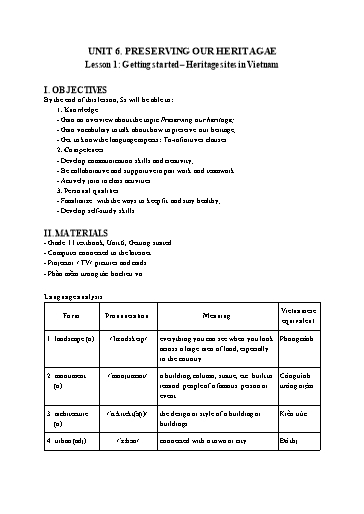
 5. promote (v) /prəˈməʊt/ to help something to happen or Đẩy mạnh,
 develop phát triển
 Assumption
 Anticipated difficulties Solutions
 - Encourage students to work in pairs and in groups so
 Students are reluctant to work in
 that they can help each other.
 groups.
 - Provide feedback and help if necessary.
 - Explain expectations for each task in detail.
 - Continue to explain task expectations in small
 chunks (before every activity).
 Students may lack vocabulary to deliver
 - Provide vocabulary and useful language before
 a speech
 assigning tasks
 - Encourage students to work in groups so that they
 can help each other.
 III. PROCEDURES
 1. WARM-UP (5 mins)
 a. Objectives:
 - To stir up the atmosphere and activate students’ knowledge on the topic of heritage sites;
 - To set the context for the listening and reading part;
 - To enhance students’ skills of cooperating with teammates.
 b. Content:
 - Game: Name the places.
 c. Expected outcomes:
 - Students can name some famous destinations in Vietnam.
 d. Organisation
 TEACHER’S AND STUDENTS’ ACTIVITIES CONTENTS
GAME: NAME THE PLACES Suggested pictures:
- Ss work in 2 groups. 1. Tam Chuc Pagoda
- Teacher shows pictures on the screen and Ss have to 2. Trang An Scenic Landscape Complex.
say BINGO to grasp the chance to answer where it is. 3. Hoi An Ancient Town
- One point for each correct answer. 4. Mekong River Delta
- The group which gains most points is the winner of the 5. Thang Long Imperial Citadel
game. - Teacher reveals that these five words will appear in the
reading text and asks students to open their textbook to
discover further.
 e. Assessment
 - Teacher checks students’ pronunciation and gives feedback.
 - Teacher observes Ss’ writing of vocabulary on their notebooks.
 3. ACTIVITY 2: PRACTICE (20 mins)
 a. Objectives:
 - To help students get to know the topic.
 - To introduce words and phrases related to heritage sites.
 - To help Ss identify the To-infinitives clauses.
 b. Content:
 - Task 1. Listen and read (p.66)
 - Task 2. Where can we do the following? Write T for Trang An, H for Hoi An and M for
 Mekong River Delta. (p.67)
 - Task 3. Match the words to make phrases used in Task 1 (p.67)
 - Task 4. Complete the sentences, using phrases from Task 1. (p.67)
 c. Expected outcomes:
 - Students can thoroughly understand the content of the text and complete the tasks
 successfully.
 d. Organisation
TEACHER’S AND STUDENTS’ ACTIVITIES CONTENTS
Task 1. Listen and read. (5 mins)
- Teacher puts Ss in groups. Draw a mind map on
 dance festivals
the board and write Heritage in the middle. Elicit
some sub-categories of the topic, e.g. traditions,
buildings, literature, natural sites, and write them traditions buildings
on the branches of the mind map. Have groups
brainstorm words related to each one, e.g. performances ceremonies
traditions: festivals, dance, performances, and
ceremonies.
 HERITAGE
- Call on some groups to write their words in the
mind map on the board.
- Teacher introduces the context of the conversation
(A group of international students, including Peter literature natural sites
and Anna, are discussing the destinations for their
upcoming field trip). read an adjective and another student to say the
noun that goes with it.
Task 4. Complete the sentences, using phrases from Task 1. (5 mins)
- Teacher has Ss read each incomplete sentence.
Check understanding and elicit the clause that they Answer key:
need to use to fill in the gaps. 1. to be recognized as a mixed heritage by
- Teacher asks Ss to find the clauses in the UNESCO
conversation and fill in the gaps. 2. to enjoy beautiful landscape
 3. to learn about Vietnamese history
- Teacher checks answers as a class. Call on 4. to promote Don ca Tai Tu to wider audience
individual Ss to read the complete sentences.
 e. Assessment
 - Teacher observation on Ss’ performance.
 - Teacher’s feedback and peers’ feedback.
 4. ACTIVITY 3: PRODUCTION (10 mins)
 a. Objectives:
 - To help Ss practice speaking skills;
 - To help Ss memorize the information about heritage sites in Vietnam that they have learnt
 in the lesson.
 b. Content:
 - Role play
 c. Expected outcomes:
 - Students can give a short introduction about heritage sites in Vietnam.
 d. Organisation
 TEACHER’S AND STUDENTS’ ACTIVITIES CONTENTS
Task 5. Role play
- Teacher asks Ss to work in 3 groups. Each group will Students’ own creativity.
come from one place: Trang An (Ninh Binh), Hoi An
(Quang Nam), Mekong River Delta.
- Each group has to prepare an introduction about their
home land (Where is it? What is the most special thing
about their home land? What can visitors do there?)
- Ss have 3 minutes to prepare for the role play.
- Teacher invites one representative from each group to
come to the stage and make a short presentation. UNIT 6: PRESERVING OUR HERITAGE
 Lesson 2: Language
I. OBJECTIVES
By the end of this lesson, Ss will be able to:
 1. Knowledge
 - Use the lexical items related to the topic Preserving our heritage;
 - Revise intonation in statements, commands and lists;
 - Review and practise the use of to-infinitive clauses.
 2. Core competence
 - Be collaborative and supportive in pair work and team work;
 - Access and consolidate information from a variety of sources;
 - Actively join in class activities.
 3. Personal qualities
 - Be ready to have a healthy lifestyle;
 - Develop self-study skills.
II. MATERIALS
- Grade 11 textbook, Unit 6, Language
- Computer connected to the Internet
- Projector / TV/ pictures and cards
- Phần mềm tương tác hoclieu.vn
Language analysis
 A to-infinitive clause can be used:
1. to express purpose E.g: He studied hard to pass the exam.
 I bought some souvenirs to give to my
 parents.
2. to modify a noun or noun phrase that E.g. Ethan is usually the last person to
contain ordinal numbers (the first, the understand the joke.
second, etc.), superlatives (the best, the most
beautiful, etc.) and next, last, and only.
Assumption
 Anticipated difficulties Solutions
 - Encourage students to work in pairs and in groups so
 Students are reluctant to work in that they can help each other.
 groups.
 - Provide feedback and help if necessary. 2. ACTIVITY 1: PRONUNCIATION (12 mins)
 a. Objectives:
 - To help Ss revise intonation in statements, commands and lists;
 - To help Ss practise intonation in statements, commands and lists.
 b. Content:
 - Task 1: Listen and repeat. Pay attention to the falling intonation and level-rising intonation
 in the following sentences. (p.67)
 - Task 2: Listen and mark the intonation in these sentences, using falling intonation or level-
 rising intonation. Then practise saying them in pairs. (p.68)
 c. Expected outcomes:
 - Students can put correct intonation in statements, commands and lists.
 d. Organisation
 TEACHER’S AND STUDENTS’ ACTIVITIES CONTENTS
Task 1: Listen and repeat. Pay attention to the falling intonation and level-rising intonation in the
following sentences. (5 mins)
- Teacher plays the recording and asks Ss to listen and Audio script – Track 45:
repeat after each sentence, paying attention to intonation 1. Our class is going on a field trip
in the sentences. Play the recording as many times as next week. ↘
necessary. 2. Put your rubbish in the bin! ↘
 3. You can see beautiful caves ↗,
- Focus attention on the way the intonation patterns are green valleys ↗, and mountains. ↘
used (We usually use a falling intonation at the end of
statements and commands. When listing things, we
slightly raise our voice on each item (level-rising) and
lower our voice on the last item to show that the list is
complete.).
- Teacher puts Ss into pairs and has them practise reading
the sentences to each other as naturally as they can.
Task 2: Listen and mark the intonation in these sentences, using falling intonation or level-rising
intonation. Then practise saying them in pairs. (7 mins)
- Teacher puts Ss into pairs and has them read out the Answer key:
sentences to each other as naturally as possible. 1. Hoi An Ancient Town became a
- Teacher reminds Ss to raise or lower their voice at the world heritage site in 1999 ➘.
right words. 2. Please turn on the light ➘. It’s dark
 in here. ➘
- Teacher has Ss mark the changes in intonation in the
 3. Cultural heritage may include
sentences individually.
 temples ➚, pagodas ➚ and
- Teacher has Ss compare their answers in pairs. Check monuments. ➘
answers as a class. adjective and the context (novels set in World War Two)
suggests “historical” is the best choice here.
- Teacher asks some Ss to read the complete sentences.
Extension: Divide Ss into two teams. Have each team come up
with a sentence with each of the target words. Have teams take
turns reading out their sentences while a student from the other
team race to write it down on the board. Give a time limit of 20
seconds for each sentence. Check all the sentences at the end.
The winner is the team with five correct sentences or most
correct words.
 e. Assessment
 - Teacher observation on Ss’ performance.
 - Teacher’s feedback and peers’ feedback.
 4. ACTIVITY 3: GRAMMAR (13 mins)
 a. Objectives:
 - To help Ss understand the use of to-infinitive clauses;
 - To help Ss practise the use of to-infinitive clauses.
 b. Content:
 - Task 1. Combine the sentences using to-infinitive clauses (p.68)
 - Task 2. Work in pairs. Ask and answer questions about heritage sites of traditions, using to-
 infinitive clauses. (p.68)
 c. Expected outcomes:
 - Students know how to use To-infinitive clauses and can apply it to make a conversation on
 the given topic.
 d. Organisation
 TEACHER’S AND STUDENTS’ ACTIVITIES CONTENTS
Task 1. Combine the sentences using to-infinitive clauses (6 mins)
- Teacher tells Ss to look at the Remember! box and Answer key:
introduces the use of a to-infinitive clause. 1. Lan went to Hue to see the monuments
 there.
- In stronger classes, explain that a to-infinitive clause can be
 2. Minh created a website to give more
used in other structures and have other functions, but this unit
 information about local historic sites to
only focuses on two uses: to express purpose and to modify a visitors.
noun or noun phrase. 3. Peter took a boat trip around the
- Teacher asks Ss to work in pairs or individually to combine floating market to listen to Cai Luong
the sentences. there.
 4. My sister opened a small shop behind
- Teacher calls on some Ss to write the sentences on the board. the museum to sell postcards and
 souvenirs to tourists. - Task 2: Listen and mark the intonation in these sentences, using falling intonation or
level-rising intonation. Then practise saying them in pairs.
* Vocabulary
- Task 1: Match the words with their meanings
- Task 2. Complete the sentences using the words in Task 1
* Grammar
- Task 1. Combine the sentences using to-infinitive clauses
- Task 2. Work in pairs. Ask and answer questions about heritage sites of traditions,
using to-infinitive clauses.
*Homework 5. keen (adj) /kiːn/ [usually before noun] strong or deep Mạnh mẽ,
 sâu sắc
 Assumption
 Anticipated difficulties Solutions
 1. Students may lack knowledge about Provide students with the meaning and pronunciation
 some lexical items. of words.
 - Let students read the text again (if necessary).
 - Create a comfortable and encouraging environment
 2. Students may have underdeveloped
 for students to speak.
 reading, speaking and co-operating
 - Encourage students to work in pairs, in groups so
 skills.
 that they can help each other.
 - Provide feedback and help if necessary.
 III. PROCEDURES
 1. WARM-UP (5 mins)
 a. Objectives:
 - To stir up the atmosphere and activate students’ knowledge on the topic of heritage site;
 - To set the context for the reading part;
 - To enhance students’ skills of cooperating with teammates.
 b. Content:
 - Brainstorming: What can we do to protect our heritage?
 c. Expected outcomes:
 - Students can find out as many as ideas as possible to protect the heritage.
 d. Organisation
TEACHER’S AND STUDENTS’ ACTIVITIES CONTENTS
 BRAINSTORMING Suggested ideas
- Teacher divides the class into 4 groups. - Organize nature walks/excursions to local parks,
- Teacher gives each group a big piece of paper. areas of bio-diversity
Ask them to work in groups and write down as - Organize site visits to museums, interpretation
many ideas as possible for the questions: What centres, and archaeological sites
can we do to protect our heritage? - Organize essay competitions on literature (in
- Students have 3 minutes to discuss and write. English and local languages)
- All groups stick their paper on the board. - Carry out small research projects for students
- Teacher checks the answers. that can be put up as mini-exhibitions/bulletin
- The group with the most ideas will be the board displays on heritage.
winner. - Involve students in documenting local living
 heritage like festivals, performing arts or
 craftsmen and women.
File đính kèm:
- ke_hoach_bai_day_tieng_anh_lop_11_global_success_unit_6_pres.docx
