

Kế hoạch bài dạy Tiếng Anh Lớp 11 Global Success theo CV5512 - Unit 7: Education options for school leavers
 51 trang
10/10/2025
2575
51 trang
10/10/2025
2575
Bạn đang xem 30 trang mẫu của tài liệu "Kế hoạch bài dạy Tiếng Anh Lớp 11 Global Success theo CV5512 - Unit 7: Education options for school leavers", để tải tài liệu gốc về máy hãy click vào nút Download ở trên.
Tóm tắt nội dung tài liệu: Kế hoạch bài dạy Tiếng Anh Lớp 11 Global Success theo CV5512 - Unit 7: Education options for school leavers
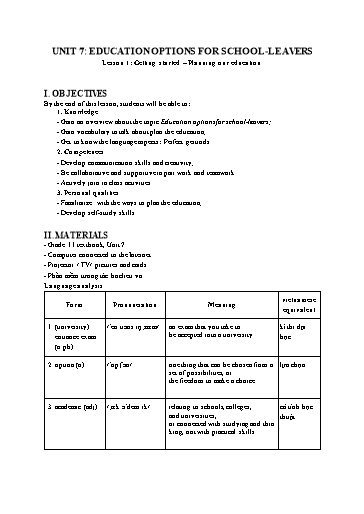
 4. vocational (adj) /vəʊˈkeɪ.ʃən.əl/ (of an educational course or thuộc về
 a qualification) providing knowled nghề nghiệp
 ge and skills that prepare you for
 a particular job
 5. mechanic (n) /məˈkổn.ɪk/ someone whose job is repairing the thợ sửa mỏy
 engines of vehicles and other
 engines
 6. sensible (adj) /ˈsen.sə.bəl/ based on or acting on hợp lý
 good judgment and practical ideas
 or understanding
 Assumption
 Anticipated difficulties Solutions
 Students may find the lesson boring due - Encourage students to work in pairs and in groups
 to a large number of language so that they can help each other.
 exercises. - Provide feedback and help if necessary.
 - Explain expectations for each task in detail. Have
 Some students will excessively talk in excessive talking students practice.
 the class. - Continue to explain task expectations in small
 chunks (before every activity).
 III. PROCEDURES
 1. WARM-UP (5 mins)
 a. Objectives:
 - To stir up the atmosphere and activate students’ knowledge on the topic of Education
 options for school-leavers;
 - To set the context for the listening and reading part;
 - To enhance students’ skills of cooperating with teammates.
 b. Content:
 - Guessing game: Guess the name of famous universities in Vietnam
 c. Expected outcomes:
 - Students can distinguish healthy and unhealthy activities
 d. Organisation
 TEACHER’S AND STUDENTS’ ACTIVITIES CONTENTS
GUESSING GAME Lists of university: b. Content:
 - Task 1: Listen and read (p.76)
 - Task 2. Read the conversation again. Decide whether the following statements are true (T)
 or false (F). (p.77)
 - Task 3. Find phrases in the conversation that mean the following. (p.77)
 - Task 4. Complete the sentences using phrases from the conversation. (p.77)
 c. Expected outcomes:
 - Students can thoroughly understand the content of the text and complete the tasks
 successfully.
 d. Organisation
TEACHER’S AND STUDENTS’ ACTIVITIES CONTENTS
Task 1. Listen and read. (5 mins)
- Teacher asks Ss to look at the pictures in the
book as well as the dialogue and answer the
questions.
- Ss answer the questions in pairs.
- Teacher plays the recording twice. Ss listen and
read.
 Questions:
- Teacher checks Ss’ prediction. T calls 2 Ss to
 - What can you see?
read the conversation aloud.
 - What’s in Mai’s thought bubble?
 - What can you see in Nam’s thought bubble?
 Suggested answers:
 - A female teacher and her students/Ms Hoa and
 her students, including Nam and Mai.
 - Mai doing a science experiment.
 - Nam repairing a car engine.
Task 2. Read the conversation again. Decide whether the following statements are true (T) or
false (F). (5 mins)
- Teacher tells Ss to read the conversation again
and work independently to find the answers. Answer key:
Remind Ss to underline the information and 1. F
correct the false statements. 2. T
- Ss work independently to find the answers. 3. T
- Teacher has Ss compare the answers in pairs 4. F
before checking with the whole class.
- Teacher checks the answers as a class and gives
feedback.
Task 3. Find phrases in the conversation that mean the following. (5 mins) a. Objectives:
 - To help Ss practice speaking skills;
 - To help Ss memorize the basic knowledge on how to stay healthy.
 b. Content:
 - Role play
 c. Expected outcomes:
 - Students can give a short talk about good habits to stay healthy.
 d. Organisation
 TEACHER’S AND STUDENTS’ ACTIVITIES CONTENTS
Task 5. Role play
- Teacher asks Ss to work in groups. Students’ own creativity.
- In each group, one student plays the role of teacher and
others will be students
- Teacher asks the students about their plans after high
school and students will share their plans.
- Ss have 3 minutes to prepare for the role play.
- Teacher invites 1 or 2 groups to come to the stage and
do the role play.
- Teacher asks other groups to listen and give
comments.
- Teacher gives feedback and give marks to the best
group.
 e. Assessment
 - Teacher observation on Ss’ performance.
 - Teacher’s feedback and peers’ feedback.
 4. CONSOLIDATION (3 mins)
 a. Wrap-up
 - T asks Ss to talk about what they have learnt in the lesson.
 b. Homework
 - Write a short paragraph about how to keep fit and stay healthy.
 - Prepare for the project in Lesson 8
 Board Plan
 Date of teaching
 Unit 7: Education options for school-leavers
 Lesson 1: Getting started – Planning our education
 * Warm-up: Guessing game
 * Vocabulary UNIT 7: EDUCATION OPTIONS FOR SCHOOL-LEAVERS
 Lesson 2: Language
I. OBJECTIVES
By the end of this lesson, Ss will be able to:
 1. Knowledge
 - Use the lexical items related to the topic education after leaving school;
 - Recognise and practise intonation in Wh- and Yes/ No questions;
 - Review the use of Perfect gerunds and. Perfect participle clauses.
 2. Core competence
 - Be collaborative and supportive in pair work and team work;
 - Access and consolidate information from a variety of sources;
 - Actively join in class activities.
 3. Personal qualities
 - Understand about education after leaving school;
 - Develop self-study skills.
II. MATERIALS
- Grade 11 textbook, Unit 7, Language
- Computer connected to the Internet
- Projector / TV/ pictures and cards
- Phần mềm tương tỏc hoclieu.vn
Language analysis
Perfect gerunds
The perfect gerund (having done) always refers to a time before that of the verb in the main
clause. It is used to emphasise that the action was completed in the past.
It can be used as:
• the subject of a sentence.
Example: Having studied science subjects made it easy for me to choose a university
degree.
• an object after some verbs, e.g. admit, deny, forget, mention, regret, and remember or
after prepositions.
Example: My friend didn’t remember having lent me his English textbook.
 My cousin often talked about having studied for five years at a top university.
Perfect participle clauses
The perfect participle has the same form as the perfect gerund, e.g. having asked, having
studied.
We can use perfect participle clauses to:
• describe an action that happened before the action in the main clause.
Example: Having finished their course, they started looking for jobs.
• talk about the reason for the action in the main clause.
Example: Not having read the book, he can’t give us his opinion.
Assumption - Task 1: Listen and repeat. Pay attention to the falling or rising intonation in each of the
 following questions. (p.77)
 - Task 2: Listen and mark the intonation in these questions, using (rising intonation) or (falling
 intonation). Then practise saying them in pairs. (p.77)
 c. Expected outcomes:
 - Students can practise intonation in wh- and yes/no questions.
 d. Organisation
 TEACHER’S AND STUDENTS’ ACTIVITIES CONTENTS
Task 1: Listen and repeat. Pay attention to the falling or rising intonation in each of the following
questions. (5 mins)
- Teacher asks Ss to listen to the recording. Have them pay Audio script:
attention to the rising or falling intonation in the given
sentences. 1. Did anyone go?
- Teacher asks Ss to work in pairs and take turns to read 2. Would you like to share some of it with
the sentences with correct intonation. the class?
- Teacher checks the answers as a class. 3. What are your plans for the future?
- Teacher has Ss read the explanation in the Remember!
box Ask questions to check understanding of the use of 4. When does the course start?
rising and falling intonation in Wh- and Yes/No questions.
Task 2: Listen and mark the intonation in these questions, using (rising intonation) or (falling
intonation). Then practise saying them in pairs. (5 mins)
 Answer key:
- Teacher asks Ss to listen to the Wh- and Yes/No
questions and mark the correct intonation pattern (rising 1. Do you want to go to university?
or falling) at the end of each question.
 2. Have you talked with your parents about
- Teacher plays the recording several times, if necessary, your plans?
pause after each sentence for Ss to repeat.
 3. How much does it cost to study at
- Teacher checks answers as a class. university?
- Teacher puts Ss into pairs and have them practise saying 4. What’s your favourite subject at school?
these questions. Walk round the class, praising pairs for
good effort and using the appropriate intonation pattern.
Extension: In stronger classes, put Ss into groups and
have each group write three Wh-questions and three
Yes/No questions. Invite each group to read out their
questions in front of the class. Have the other groups say
if they use the appropriate intonation.
 e. Assessment
 - Teacher checks students’ pronunciation and gives feedback.
 - Students in class listen and give feedback on their friends’ performance. institutions or vocational education
 institutions. These students believe that
 with the right qualifications from these
 institutions, they will have a better
 chance of getting good jobs after
 graduation.
 e. Assessment
 - Teacher observation on Ss’ performance.
 - Teacher’s feedback and peers’ feedback.
 4. ACTIVITY 3: GRAMMAR (15 mins)
 a. Objectives:
 - To help Ss recognise the difference between Modal verbs: must, have to, and should.
 - To help Ss practise Modal verbs: must, have to, and should.
 b. Content:
 - Task 1. Find and correct the mistakes in the following sentences. (p.78)
 - Task 2. Rewrite these sentences using perfect participle clauses. (p.79)
 - Task 3. Work in pairs. Make sentences, using perfect gerunds and perfect participle clauses. (p.79)
 c. Expected outcomes:
 - Students know how to use the past simple or the present perfect and can apply it to give a
 short talk on the given topic.
 d. Organisation
 TEACHER’S AND STUDENTS’ ACTIVITIES CONTENTS
Task 1. Find and correct the mistakes in the following sentences. (5 mins)
 Answer key:
- Teacher asks Ss to look at the Remember! box and read the
rules for using perfect gerunds. Check understanding by 1. I forgot have discussed this topic with
asking, e.g. Which verbs are often followed by a perfect you. having
gerund? (admit, deny, forget, and remember); Can a perfect
 2. Had won many maths competitions
gerund be used as a subject / an object? (Yes); What are the
 helped me to win a place at university.
similarities between gerunds and perfect gerunds?(They both
can be used as subjects and objects); What are the differences Having
between gerunds and perfect gerunds? (Their forms; perfect 3. Nam regretted not having choose a
gerunds refer to the actions that were completed in the past) more interesting course at university.
- Teacher tells Ss to work in pairs or individually to complete chosen
the activity.
 4. He was proud of had won the first place
- Teacher checks answers as a class. at the Biology Olympiad. having
- Extension: Write more sentences with mistakes in using
perfect gerunds on the board and have Ss correct them in Date of teaching
 Unit 7: Education options for school-leavers
 Lesson 2: Language
*Warm-up
 Watch a video
* Pronunciation
- Task 1: Listen and repeat. Pay attention to the falling or rising intonation in each of the
following questions. (p.77)
- Task 2: Listen and mark the intonation in these questions, using (rising intonation) or
(falling intonation). Then practise saying them in pairs. (p.77)
* Vocabulary
- Task 1: Match the words and phrases with their meanings. (p.78)
- Task 2. Complete the sentences using the correct forms of the words and phrases in 1.
(p.78)
* Grammar
- Task 1. Find and correct the mistakes in the following sentences. (p.78)
- Task 2. Rewrite these sentences using perfect participle clauses. (p.79)
- Task 3. Work in pairs. Make sentences, using perfect gerunds and perfect participle clauses.
(p.79)
*Homework 4. salary (n) /ˈsổl.ər.i/ a fixed amount of money agreed every lương thỏng
 year as pay for an employee,
 usually paid directly into his or
 her bank account every month
 Assumption
 Anticipated difficulties Solutions
 1. Students may lack knowledge about Provide students with the meaning and pronunciation
 some lexical items. of words.
 - Let students read the text again (if necessary).
 - Create a comfortable and encouraging environment
 2. Students may have underdeveloped
 for students to speak.
 reading, speaking and co-operating
 - Encourage students to work in pairs, in groups so
 skills.
 that they can help each other.
 - Provide feedback and help if necessary.
 III. PROCEDURES
 1. WARM-UP (5 mins)
 a. Objectives:
 - To activate Ss’ background knowledge about the topic and get Ss involved in the lesson;
 - To set the context for the reading part;
 - To enhance students’ skills of cooperating with teammates.
 b. Content:
 - Answer the questions
 c. Expected outcomes:
 - Students can talk about the options after leaving school.
 d. Organisation
 TEACHER’S AND STUDENTS’ CONTENTS
 ACTIVITIES
Task 1: Answer the questions
- Teacher asks Ss look at the pictures of a
university student and a vocational school
student. Have them to work in pairs and discuss
which of the two options is more common in the
area they live in.
- Teacher encourages Ss to think of other A vocational school A university student
 student
File đính kèm:
- ke_hoach_bai_day_tieng_anh_lop_11_global_success_unit_7_educ.docx
