

Kế hoạch bài dạy Tiếng Anh Lớp 11 Global Success theo CV5512 - Unit 9: Social issues
 49 trang
10/10/2025
2844
49 trang
10/10/2025
2844
Bạn đang xem 30 trang mẫu của tài liệu "Kế hoạch bài dạy Tiếng Anh Lớp 11 Global Success theo CV5512 - Unit 9: Social issues", để tải tài liệu gốc về máy hãy click vào nút Download ở trên.
Tóm tắt nội dung tài liệu: Kế hoạch bài dạy Tiếng Anh Lớp 11 Global Success theo CV5512 - Unit 9: Social issues
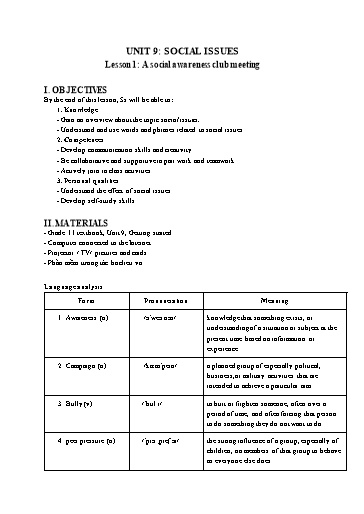
 5. body shaming (n) /ˈbɒd.i ˌʃeɪ.mɪŋ/ criticism of someone based on the shape, size,
 or appearance of their body
 Assumption
 Anticipated difficulties Solutions
 - Encourage students to work in pairs and in groups so
 Students are reluctant to work in
 that they can help each other.
 groups.
 - Provide feedback and help if necessary.
 - Explain expectations for each task in detail.
 - Continue to explain task expectations in small
 chunks (before every activity).
 Students may lack vocabulary to deliver
 - Provide vocabulary and useful language before
 a speech
 assigning tasks
 - Encourage students to work in groups so that they
 can help each other.
 III. PROCEDURES
 1. WARM-UP (5 mins)
 a. Objectives:
 - To stir up the atmosphere and activate students’ knowledge on the topic of social issue.
 - To set the context for the listening and reading part.
 - To enhance students’ skills of cooperating with teammates.
 b. Content:
 - Quiz: Multiple choice.
 c. Expected outcomes:
 - Students can have an overview of global warming.
 d. Organisation
 TEACHER’S AND STUDENTS’ ACTIVITIES CONTENTS
QUIZ List of answers:
- Teacher shows the quiz. 1. Homelessness
- Ss work in 4 groups. Each group raise hands to take 2. Climate change
turn and answer the multiple-choice questions. The team 3. School violence/ bullying
gains bonus with every correct answer. 4. Childhood obesity
- The team with highest points is the winner.
 e. Assessment - Ask Ss to open their books. Students’ performance.
- Ask Draw Ss’ attention to the illustration  Ask
Ss to skim through the conversation and ask, e.g.
Who are the speakers? (Nam, Mai and Mark)
What do you think they are discussing? (Social
issues).
- Play the recording twice for Ss to listen and read
silently along. Have Ss underline words / phrases
related to social issues.
- Put Ss in pairs and ask them to compare the
words and phrases they have underlined and
discuss their meaning. Then check comprehension
as a class.
- Call on two or three pairs of Ss to read the
conversation aloud.
Task 2. . Who suggests the following ideas? Tick (✓ ) the correct box. (5 mins)
- Ask Ss to read the conversation again.
- Ask Ss to identify and underline the key words Answer key:
in the statements in the tables. Then have them 1. Mai
read the conversation again and locate the part that 2. Nam
contains information about each statement. Have 3. Mark/Nam
them compare the information with each statement
in the table.
- Have Ss work in pairs to discuss and compare
their answers.
- Check answers as a class.
Task 3. Find five social issues in 1. use the pictures and hints below to help you. (5 mins)
- Have Ss look at the pictures and the first letters
of the missing words. Explain that these words are Answer key:
related to social issues and they are all in the 1. poverty 2. crime 3. overpopulation 4. bullying
conversation in Activity 1. 5. peer pressure 6. body shaming
- Ask Ss to write down the words.
- Check answers as a class.
- Explain the meaning of any words Ss don’t know
or find hard to understand, e.g. What is peer
pressure? (Pressure from people of your age or
social group to behave like them to be liked or
accepted)
Task 4. Complete the summary with words from task 1. (p.101). (5 mins)
- Tell Ss to read the summary.
 Answer key: - Put Ss into groups and have them choose their group
leader. Then ask them to assign tasks for each group
member, making sure that all group members contribute
to the project work.
- Help Ss set deadlines for each task and support them
throughout the process.
- In each of the next lessons, help Ss work on the
structure of their presentation. Encourage them to
prepare some notes to refer to when they speak.
- Ss practice their presentation in their group for 5-10
minutes. Encourage groups to meet after classes for
further practice so that they can be well-prepared for
their group presentations in the last lesson.
 e. Assessment
 - Teacher observation on Ss’ performance.
 - Teacher’s feedback and peers’ feedback.
 4. CONSOLIDATION (3 mins)
 a. Wrap-up
 - T asks Ss to talk about what they have learnt in the lesson.
 b. Homework
 - Prepare for the next lesson
 Board Plan
 Date of teaching
 UNIT 9: SOCIAL ISSUES
 Lesson 1: A social awareness club meeting
 *Warm-up
 * Vocabulary
 1. Awareness (n)
 2. Campaign (n)
 3. Bully (v)
 4. peer pressure (n)
 5. body shaming (n)
 - Task 1: Listen and read (p.100)
 - Task 2. Who suggests the following ideas? Tick (✓ ) the correct box. (p.101) UNIT 9: SOCIAL ISSUES
 Lesson 2: Language
I. OBJECTIVES
By the end of this lesson, Ss will be able to:
 1. Knowledge
 - Use intonation appropriately to speak with a natural rhythm.
 - Understand and use words and phrases related to social issues.
 - Use linking words and phrases correctly.
 2. Core competence
 - Be collaborative and supportive in pair work and team work;
 - Access and consolidate information from a variety of sources;
 - Actively join in class activities.
 3. Personal qualities
 - Understand how to use intonation in choice questions.
 - Develop self-study skills.
II. MATERIALS
- Grade 11 textbook, Unit 9, Language
- Computer connected to the Internet
- Projector / TV/ pictures and cards
- Phần mềm tương tỏc hoclieu.vn
Language analysis
 Intonation in choice questions
Choice questions are questions that include a list of
choices. Each choice mentioned before the word ‘or’ has
rising intonation at the end, while the last one has falling
intonation at the end.
We use linking words and phrases to connect ideas, clauses, or sentences.
Below are some common linking words and phrases:
To add ideas and information Besides (this/that),
 Moreover,
 In addition (to + noun or gerund),
To contrast ideas However,
 Although ,
 In spite of/ Despite (noun or gerund),
 By contrast,
To give reasons Because ,
 Because of (noun or gerund),
 As/Since , . TEACHER’S AND STUDENTS’ ACTIVITIES CONTENTS
Listen & Answer Answers:
- Students work in 4 groups. 1. Thanks- really
- Ss will hear and find the words/ phrases with raised 2. Train- ten
voice in 3 sentences below. 3. You- your sister- always argue
- Raise your hands to get turn and answer.
 e. Assessment
 - Teacher observes the groups and give feedback.
 2. ACTIVITY 1: PRONUNCIATION (12 mins)
 a. Objectives:
 - To help Ss recognise and practise the intonation in choice questions..
 b. Content:
 - Task 1: Listen and repeat. Pay attention to the intonation. Practise saying the questions in
 pairs. (p.101)
 - Task 2: Mark the intonation in these questions. Then listen and check. Practise saying them
 in pairs. (p.101)
 c. Expected outcomes:
 - Students can speak with a natural rhythm.
 d. Organisation
 TEACHER’S AND STUDENTS’ ACTIVITIES CONTENTS
Task 1: Listen and repeat. Pay attention to the intonation. Practise saying the questions in pairs.
(5 mins)
- Tell Ss that they are going to listen to some sentences Students’ performance
from Getting started.
- Play the recording and have Ss pay attention to the
rising tone and the falling tone in each intonation pattern.
- Play the recording again and have Ss repeat.
- Ask Ss to read the notes in the Remember! box. Check
understanding by asking individual Ss to list the choices
before and after the word ‘or’ in each question.
- Ss practise saying the questions in pairs.
Task 2: Mark the intonation in these questions. Then listen and check. Practise saying them in
pairs. (7 mins)
- Ask Ss to read quickly through the sentences. Check Answer key:
understanding. 1. Is peer pressure good ↗or bad↘?
- Have Ss work in pairs to take turns to read each
sentence aloud. Ask them to pay attention to the rising 2. Is this a social ↗or environmental
and falling tones on the choices. issue↘?
- Ask Ss to mark the falling and rising tones in each
question. - Tell Ss to read the sentences carefully and decide which Answer key:
word in Activity 1 can be used to complete each of the 1. alcohol 2. bullied 3. drugs 4. violent
sentences. Tell them to change the forms of some words if 5. campaign
necessary.
- Check answers as a class. Confirm the correct answers.
- Ask some Ss to read the complete sentences.
 e. Assessment
 - Teacher observation on Ss’ performance.
 - Teacher’s feedback and peers’ feedback.
 4. ACTIVITY 3: GRAMMAR (13 mins)
 a. Objectives:
 - To help Ss recognise different types of linking words or and phrases.
 - To help Ss practise using linking words/phrases.
 b. Content:
 - Task 1. Connect these sentences, using linking words or phrases. (p.102)
 - Task 2. Work in pairs. add more sentences to each item. use different linking words and/or
 phrases. (p.102)
 c. Expected outcomes:
 - Students know how to use linking words/phrases in sentences.
 d. Organisation
 TEACHER’S AND STUDENTS’ ACTIVITIES CONTENTS
Task 1. Connect these sentences, using linking words or phrases. (6 mins)
- Encourage Ss to study the Remember! box. Tell them that Answer key:
there are several types of linking words/phrases with different 1. b 2. c 3. a 4. d
meanings (i.e. to add ideas, to contrast ideas, to give reasons,
and to show results) and sentence structure (i.e. some
words/phrases are followed by a clause, while others are
followed by nouns or gerunds; some are used to connect two
dependent clauses of a sentence, while others can be used to
connect two sentences or independent clauses). Give some
examples to illustrate these differences.
- Ask Ss to match the two parts to link the sentences. Tell them
to pay attention to the meaning of each linking word/phrase
and the relationship between the parts of the sentences, e.g. 1.
“moreover” indicates an addition of ideas and information.
- Check answers as a class. Go through each item and ask Ss
to explain why they linked the two sentences or clauses, e.g.
1. 1 goes with b because b adds more ideas (that victims of
bullying often prefer to be silent) to 1. UNIT 9: SOCIAL ISSUES
 Lesson 3: Reading- Peer pressure
I. OBJECTIVES
By the end of this lesson, Ss will be able to:
 1. Knowledge
 - Read for main ideas and specific information in an article about peer pressure.
 2. Competences
 - Develop communication skills and creativity;
 - Be collaborative and supportive in pair work and teamwork;
 - Develop presentation skills;
 - Actively join in class activities.
 3. Personal qualities
 - Acknowledge and understand more about the effect of peer pressure.
 - Develop self-study skills.
II. MATERIALS
- Grade 11 textbook, Unit 9, Reading
- Computer connected to the Internet
- Projector / TV/ pictures and cards
- Phần mềm tương tỏc hoclieu.vn
Language analysis
 Form Pronunciation Meaning
1. Depression (n) /dɪˈpreʃ.ən/ the state of feeling very unhappy and without
 hope for the future
2. self-confidence (n) /ˌselfˈkɒn.fɪ.dəns/ the belief that you can do things well and that
 other people respect you
3. Smoker (n) /ˈsməʊ.kər/ someone who smokes tobacco regularly
4. hang out /ˈhổŋ ˈaʊt/ to spend a lot of time in a place or with someone
Assumption
 Anticipated difficulties Solutions
 1. Students may lack knowledge about Provide students with the meaning and pronunciation
 some lexical items. of words. - Task 1. Work in pairs. Discuss the question. (p.103)
 c. Expected outcomes:
 - Students can use key language more appropriately before they read.
 d. Organisation
 TEACHER’S AND STUDENTS’ ACTIVITIES CONTENTS
Task 1. Work in pairs. Discuss the question. (5 mins)
 Student’s performance
- Ask Ss to work in pairs and discuss the questions.
- Have some Ss share their answers with the whole class.
- Lead in to the topic of the reading text by explaining
that these acts of making friends do things they do not
like are examples of (i.e. Peer pressure).
Vocabulary pre-teaching (5 mins)
- Teacher introduces the vocabulary. New words:
- Teacher explains the meaning of the new vocabulary 1. Depression (n)
by pictures. 2. self-confidence (n)
- Teacher checks students’ understanding with the “Rub 3. Smoker (n)
out and remember” technique. 4. hang out
- Teacher reveals that these five words will appear in the
reading text and asks students to open their textbook to
discover further.
 e. Assessment
 - Teacher checks students’ pronunciation and gives feedback.
 - Teacher observes Ss’ writing of vocabulary on their notebooks.
 3. ACTIVITY 2: WHILE-READING (20 mins)
 a. Objectives:
 - To help Ss practise reading for main ideas in an article about peer pressure.
 b. Content:
 - Task 2. Read the article. match the highlighted words and phrase with their meanings.
 (p.103)
 - Task 3. Read the article again. Which paragraph contains the following information?
 Write A, B, or C. (p.103)
 - Task 4. Read the article again and choose the best answers A, B, or C. (p.104)
 c. Expected outcomes:
 - Students can thoroughly understand the content of the text and complete the tasks
 successfully
 d. Organisation
 TEACHER’S AND STUDENTS’ ACTIVITIES CONTENTS
File đính kèm:
- ke_hoach_bai_day_tieng_anh_lop_11_global_success_unit_9_soci.docx
