

Kế hoạch bài dạy Tiếng Anh Lớp 12 Global Success theo CV5512 - Review 4
 20 trang
29/11/2025
2010
20 trang
29/11/2025
2010
Bạn đang xem tài liệu "Kế hoạch bài dạy Tiếng Anh Lớp 12 Global Success theo CV5512 - Review 4", để tải tài liệu gốc về máy hãy click vào nút Download ở trên.
Tóm tắt nội dung tài liệu: Kế hoạch bài dạy Tiếng Anh Lớp 12 Global Success theo CV5512 - Review 4
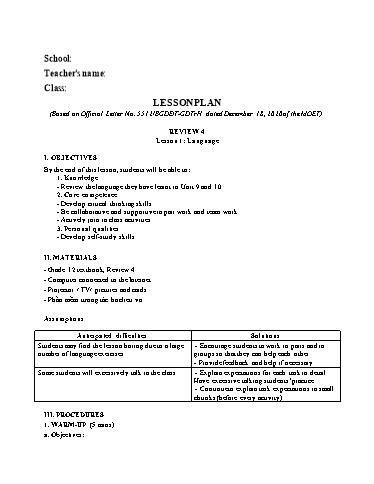
 - To revise the vocabulary related to the topic of Unit 9 and Unit 10.
 b. Content:
 - Miming game: Students guess the word using the clue given. The results are the words that they
 have learnt in 2 units.
 c. Expected outcomes:
 - Students can recall the important new words that they have learnt.
 d. Organisation
 TEACHER’S ACTIVITIES STUDENTS’ ACTIVITIES CONTENTS
MINI GAME: CATCH A WORD - Students raise hands and Answers:
- Divide 2 teams and tell students the answer the questions in their Automate, adapt, go in for,
rules of the game team. bullying, live up to, brush up,
- T shows the pictures to students adult education, complex
- Introduces the lesson
 e. Assessment
 - Teacher observes the groups and gives feedback.
 2. ACTIVITY 1: PRONUNCIATION (12 mins)
 a. Objectives:
 - To check if Ss can identify different sounds and provide further pronunciation practice.
 - To check if Ss can identify word stress and provide further pronunciation practice.
 - To help Ss review stressed words in a sentence.
 - To check whether Ss can identify the appropriate intonation pattern in different types of
 questions.
 b. Content:
 - Mark the letter A, B, C, or D to indicate the word whose underlined part differs from the other
 three in pronunciation. (p. 140)
 - Mark the letter A, B, C, or D to indicate the word which differs from the other three in the
 position of the main stress. (p. 140)
 - Underline the stressed words in the sentences. Listen and check. Then practise saying the
 sentences with a natural rhythm. (p. 140)
 - Circle the correct intonation pattern in the following questions. Listen and check. Then practice
 saying them in pairs. (p. 140)
 c. Expected outcomes:
 - Students understand the knowledge and do the task successfully.
 d. Organisation
 TEACHER’S ACTIVITIES STUDENTS’ ACTIVITIES CONTENTS
Mark the letter A, B, C, or D to indicate the word whose underlined part differs from the other three in
pronunciation. (3 mins) - Play the recording for Ss to listen,
pausing after each sentence to check the
answers with the whole class.
- Ask Ss to work in pairs to practise
saying these sentences.
 e. Assessment
 - Teacher checks students’ pronunciation and gives feedback.
 - Students in class listen and give feedback on their friends’ performance.
 3. ACTIVITY 2: VOCABULARY (12 mins)
 a. Objectives:
 - To help Ss review topic-related words and phrases from Units 9-10, and provide further
 vocabulary practice.
 b. Content:
 - Mark the letter A, B, C, or D to indicate the word or phrase CLOSEST in meaning to the
 underlined word or phrase. (p.140)
 - Mark the letter A, B, C, or D to indicate the word OPPOSITE in meaning to the underlined
 word. (p.140)
 - Read the following passage and mark the letter A, B, C, or D to indicate the
 correct word or phrase that best fits each of the numbered blanks from 1 to 8. (p.141)
 c. Expected outcomes:
 - Students understand the knowledge and do the task successfully.
 d. Organisation
 TEACHER’S ACTIVITIES STUDENTS’ ACTIVITIES CONTENTS
Mark the letter A, B, C, or D to indicate the word or phrase CLOSEST in meaning to the underlined
word or phrase. (4 mins)
- Ask Ss to do the activity individually. - Follow the instructions and Answer key:
Tell them to read and try to understand do the tasks. 1- A; 2- C; 3- D; 4- A
the meaning of each sentence.
- Tell Ss to replace the underlined word
with each of the words from four options.
If they are not sure about the meaning of
any word, tell them to skip it and focus
on the others. The words that change the
meaning of the sentence cannot be the
correct answers.
- Ask Ss to share their answers with the
whole class. a. Objectives:
 - To help Ss revise the uses of phrasal verbs consisting of a verb, an adverb and a preposition as
 well as reported speech to report orders, requests, offers, and advice.
 b. Content:
 - Mark the letter A, B, C, or D to indicate the underlined part that needs correction in each of the
 following sentences. (p. 141)
 - Mark the letter A, B, C, or D to indicate the correct answer. (p.141)
 - Mark the letter A, B, C, or D to indicate the reported sentence that is closest in meaning to each
 of the following direct speech sentences. (p.141)
 c. Expected outcomes:
 - Students understand the knowledge and do the task successfully.
 d. Organisation
 TEACHER’S ACTIVITIES STUDENTS’ ACTIVITIES CONTENTS
Task 1. Mark the letter A, B, C, or D to indicate the underlined part that needs correction in each of the
following sentences. (4 mins)
- Tell Ss to read the whole sentence and - Follow the instructions and Answer key:
focus on the underlined words/ phrases. do the tasks. 1-A → to;
- Check whether these underlined words/ 2-C → with;
phrases are grammatically correct or not 3-B → to give;
by studying both the underlined parts, the 4-C → put;
phrases and the sentences that contain 5-C → up;
these parts. 6-D → on
- If you're not sure about a choice, tell Ss
to skip it and focus on the others to see if
you can find the mistake in these choices
or not.
- Then have them compare answers and
correct the mistakes in pairs, before
confirming answers as a class.
Task 2. Mark the letter A, B, C, or D to indicate the correct answer. (4 mins)
- Ask Ss to read each sentence first and - Follow the instructions and Answer key:
check the meaning. do the tasks. 1.B; 2.A; 3. D; 4.A; 5. B; 6. C
- Tell Ss to identify the grammar point
needed for the gap by studying four
options.
- Tell Ss to eliminate the options that can
be grammatically incorrect. Board Plan
 Date of teaching
 REVIEW 4
 Lesson 1: Language
*Warm-up
 Mini game
* Pronunciation
- Mark the letter A, B, C, or D to indicate the word whose underlined part differs from the
other three in pronunciation. (p. 140)
- Mark the letter A, B, C, or D to indicate the word which differs from the other three in
the position of the main stress. (p. 140)
- Underline the stressed words in the sentences. Listen and check. Then practise saying the
sentences with a natural rhythm. (p. 140)
- Circle the correct intonation pattern in the following questions. Listen and check. Then
practice saying them in pairs. (p. 140)
* Vocabulary
- Mark the letter A, B, C, or D to indicate the word or phrase CLOSEST in meaning to the
underlined word or phrase. (p.140)
- Mark the letter A, B, C, or D to indicate the word OPPOSITE in meaning to the
underlined word. (p.140)
- Read the following passage and mark the letter A, B, C, or D to indicate the
correct word or phrase that best fits each of the numbered blanks from 1 to 8. (p.141)
* Grammar
- Mark the letter A, B, C, or D to indicate the underlined part that needs correction in each
of the following sentences. (p. 141)
- Mark the letter A, B, C, or D to indicate the correct answer. (p.141)
- Mark the letter A, B, C, or D to indicate the reported sentence that is closest in meaning
to each of the following direct speech sentences. (p.141)
*Homework - To practise listening for main ideas
 - To practise listening for specific information
 b. Content:
 - Task 1. Listen to a talk about lifelong learning. Which of the following is NOT mentioned as a
 reason for lifelong learning? (p.142)
 - Task 2. Listen again and complete the following notes with no more than THREE words for
 each gap. (p.142)
 c. Expected outcomes:
 - Students can understand the skills and solve the exercises successfully.
 d. Organisation
 TEACHER’S ACTIVITIES STUDENTS’ ACTIVITIES CONTENTS
Task 1. Listen to a talk about lifelong learning. Which of the following is NOT mentioned as a reason
for lifelong learning? (10 mins)
- Focus Ss’ attention on three options. - Follow the instructions and Answer key:
Tell them that here can be the reasons for do the tasks. B
lifelong learning.
- Tell Ss that they are going to hear a talk
about lifelong and choose the one that is
NOT mentioned in the talk.
- Play the recording and encourage Ss to
note down as much information as
possible in their notebooks.
- Call on some Ss to share their
information. Ask Ss to eliminate the
options that are mentioned in the talk.
- Confirm the correct answer. Ask Ss to
give the clues that help them work out
the answer.
Task 2. Listen to the talk show again. Choose the correct answers A, B, or C. (10 mins)
- Ask Ss to look at the sentences and - Follow the instructions and Answer keys:
underline the key words. Tell them to do the tasks. 1) pursuit of knowledge; 2) AI 3)
decide which part of speech needed to fill obsolete 4) high-skilled jobs 5)
in each blank (e.g.: 1. noun/noun phrase; new things quickly 6) lifelong
2. noun/noun phrase; 3. adjective; 4.
noun/noun phrase; 5. noun/noun phrase; learning
6. noun/noun phrase)
- Play the recording again and have Ss
listen and write down their answers in
their notebooks.
- Have Ss work in pairs to compare their
answers.
- Check the answers as a class. Task 1. Work in pairs. Below are some ways to keep learning throughout life. Discuss and rank them in
order of importance. (10 mins)
- Have Ss read some ways to keep - Follow the instructions and Students’ performance
learning throughout life. Make sure they do the tasks.
can understand the ideas. Draw the table
on the board if necessary.
- Ask Ss to work in pairs to discuss and
rank the ways in the table in order of
importance (1 = the least important way
and 5 = the most important). Encourage
them to tell the reasons for their choice.
- Walk around the class to offer help if
necessary.
- Invite some pairs to share the answers.
- Confirm the answers as a class.
Task 2. Work in groups. Think about other ways to keep learning through life and add them to the table
in 1. Share your group's ideas with the class. (10 mins)
- Ask Ss to work in groups. Tell them to - Follow the instructions and Students’ performance
think about other ways of maintaining do the tasks.
learning throughout life.
- Have Ss work in groups and add their
ideas to the table from 1 in Speaking.
- Walk around the class to offer help if
necessary.
- Invite some groups to present summary
of their group discussion to the class.
 e. Assessment
 - Teacher observation on Ss’ performance.
 - Teacher’s feedback and peers’ feedback.
 3. CONSOLIDATION (5 mins)
 a. Wrap-up
 - T asks Ss to talk about what they have learnt in the lesson.
 b. Homework
 - Do exercises in the workbook.
 - Prepare for Review 4. Lesson 3. Reading and Writing. School:
Teacher’s name:
Class:
 LESSON PLAN
 (Based on Official Letter No. 5512/BGDĐT-GDTrH dated December 18, 2020 of the MOET)
 REVIEW 4
 Lesson 3: Skills (2) - Reading and Writing
 I. OBJECTIVES
 By the end of this lesson, students will be able to:
 1. Knowledge
 - Review the Reading and Writing skills they have learnt in Unit 9 and 10.
 2. Core competence
 - Develop critical thinking skills;
 - Be collaborative and supportive in pair work and team work;
 - Actively join in class activities.
 3. Personal qualities
 - Develop self-study skills.
 II. MATERIALS
 - Grade 12 textbook
 - Computer connected to the internet
 - Pictures, A0 paper
 - Projector/ TV
 - sachmem.vn
 Assumptions
 Anticipated difficulties Solutions
 Students may find the lesson boring due to a - Encourage students to work in pairs and in
 large number of language exercises. groups so that they can help each other.
 - Provide feedback and help if necessary.
 Some students will excessively talk in the - Explain expectations for each task in
 class. detail. Have excessive talking students
 practise.
 - Continue to explain task expectations in
 small chunks (before every activity).
 III. PROCEDURES
 1. ACTIVITY 1: READING (20 mins)
 a. Objectives: - Have Ss work in pairs to compare their
answers.
- Check the answers as a class and ask Ss
to explain their choice.
For question 1, the article is organised
into four themes including (1) exploring
career options, (2) getting to know
yourself, (3) reaching out for guidance,
and (4) taking action to turn goals into
reality.
For question 2, in the last sentence of
paragraph 2, the writer mentioned
matching your career options to your
personalities and interests to identify the
suitable job.
For question 3, in the last sentence of
paragraph 3, the writer mentioned
researching the companies you are going
to meet in advance.
For question 4, the writer asks those
questions in paragraph 4 as a way of
engaging readers and encouraging them
to think about the answers to these
questions.
For question 5, Ss can replace the word
“monitor” by the other words from four
options. The one that has the closest
meaning to “monitor” is “check
regularly”.
 e. Assessment
 - Teacher checks students’ work and gives feedback.
 - Students in class listen and give feedback on their friends’ performance.
 3. ACTIVITY 2: WRITING (20 mins)
 a. Objectives:
 - To help Ss practise writing a CV which matches the job description. • Have experience of working as a fashion assistant. If not, on-the-job training
Experience
 will be offered.
 Sample outline:
 CURRICUMUM VITAE
Personal details
Name: Phuong Mai Vu
Phone: 0382461357
Email: vuphuong@webmail.com
Personal statement
Enthusiastic and outgoing senior secondary school student currently studying towards a school
graduation diploma. Interested in fashion design, with excellent drawing skills. Eager to find an
entry position to help me gain work experience and prepare for a career in fashion design.
 (1) Education
 (2) Work experience
 (3) Skills
 (4) Hobbies and interests
References
Available upon request
 Sample answer:
 CURRICUMUM VITAE
Personal details
Name: Phuong Mai Vu
Phone: 0382461357
Email: vuphuong@webmail.com
File đính kèm:
- ke_hoach_bai_day_tieng_anh_lop_12_global_success_theo_cv5512.docx
