

Kế hoạch bài dạy Tiếng Anh Lớp 12 Global Success theo CV5512 - Unit 3: Think green
 46 trang
29/11/2025
1260
46 trang
29/11/2025
1260
Bạn đang xem 30 trang mẫu của tài liệu "Kế hoạch bài dạy Tiếng Anh Lớp 12 Global Success theo CV5512 - Unit 3: Think green", để tải tài liệu gốc về máy hãy click vào nút Download ở trên.
Tóm tắt nội dung tài liệu: Kế hoạch bài dạy Tiếng Anh Lớp 12 Global Success theo CV5512 - Unit 3: Think green
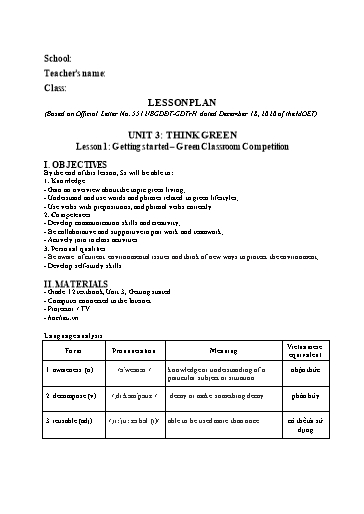
 4. carbon footprint /ˌkɑː.bən a measurement of the amount of dấu chõn
 ˈfʊt.prɪnt/ carbon dioxide that human activities cỏc-bon
 produce
 Assumption
 Anticipated difficulties Solutions
 - Encourage students to work in pairs and in
 Students are reluctant to work in groups. groups so that they can help each other.
 - Provide feedback and help if necessary.
 - Explain expectations for each task in detail.
 - Continue to explain task expectations in small
 chunks (before every activity).
 Students may lack vocabulary to deliver a
 speech. - Provide vocabulary and useful language
 before assigning tasks.
 - Encourage students to work in groups so that
 they can help each other.
 III. PROCEDURES
 1. WARM-UP (5 mins)
 a. Objectives:
 - To stir up the atmosphere and activate students’ knowledge on the topic;
 - To set the context for the listening and reading part;
 - To enhance students’ skills of cooperating with teammates.
 b. Content:
 - Guessing game
 c. Expected outcomes:
 - Students can list some types of pollution.
 d. Organisation:
 TEACHER’S ACTIVITIES STUDENTS’ ACTIVITIES CONTENTS
Guessing game - Students work in groups. 1. plastic pollution
- Teacher divides the class into two - Students look at the picture 2. light pollution
teams. that the teacher shows them 3. air pollution
- Teacher prepares the pictures of 6 and describe the picture. 4. noise pollution
types of pollution. - Other students try to guess 5. water pollution
 the name.
- Teacher gives instructions for the 6. soil pollution
game:
+ One student from each group comes
and sees a picture. Students use their
own words to describe the picture so - Task 1: Listen and read. (p.32)
 - Task 2: Read the conversation again and tick the green ideas mentioned in task 1. (p.33)
 - Task 3: Find words and phrases in Task 1 with the following meanings. (p.33)
 - Task 4: Complete the sentences with words from task 1. (p.33)
 c. Expected outcomes:
 - Students can thoroughly understand the content of the text and complete the tasks
 successfully.
 d. Organisation
 TEACHER’S ACTIVITIES STUDENTS’ ACTIVITIES CONTENTS
Task 1: Listen and read. (6 mins)
- Set the context for the listening and - Students look at the picture Questions:
reading. and answer the questions. 1. Who are the speakers?
- Ask Ss to look at the picture, the - Students listen to the 2. What do you think they
heading and the conversation, and ask recording. are discussing?
questions. - Students underline
- Play the recording twice for Ss to listen words/phrases related to Suggested answers:
and read silently along. Have Ss underline green living. 1. Nam and his friend,
words/phrases related to green living: - Students compare the words Mark.
awareness, refill, reusable, ecotrour, and phrases with their 2. They are talking about
decompose.
 partners. how to win an ecotour by
- Put Ss in pairs and ask them to compare - Students read the participating in a Green
the words and phrases they have
 conversation aloud. Classroom Competition.
underlined and discuss their meaning.
Then check comprehension as a class.
- Call on two or three pairs of Ss to read
the conversation aloud.
- In stronger classes, teacher asks Ss to
close their books and just listen to the
conversation once. Teacher asks some
comprehension questions to check
understanding. Then have them open
their books and listen again, this time
following the text and checking if their
answers were correct.
Task 2: Read the conversation again and tick the green ideas mentioned in task 1. (5 mins)
- Ask Ss to read the conversation again - Students work Answer key:
and tick the green ideas. Ask them to independently to do the 1. ✔putting more plants in
identify and underline the key words in activity. classrooms
the statements first. Then have them read - Students compare the 2. ... asking students to
the conversation again and locate the part answers in pairs. bring single-use water
that contains the information for each bottles
statement. Have them compare the 3. ✔placing a big water
information in the conversation with each jug in the classroom - Teacher lets Ss work in groups of 4. Give - Students work in groups to Students’ own creativity
each group a big sheet of paper and colours. follow teacher’s instruction.
- Give instructions to students. - Students perform in front of
- Ask students to make a mind map. the class.
- Teacher asks all groups to stick their works
on the blackboard.
- Teacher calls on some groups to present
their map.
- Teacher asks other groups to listen and give
comments.
- Teacher gives feedback and gives marks to
the best group.
 e. Assessment
 - Teacher’s observation on Ss’ performance.
 - Teacher’s feedback and peers’ feedback.
 5. CONSOLIDATION
 a. Wrap-up
 - Teacher asks students to talk about what they have learnt in the lesson.
 b. Homework
 - Do exercises in the workbook.
 - Prepare for the project in Lesson 8
 Board plan
 Date of teaching
 Unit 3: GREEN LIVING
 Lesson 1: Getting started
 * Warm-up
 * Vocabulary
 1. awareness (n)
 2. decompose (v)
 3. reusable (adj)
 4. carbon footprint
 Task 1: Listen and read.
 Task 2: Tick the correct answer.
 Task 3: Find words and a phrase.
 Task 4: Complete the sentences.
 Mind Map
 *Homework
 UNIT 3: GREEN LIVING Students may lack knowledge about some Provide students with the meaning and
 lexical items. pronunciation of some lexical items.
 Students may have underdeveloped listening, - Play the recording many times if any
 speaking and co-operating skills. necessary.
 - Encourage students to work in pairs, in
 groups so that they can help each other.
 - Provide feedback and help if necessary.
 Some students will excessively talk in the - Define expectation in explicit detail.
 class. - Continue to define expectations in small
 chunks (before every activity).
 III. PROCEDURES
 1. WARM-UP (5 mins)
 a. Objectives:
 - To stir up the atmosphere and activate students’ knowledge on the topic;
 - To enhance students’ skills of cooperating with teammates.
 b. Content:
 - Game: Say a name
 c. Expected outcomes:
 - Students can revise vocabulary related to green cleaning.
 - Students can do all the exercises.
 d. Organisation:
 TEACHER’S ACTIVITIES STUDENTS’ ACTIVITIES CONTENTS
Game: Kim’s game - Students work in groups to
- Divide the class into two teams. do the activity.
- Give instructions. Look at the - Students remember and
pictures in 10 seconds. Try to write words on the board:
remember all the pictures without Ear, pear, chair, deer, stairs,
writing anything. Students have January
20 minute to go to the board and
write the words one by one. The
team with more correct answers
becomes the winner.
 e. Assessment
 - Teacher observes and gives feedback. famous people), containing as many
diphthongs /ɪə/, /eə/ and /ʊə/ as possible.
Invite them to read these sentences aloud
in front of the class, and have other
students listen and count the number of
correct words with diphthongs. The
pair(s) with the most correct diphthongs
are winners.
 e. Assessment
 - Teacher checks students’ pronunciation and gives feedback.
 - Students in class listen and give feedback on their friends’ performance.
 3. ACTIVITY 2: VOCABULARY (12 mins)
 a. Objectives:
 - To introduce words / phrases related to the topic Green living.
 - To help Ss practise the words in meaningful contexts.
 b. Content:
 - Task 1: Match the words/phrases (1–5) with the words/preposition (a–e) to make phrases
 with the meanings below. (p.34)
 - Task 2: Complete the following sentences using the correct forms of the phrases in Task 1.
 (p.34)
 c. Expected outcomes:
 - Students understand the meaning of words, memorise them and are able to use them in
 meaningful contexts.
 d. Organisation
 TEACHER’S ACTIVITIES STUDENTS’ ACTIVITIES CONTENTS
Task 1: Match the words/phrases (1–5) with the words/preposition (a–e) to make phrases with the
meanings below. (6 mins)
- Tell Ss that the words in the activity are - Students match each Answer key:
related to green lifestyles. word/phrase on the left with 1. f 2. a 3. d 4.b 5. c
- Have Ss match each word/phrase on the the one on the right
left with the one on the right so that they - Students study the meanings
make a phrase with the given meaning. and underline key words.
Encourage Ss to study the meanings and
underline key words. This way, they will
develop a better understanding of the
phrases.
- In weaker classes, do the first one as an
example before asking Ss to match the rest
individually or in pairs.
- Check answers as a class.
Task 2: Complete the following sentences using the correct forms of the phrases in Task 1. (6 mins)
- Tell Ss to read the sentences carefully and - Students read the sentences Answer key:
decide which word in Task 1 can be used to carefully and decide which 1. waste
complete each of the sentences. Tell them to words can be used. 2. packaging some verbs. Give more explanation and - Students write the correct 1. about 2. on 3. out 4
examples if necessary. prepositions. after
- Ask Ss to complete the sentences with the - Students explain their
suitable prepositions. Tell them to pay answers.
attention to the meaning of each sentence and
the grammatical clue (i.e. which verb comes
before the blank, and which preposition often
follows that verb, as suggested in the
Remember box).
- Check answers as a class. Go through each
sentence and ask Ss to explain the meaning of
the whole phrase, e.g. 1. We use ‘about’,
because ‘care about’ means ‘worrying about
or paying attention to’.
Task 2: Combine the sentences using relative clauses. (4 mins)
- Ask Ss to read the notes in the Remember - Students work in pairs and 1. Plastic takes
box to introduce the use of relative clauses to think of a person they admire. hundreds of years to
refer to a whole sentence. - Students decide on the ideas decompose in the
- Ask Ss to combine the sentences using they are going to say and make ground, which
relative clauses. In weaker classes, remind 3-5 sentences, using the past explains why it is
them that each clause should refer to the whole simple and past continuous. harmful to
sentence that comes before it. - Present their ideas in front of the environment.
- Check answers as a class by asking some class. 2. Public transport
students to write the full sentences on the does not pollute the air
board. as much as private
 vehicles, which is why
 more people should
 consider using it.
 3. All students work
 very hard to help
 clean up the school,
 which the teacher
 encourages.
Task 3: Work in pairs. Talk about green things and activities you and your family often do. Use
verbs with prepositions or phrasal verbs, and relative clauses referring to the whole sentence. (6
mins)
- Ask Ss to work in pairs. Ask them to take - students work in pairs
 Suggested answers:
turns to talk about green things and activities - Talk about green things and
they and their family often do. They should activities they and their family We often go around by
make 3-5 sentences, using the verbs with often do. bicycle, which is more
prepositions or phrasal verbs, and relative friendly to the
clauses referring to the whole sentence as
 environment than
much as they can.
 travelling by car or
- Encourage them to study the example in pairs
first. Tell them to pay attention to the use of motorbike.
verbs with prepositions or phrasal verbs, and I often help clean up
 the neighbourhood UNIT 3: GREEN LIVING
 Lesson 3: Reading – Going green with plastics
I. OBJECTIVES
By the end of this lesson, Ss will be able to:
1. Knowledge
- Read for specific information in emails about green ways to deal with plastic.
2. Competences
- Develop communication skills and creativity;
- Be collaborative and supportive in pair work and teamwork;
- Develop presentation skills;
- Actively join in class activities.
3. Personal qualities
- Be responsible with plastics;
- Develop self-study skills.
II. MATERIALS
- Grade 12 textbook, Unit 3, Reading
- Computer connected to the Internet
- Projector / TV
- hoclieu.vn
Language analysis
 Vietnamese
 Form Pronunciation Meaning
 equivalent
 1. leftover (n) /ˈleftəʊvə / remaining after all the rest has been đồ ăn thừa
 used, taken, or eaten
 2. contaminate /kənˈtổmɪneɪtɪd water, food etc that is contaminated ụ nhiễm
 d (adj) / has had a harmful substance added to
 it
 3. get rid of to throw away or destroy something loại bỏ
 you do not want anymore
 4. rinse (v) /rɪns/ to wash something with clean water trỏng qua
 only, not using soap
 5. convenience /kənˈviːniəns/ the quality of being useful, easy or sự thuận tiện
 (n) suitable for somebody
Assumption
File đính kèm:
- ke_hoach_bai_day_tieng_anh_lop_12_global_success_theo_cv5512.docx
