

Kế hoạch bài dạy Tiếng Anh Lớp 12 Global Success theo CV5512 - Unit 4: Urbanisation
 48 trang
29/11/2025
1270
48 trang
29/11/2025
1270
Bạn đang xem 30 trang mẫu của tài liệu "Kế hoạch bài dạy Tiếng Anh Lớp 12 Global Success theo CV5512 - Unit 4: Urbanisation", để tải tài liệu gốc về máy hãy click vào nút Download ở trên.
Tóm tắt nội dung tài liệu: Kế hoạch bài dạy Tiếng Anh Lớp 12 Global Success theo CV5512 - Unit 4: Urbanisation
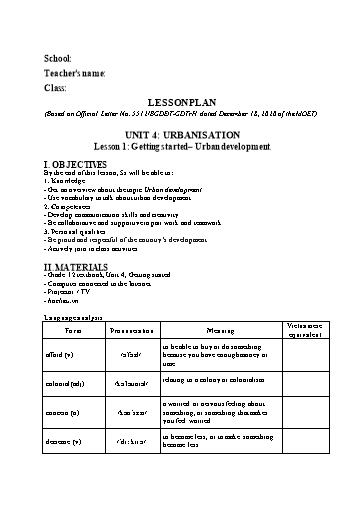
 to increase in size, number, or
 expand (v) /ɪkˈspổnd/ importance, or to make something
 increase in this way
 slowly over a period or a distance
 gradually (adv) /ˈɡrổdʒ.u.ə.li/
 buildings for people to live in
 housing (n) /ˈhaʊ.zɪŋ/
 the time when you are not working or
 leisure (n) /ˈleʒ.ər/
 doing other duties
 the number or amount of a group or
 proportion (n) /prəˈpɔː.ʃən/ part of something when compared to
 the whole
 very quickly, at a great rate
 rapidly (v) /ˈrổpɪdli/
 Someone or something that is reliable
 can be trusted or believed because he,
 reliable (adj) /rɪˈlaɪ.ə.bəl/
 she, or it works or behaves well in the
 way you expect
 a person who lives or has their home in
 resident (n) /ˈrez.ɪ.dənt/
 a place
 the busy part of the day when towns
 and cities are crowded, either in the
 rush hour /ˈrʌʃˌou(ə)r/
 morning when people are travelling to
 work, when people are travelling home
 to try to find or get something,
 seek (v) /siːk/ especially something that is not a
 physical object
 /ˌʌn.ɪmˈplɔɪ.mə the number of people who do not have
 unemployment (n)
 nt/ a job that provides money
Assumption
 Anticipated difficulties Solutions
 Students may lack knowledge and - Encourage students to work in groups so that
 experiences about the topic. they can help each other.
 - Give short, clear instructions, and help if
 necessary. 11. reliable (adj)
 12. resident (n)
 13. rush hour
 14. seek (v)
 15. unemployment (n)
 e. Assessment
 - Teacher checks students’ pronunciation & understanding and gives feedback.
 3. ACTIVITY 2: PRACTICE (30 mins)
 a. Objectives:
 - To help Ss know how to read for main ideas and specific information in an article about the
 urbanisation of Ha Noi.
 - To check Ss’ comprehension of the conversation.
 - To introduce words and phrases related to urban development.
 - To help Ss identify the use of present perfect tense and double comparatives.
 b. Content:
 - Task 1: Listen and read. (p.48)
 - Task 2: Read the conversation again. Decide whether the following statements are true (T)
 or false (F). (p.49)
 - Task 3: Match the words to make phrases mentioned in Task 1. (p.49)
 - Task 4: Complete the sentences using phrases from Task 1. (p.49)
 c. Expected outcomes:
 - Students can understand the lesson and do the tasks successfully.
 d. Organisation
 TEACHER’S ACTIVITIES STUDENTS’ ACTIVITIES CONTENTS
Task 1: Listen and read. (8 mins)
- Set the context for listening and - Students look at the picture
reading the conversation. Have Ss and answer the questions.
look at the picture and ask questions - Students listen to the
about it. recording.
- Play the recording twice for Ss to - Students read the
listen and read along. Have Ss conversation aloud.
underline words and phrases related
to the topic of urbanization (high-
rise buildings, urban areas, public
parks )
- Put Ss in pairs and have them
compare the words and phrases they
have underlined and discuss their
meaning. Then check
comprehension as a class.
- Call on some Ss to read the
conversation aloud.
Task 2: Read the conversation again. Decide whether the following statements are true (T) or false
(F). (7 mins)
- Ask Ss to work in pairs and read - Students work and compare Answer key:
each statement carefully. Ask them the answers in pairs. 1. T - Task 5: Work in pairs. Student A has just returned to the neighborhood. You don’t know
 much about the area because everything has changed. You ask for more information about
 the town. Student B poses as a local to introduce the neighborhood.
 c. Expected outcomes:
 - Students can understand the lesson and do the tasks successfully.
 d. Organisation
 TEACHER’S ACTIVITIES STUDENTS’ ACTIVITIES CONTENTS
Task 5: Work in pairs. Student A has just returned to the neighborhood. You don’t know much
about the area because everything has changed. You ask for more information about the town.
Student B poses as a local to introduce the neighborhood. (10 mins)
- Ask Ss to work in pairs. - Students work in pairs to Suggested answer:
- Elicit some places that can be follow teacher’s instruction. A: Can you show me the way
different from the past in the - Students practice in pairs. to the nearest bus stop? It used
neighborhood. - Students perform in front of to be here three years ago, but I
- Tell Ss to look at the conversation the class. can’t find it now.
in Task 1 again to look for the B: It was relocated to the
sample sentences. corner of Cach Mang Thang
- When they know exactly what to Tam Street and Bac Hai Street
do, ask them to work in pairs. last year. That place is now a
Teacher may go around to observe busy street. Things has
and offer help if necessary. changed rapidly.
- Invite some pairs to perform in
front of the class.
 e. Assessment
 - Teacher and other Ss listen to the instructions and comment.
 5. CONSOLIDATION
 a. Wrap-up
 - Teacher asks students to talk about what they have learnt in the lesson.
 b. Homework
 - Do exercises in the workbook.
 - Start preparing for the Project of the unit:
 • Ask Ss to open their books at the last page of Unit 4, the Project section, look at the
 picture and say what the topic of the project is (An urban area)
 • Explain the project requirements: Ss will have to do research on an urban area in Viet
 Nam that has been created through urbanisation and then give an oral presentation to report
 the results of their research. Ss should interview three people from different generations and
 ask the questions in the table. In stronger classes, they can add more questions. Ss can choose
 different ways to present their findings (e.g. PPT presentation, poster presentation, video
 recording). Encourage Ss to use photos and / or illustrations to support their ideas.
 • Put Ss into groups, and have them choose their group leader. Then ask them to assign
 tasks to each group member (e.g. doing the research, combining the collected information,
 combining and synthesizing the information, writing the scripts, preparing the slides, and
 delivering the presentation), making sure that all group members contribute to the project.
 • Help Ss set deadlines for each task and support them throughout the process.
 • In each of the next lessons, spend a few minutes checking Ss progress, helping them
 with any topic-related or functional language they need, (e.g. words and phrases to describe UNIT 4: URBANISATION
 Lesson 2: Language
I. OBJECTIVES
By the end of this lesson, Ss will be able to:
1. Knowledge
- Use the lexical items related to the topic urbanisation
- Use Present perfect (review and extension) and double comparatives to show changes in a
 neighbourhood.
- Use unstressed words in connected speech
2. Competences
- Develop communication skills
- Be collaborative and supportive in pair work and teamwork
3. Personal qualities
- Be proud and respectful of the country’s development
- Actively join in class activities
II. MATERIALS
- Grade 12 textbook, Unit 4, Language
- Computer connected to the Internet
- Projector / TV
- hoclieu.vn
Language analysis
 Vietnamese
 Form Pronunciation Meaning
 equivalent
 to be able to buy or do something
 afford (v) /əˈfɔːd/ because you have enough money or
 time
 to increase in size, number, or
 expand (v) /ɪkˈspổnd/ importance, or to make something
 increase in this way
 buildings for people to live in
 housing (n) /ˈhaʊ.zɪŋ/
 to try to find or get something,
 seek (v) /siːk/ especially something that is not a
 physical object
 /ˌʌn.ɪmˈplɔɪ.mə the number of people who do not have
 unemployment (n)
 nt/ a job that provides money
 Unstressed words in connected speech
 In connected speech, most grammatical
 words are not usually stressed. These words include: Students may have underdeveloped listening, - Play the recording many times if any
 speaking and co-operating skills. necessary.
 - Encourage students to work in pairs, in
 groups so that they can help each other.
 - Provide feedback and help if necessary.
 Some students will excessively talk in the - Define expectation in explicit detail.
 class. - Continue to define expectations in small
 chunks (before every activity).
 III. PROCEDURES
 1. WARM-UP (5 mins)
 a. Objectives:
 - To activate students’ prior knowledge and vocabulary related to the topic, the targeted
 vocabulary, and its pronunciation.
 b. Content:
 - Matching game
 c. Expected outcomes:
 - Students can understand the lesson and do the tasks successfully.
 d. Organisation:
 TEACHER’S ACTIVITIES STUDENTS’ ACTIVITIES CONTENTS
Game: Matching - Students work in groups to Answer key:
- Teacher divides students into 4 groups do the activity. 1. /ɪə/: volunteers, idea
and models how to play this game. - Students pronounce the 2. /ʊə/: Ecotourism, poor
- Ss match the diphthongs to the right words and match them to the 3. /eə/: air conditioners,
word. correct group. awareness
- The group with the most correct words
will be the winner.
 e. Assessment
 - Teacher observes and gives feedback.
 2. ACTIVITY 1: PRONUNCIATION (10 mins)
 a. Objectives:
 - To help Ss recognise and practise saying unstressed words in connected speech
 - To help Ss identify the unstressed words in sentences, and practise saying them.
 b. Content:
 - Task 1: Listen and repeat. Pay attention to the pronunciation of unstressed words. (p.49)
 - Task 2: Listen and identify the unstressed words in the following sentences. Then practise
 saying the sentences in pairs. (p.49)
 c. Expected outcomes:
 - Students can understand the lesson and do the tasks successfully.
 d. Organisation
 TEACHER’S ACTIVITIES STUDENTS’ ACTIVITIES CONTENTS
Task 1: Listen and repeat. Pay attention to the pronunciation of unstressed words. (4 mins)
- Ask Ss to look at the sentences, listen to - Students read the Remember Box Suggested answer:
them and repeat, paying attention to the - Students listen to the recording (and – conjunction; a
 and check the unstressed words – article; It-personal - Ask Ss to read the definitions of - Students read the words and Answer key:
the words and check understanding. do the matching. 1. C
- Tell Ss to match the words with the - Students work in pairs and 2. D
given definitions. check answers. 3. A
- Have Ss compare their answers in 4. E
pairs. 5. B
- Check answers as a class. Ask
individual Ss to read the definitions
while other Ss call out the correct
words.
Task 2: Complete the sentences using the correct forms of the words in Task 1. (5 mins)
- Have Ss work in pairs. Tell them to - Students work in pairs and Answer key:
read the sentences and decide which practice reading the sentences. 1. unemployment
word in 1 can be used to complete 2. afford
each of the sentences. Encourage 3. housing
them to look for context clues to 4. expanded
help them decide on the correct 5. seek
word.
- Check answers as a class.
- Ask individual Ss to read the
complete sentences.
 e. Assessment
 - Teacher observes and gives feedback.
 4. ACTIVITY 3: GRAMMAR (16 mins)
 a. Objectives:
 - To help Ss revise and extend the use of the present perfect tense with some structures.
 - To help Ss use double comparatives correctly to show changes.
 - To help Ss practise using the present perfect and/or the double comparatives in a speaking
 activity.
 b. Content:
 - Task 1: Circle the underlined part that is incorrect in each of the following sentences. Then
 correct it. (p 51)
 - Task 2: Choose the best option to indicate the sentence that is closest in meaning to the
 sentence given. (p 51)
 - Task 3: Work in pairs. make true sentences about urbanisation in an area that you know,
 using double comparatives and the present perfect. (p 51)
 c. Expected outcomes:
 - Students can understand the lesson and do the tasks successfully.
 d. Organisation
 TEACHER’S ACTIVITIES STUDENTS’ ACTIVITIES CONTENTS
Task 1: Circle the underlined part that is incorrect in each of the following sentences. Then
correct it. (5 mins)
- Ask Ss to look at the sentences 1 - Students work and check in Answer key:
and 3 in 4 in Getting Started and pairs. 1. B: saw have seen
elicit the verbs used there, have - Students practice reading the 2. C: had have
built, and has been. sentences.
File đính kèm:
- ke_hoach_bai_day_tieng_anh_lop_12_global_success_theo_cv5512.docx
