

Kế hoạch bài dạy Tiếng Anh Lớp 12 Global Success theo CV5512 - Unit 5: The world of work
 52 trang
29/11/2025
3600
52 trang
29/11/2025
3600
Bạn đang xem 30 trang mẫu của tài liệu "Kế hoạch bài dạy Tiếng Anh Lớp 12 Global Success theo CV5512 - Unit 5: The world of work", để tải tài liệu gốc về máy hãy click vào nút Download ở trên.
Tóm tắt nội dung tài liệu: Kế hoạch bài dạy Tiếng Anh Lớp 12 Global Success theo CV5512 - Unit 5: The world of work
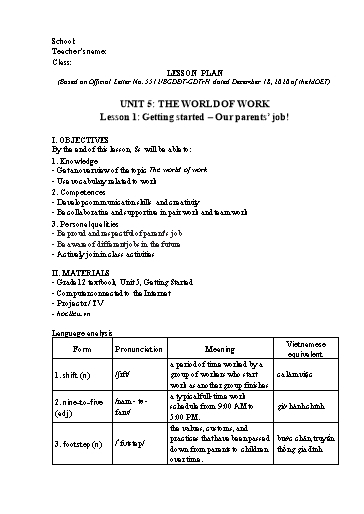
4. accountant a person whose job is to keep /əˈkaʊntənt/ kế toán (n) or check financial accounts Assumption Anticipated difficulties Solutions Students may lack knowledge and - Encourage students to work in groups so experience about the topic. that they can help each other. - Give short, clear instructions and help if necessary. III. PROCEDURES 1. WARM-UP (5 mins) a. Objectives: - To introduce the topic of the unit. - To set the context for the listening and reading part. b. Content: - Watching a video c. Expected outcomes: - Students can understand what children say in the video and guess the topic of the unit. d. Organisation: TEACHER’S STUDENTS’ ACTIVITIES CONTENTS ACTIVITIES Watching a video - Students watch a video and Questions: - Teacher plays a video and answer the question What are they talking asks Ss to watch and answer about? the question. Suggested answer: Link: Their parent’s job. https://www.youtube.com/w atch?v=8bZbRTh92NM&t= 84s e. Assessment - T observes and gives feedback. 2. ACTIVITY 1: PRESENTATION (5 mins) a. Objectives: - To provide students with new words related to the topic of The world of work. - To help students be well-prepared for the listening and reading tasks. b. Content: - Vocabulary pre-teaching c. Expected outcomes: - Students can identify some vocabulary related to the topic. words and phrases related to the world of work while they are listening and reading. - Teacher puts Ss in pairs and - Ss compare the words and asks them to compare the phrases with their partner. words and phrases they have underlined and discuss their meaning. Then check comprehension as a class. - Call on three Ss to read the - Students read the conversation aloud. conversation aloud. Task 2: Read the conversation again and put a tick () in the appropriate column. (7 mins) - Teacher puts Ss in pairs. Ask - Students work in pairs to Answer key: them to read the notes do the activity. 1. Lan’s dad carefully and decide which 2. Mark’s dad information belongs to Lan’s 3. Lan’s dad dad, Mark’s dad or Lan’s 4. Lan’s mum mum. In stronger classes, encourage Ss to complete the task without looking back at the conversation. - Then have them read the conversation again and locate the part of the conversation that has the information for each of the questions. - Teacher has Ss share their answers with the class. - Students share the answers - Confirm the correct answers. in front of the class and show where they can find them. - Correct Task 3: Match the words/ phrases to make phrases mentioned in 1. (6 mins) - Ask Ss to work Answer key: independently to do the 1. d exercise 2. a - Check Ss’ understanding of 3. b the individual words in each - Students read the 4. c column. conversation again and work - Have Ss read the independently to do the conversation quickly again, activity. d. Organisation TEACHER’S STUDENTS’ CONTENTS ACTIVITIES ACTIVITIES Game: Be a footballer - Give instructions - Listen to the teacher - Show the questions and - Choose the correct answers correct Answer key: 1. A 2. B 3. C 4. B 5. B e. Assessment - Teacher checks students’ exercises individually and gives feedback. 5. CONSOLIDATION (5 minutes) a. Wrap-up - Teacher asks students to talk about what they have learnt in the lesson. Board plan Date of teaching Unit 5: The world of work Lesson 1: Getting started * Warm-up * Vocabulary 1. shift (n): ca làm việc 2. nine-to-five (adj): giờ hành chính 3. footstep (n): bước chân, truyền thống gia đình 4. accountant (n): kế toán Task 1: Listen and read. (p.60) Task 2: Read the conversation again and put a tick () in the appropriate column. (p.61) Task 3: Match the words/ phrases to make phrases mentioned in 1. (p.61) Task 4: Complete the sentences with phrases or clauses in the box based on the conversation in 1. (p.61) Game: Be a footballer. *Homework Assumption Anticipated difficulties Solutions Students may lack knowledge about some Provide students with the meaning and lexical items. pronunciation of some lexical items. Students may have underdeveloped - Play the recording many times if listening, speaking and co-operating necessary. skills. - Encourage students to work in pairs, and in groups so that they can help each other. - Provide feedback and help if necessary. Some students will excessively talk in - Define expectations in explicit detail. class. - Continue to define expectations in small chunks (before every activity). III. PROCEDURES 1. WARM-UP (5 mins) a. Objectives: - To stir up the atmosphere and activate students’ knowledge of the topic; - To enhance students’ skills of cooperating with teammates. b. Content: - Game: Sentence scramble c. Expected outcomes: - Students can revise simple, compound, and complex sentence. d. Organisation: TEACHER’S STUDENTS’ CONTENTS ACTIVITIES ACTIVITIES - Have Ss work in groups of - Work in groups Put the words/ phrases into 4-6 the correct order to make a - Have Ss put the words/ - Do the task carefully and meaningful sentence. phrases into the correct write on the posters. 1. employees./ He/ a/ order to make a meaningful manages/ team/ of/ sentence. 2. deadline/ is/ to complete - Ask Ss to pay attention to it./ tomorrow,/The project/ the subject, verbs, and other so/ we/ must work/ extra complements. hours/ - Have Ss write the answer - Stick the posters on the 3. work/ works from home./ on the posters and stick BB and/ she/ I/ in an office,/ them on the BB when 4. After/ she/ the graphic finishing. design work./ can assist/ Demonstrate the stressed auxiliary your application for and model verbs again clearly if the job yet. needed. B: I have. 4. My brother couldn’t ride a bike two months ago, but he can now. Task 2: Listen and underline the stressed auxiliary and modal verbs in the following sentences. Then practise saying the sentences in pairs. (6 mins) - Ask Ss to read the sentences and - Read the sentences and Audio script underline auxiliary and modal underline auxiliary and 1. I would help verbs that are stressed. modal verbs that are you find a job if I - Play the recording and have Ss stressed. could. check their answers. - Listen and check 2. I wasn't used - Play the recording again, pausing to the new working after each sentence, for Ss to - Listen and repeat. environment, but I repeat. am used to it now. - If time allowed, have Ss come up 3. A: Are you with their own sentences and ask ready for the them to practise with other. interview? B: Yes. I am. 4. A: Is your father a teacher? B: He was, but he’s retired now. e. Assessment - Teacher checks students’ pronunciation and gives feedback. - Students in class listen and give feedback on their friends’ performance. 3. ACTIVITY 2: VOCABULARY (12 mins) a. Objectives: - To introduce words and phrases related to work. - To help Ss practise using the words and phrases in 1 in meaningful contexts. b. Content: - Task 1. Match the words with their meanings. (p. 62) - Task 2. Complete the sentences with the words in 1. (p. 62) c. Expected outcomes: - Students understand the meaning of words, memorise them, and are able to use them in meaningful contexts. d. Organisation TEACHER’S ACTIVITIES STUDENTS’ CONTENTS ACTIVITIES - To give Ss an opportunity to practice simple, compound, and complex sentences. - To help Ss practise simple, compound, and complex sentences in a speaking activity. b. Content: - Task 1. Combine the following simple sentences, using the words in brackets. (p.63) - Task 2. Work in pairs. Add more clauses to the following sentences to make compound or complex sentences. (p.63) c. Expected outcomes: - Students can use simple, compound, and complexsentencese correctly in sentences and in speaking activity. d. Organisation TEACHER’S ACTIVITIES STUDENTS’ CONTENTS ACTIVITIES Task 1: Combine the following simple sentences, using the words in brackets. (6 mins) - Tell Ss to read the explanations - Read the explanations in Answer key: in the Remember! box on page the Remember! box on 1. Although he 62. Check understanding of the page 62. left school with no grammar point by asking - Answer the questions academic questions about the number of qualifications, he clauses in the sentences. found a well-paid job. - Explain the differences among 2. If people learn the three types of sentences to - Listen to the teacher’s English well, they will make sure Ss understand them. explanation have a better chance of - In weaker classes, give more getting a job. examples to demonstrate the 3. This job grammar points. requires not only good - In stronger classes, have Ss language skills but come up with their own also communication example sentences. skills. - Ask Ss to work in pairs or 4. My dad individually to combine the - Combine the simple attended a cooking simple sentences by using the sentences by using the course so that he can words in the bracket. words in the bracket. open his own - Check answers as a class and restaurant. ask Ss to explain their choices. - Correct Task 2: Work in pairs. Add more clauses to the following sentences to make compound or complex sentences. (7 mins) - Have Ss read the instructions - Read the instructions and Suggested answers: and examples, and make sure examples. I admire they all understand the context - Work in pairs to make teachers because they and what they have to do. In compound and complex work hard to educate sentences. students, and their demand creativity, emotional intelligence, and complex problem- solving abilities. e. Assessment - Teacher’s observation on Ss’ performance. - Teacher’s feedback and peers’ feedback. 5. CONSOLIDATION (3 mins) a. Wrap-up - T asks Ss to talk about what they have learned in the lesson. + Pronunciation: Stressing auxiliary and modal verbs + Vocabulary: Work + Grammar: Simple, compound, and complex sentences (review and extension) b. Homework - Do exercises in the workbook. - Learn by heart some vocabulary related to work. - Do more exercises about simple, compound, and complex sentences. - Prepare for the next lesson. Board plan Date of teaching Unit 5: The world of work Lesson 2: Language * Warm-up Game: Sentence Scramble * Pronunciation - Task 1. Listen and repeat. Pay attention to the stressed words. - Task 2. Listen and underline the stressed auxiliary and modal verbs in the following sentences. Then practise saying the sentences in pairs. * Vocabulary - Task 1. Match the words with their meanings. - Task 2. Complete the sentences with the words in 1. * Grammar - Task 1. Combine the following simple sentences, using the words in brackets. - Task 2. Work in pairs. Add more clauses to the following sentences to make compound or complex sentences. UNIT 5: THE WORLD OF WORK Lesson 3: Reading – Job advertisements I. OBJECTIVES By the end of this lesson, Ss will be able to: 1. Knowledge - Develop reading skills for general ideas and for specific information in job advertisements. 2. Competences - Develop communication skills and creativity; - Be collaborative and supportive in pair work and teamwork; - Develop presentation skills; - Actively join in class activities. 3. Personal qualities - Cognizant of how to read job advertisements and aware of future career prospects. - Develop self-study skills. II. MATERIALS - Grade 12 textbook, Unit 5, Reading - Computer connected to the Internet - Projector / TV - hoclieu.vn Language analysis Form Pronunciation Meaning Vietnamese equivalent 1. unpaid (adj) /ˌʌnˈpeɪd/ not receiving payment for work không được that they do trả lương 2. wage (n) /weɪdʒ/ a regular amount of money that tiền công you earn, usually every week or (trả theo giờ every month, for work or hoặc theo services khối lượng công việc) 3. donation (n) /dəʊˈneɪʃn/ something that is given to a đồ từ thiện, person or an organization such quyên góp as a charity, in order to help them; 4. overtime pay /ˈəʊvətaɪm peɪ extra money that an employee tiền ngoài (n) / receives for working more hours giờ
File đính kèm:
- ke_hoach_bai_day_tieng_anh_lop_12_global_success_theo_cv5512.docx
