

Kế hoạch bài dạy Tiếng Anh Lớp 12 Global Success theo CV5512 - Unit 6: Artificial intelligence
 49 trang
29/11/2025
2702
49 trang
29/11/2025
2702
Bạn đang xem 30 trang mẫu của tài liệu "Kế hoạch bài dạy Tiếng Anh Lớp 12 Global Success theo CV5512 - Unit 6: Artificial intelligence", để tải tài liệu gốc về máy hãy click vào nút Download ở trên.
Tóm tắt nội dung tài liệu: Kế hoạch bài dạy Tiếng Anh Lớp 12 Global Success theo CV5512 - Unit 6: Artificial intelligence
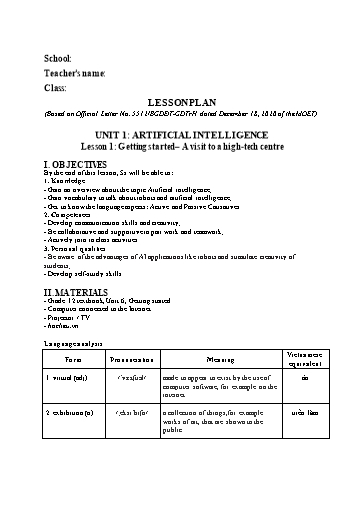
 3. activate (v) /ˈổktɪveɪt/ to make something such as a device or kớch hoạt
 chemical process start working
 4. facial /ˌfeɪʃl technology that allows a computer to nhận diện
 recognition (n) rekəɡˈnɪʃn/ identify a person by their face khuụn mặt
 Assumption
 Anticipated difficulties Solutions
 - Encourage students to work in pairs and in
 Students are reluctant to work in groups. groups so that they can help each other.
 - Provide feedback and help if necessary.
 - Explain expectations for each task in detail.
 - Continue to explain task expectations in small
 chunks (before every activity).
 Students may lack vocabulary to deliver a
 speech. - Provide vocabulary and useful language
 before assigning tasks.
 - Encourage students to work in groups so that
 they can help each other.
 III. PROCEDURES
 1. WARM-UP (5 mins)
 a. Objectives:
 - To stir up the atmosphere and activate students’ knowledge on the topic;
 - To set the context for the listening and reading part;
 - To enhance students’ skills of cooperating with teammates.
 b. Content:
 - Game: Crossword
 c. Expected outcomes:
 - Students can revise vocabulary related to the topic and guess the key word.
 d. Organisation:
 TEACHER’S ACTIVITIES STUDENTS’ CONTENTS
 ACTIVITIES
Game: Crossword - Students work in 1. ARTIFICIAL
- Teacher divides the class into four groups. 2. TECHNOLOGY
teams. - Students work together 3. LABORATORY
- Teacher gives each team a handout and solve the crossword. 4. AUTOMATIC
of a crossword for them to solve. - Students check the 5. INTELLIGENCE
 answers. Take notes the
- The first team to finish the task and 6. SCIENTIST
get the correct key word will be the important words.
winner of the game. e. Assessment
 - Teacher checks students’ pronunciation and gives feedback.
 - Teacher observes students’ writing of vocabulary in their notebooks.
 3. ACTIVITY 2: PRACTICE (22 mins)
 a. Objectives:
 - To introduce the unit topic (Artificial Intelligence);
 - To introduce some vocabulary and the grammar point to be learnt in the unit;
 b. Content:
 - Task 1: Listen and read. (p.76)
 - Task 2: Read the conversation again and answer the questions. (p.77)
 - Task 3: Find words in Task 1 with the following meanings (p.77)
 - Task 4: Complete the sentences with words or a phrase from Task 1 (p.77)
 c. Expected outcomes:
 - Students can thoroughly understand the content of the text and complete the tasks
 successfully.
 d. Organisation
 TEACHER’S ACTIVITIES STUDENTS’ ACTIVITIES CONTENTS
Task 1: Listen and read. (6 mins)
- Set the context for listening and reading - Students look at the picture Questions:
the conversation. Have Ss look at the and answer the questions. 1. What can you see in the
pictures, the heading and the speakers’ - Students listen to the two photos?
names. Ask Ss questions about them, e.g. recording. 2. Which activity do you
What can you see in the two photos? - Students underline think the students are
(photo 1: a technology center; photo 2: a words/phrases related to attending?
robot and a student); Which activity do artificial intelligence in the 3. Who might be the tour
you think the students are attending? (a conversation. guide?
field trip to a high-tech centre); Who - Students compare the words
might be the tour guide? (The robot) and phrases with their Suggested answers:
Encourage Ss to use their imagination and partners. 1. photo 1: a technology
accept all answers. Then explain that they - Students read the center; photo 2: a robot and
are visiting a high-tech centre. conversation aloud. a student
 2. a field trip to a high-tech
- Play the recording twice for Ss to centre
listen and read along. Have Ss underline 3. The robot
words / phrases related to artificial
intelligence in the conversation.
- Have Ss compare the words they
have underlined in pairs and discuss their
meaning. Then check comprehension as a
class.
- Call on three Ss to read the
conversation aloud. information. Then try to fill in the correct
verbs.
- Check answers by calling on individual
Ss to read out each sentence.
 e. Assessment
 - Teacher checks students’ exercises individually and gives feedback.
 4. ACTIVITY 3: PRODUCTION (10 mins)
 a. Objectives:
 - To help Ss memorize the key information about the science and technology;
 - To get Ss to speak about the main features of Jessica – the robot in the reading text.
 b. Content:
 - Role-play: Jessica - the AI robot
 c. Expected outcomes:
 - Ss can talk about the main features of Jessica – the robot in the reading text and some
 science and technology knowledge related to AI.
 d. Organisation
 TEACHER’S ACTIVITIES STUDENTS’ ACTIVITIES CONTENTS
Role-play: Jessica - the AI robot (10 mins)
- Teacher lets Ss work in groups of 4. In each - Students work in groups to Students’ own creativity
group, one student plays the role of Jessica – follow teacher’s instruction.
the robot, others are students who visit the - Students perform in front of
high-tech centre. the class.
- Give instructions to students.
- Ask students to do a role-play, others
students may ask Jessica about what she can
do.
- Some cues questions to ask Jessica:
+ Which special abilities do you have?
+ What are your strengths and weaknesses?
+ Which AI technology will be popular in the
future?
- Teacher asks to use their imagination and
creativity in the role play together with the
information provided in the reading text.
- Teacher calls on some groups to present
their stories.
- Teacher asks other groups to listen and give
comments. UNIT 1: ARTIFICIAL INTELLIGENCE
 Lesson 2: Language
I. OBJECTIVES
By the end of this lesson, Ss will be able to:
1. Knowledge
- identify and pronounce the homophones in words and sentences correctly.
- understand and use words and phrases related to science and technology.
- understand and use active and passive causatives correctly.
2. Competences
- Develop communication skills;
- Be collaborative and supportive in pair work and team work;
- Actively join in class activities.
3. Personal qualities
- Develop self-study skills.
II. MATERIALS
- Grade 12 textbook, Unit 6, Language
- Computer connected to the Internet
- Projector / TV
- hoclieu.vn
Language analysis
 Active and passive causatives
 • The active causative is used when the subject causes the object to do something. The
 pattern means ‛to cause someone to do something’.
 have + someone + bare infinitive
 get + someone + to-infinitive
 Example: The AI expert had his assistant activate the new robot. I will get more people to
 join the technology club.
 • The passive causative is used when the thing is done for the subject by someone else.
 The pattern means ‛to cause something to be done’.
 have/get + something + past participle
 Example: The AI expert had/got the new robot activated.
Assumption
 Anticipated difficulties Solutions
Students may lack knowledge about some Provide students with the meaning and
 lexical items. pronunciation of some lexical items.
Students may have underdeveloped listening, - Play the recording many times if any
 speaking and co-operating skills. necessary.
 - Encourage students to work in pairs, in groups
 so that they can help each other.
 - Provide feedback and help if necessary. e. Assessment
 - Teacher observes and gives feedback.
 2. ACTIVITY 1: PRONUNCIATION (12 mins)
 a. Objectives:
 - To help Ss recognise and practise homophones;
 - To help Ss practise identifying homophones.
 b. Content:
 - Task 1: Listen and repeat the following homophones. (p.78)
 - Task 2: Choose the correct words to complete the sentences. Listen and repeat. Then
 practise saying the sentences in pairs. (p.78)
 c. Expected outcomes:
 - Students can distinguish homophones and use the correct words in a complete sentence.
 d. Organisation
 TEACHER’S ACTIVITIES STUDENTS’ ACTIVITIES CONTENTS
Task 1: Listen and repeat the following homophones. (6 mins)
- Write two ‘buy, bye’ on the board and Audio script
call on one or two Ss to read it. Ask Ss to - Answer teacher’s question, to two
identify the similarity and differences identify the similarity and where wear
between these two words. Refer to the differences between these two hour our
 words. know no
Remember box to introduce homophones.
Homophones are words that have the there their
 board bored
same pronunciation but different spelling
and meanings. allowed aloud
Example: I have two books, too. wright write
 /tu:/ /tu:/
- Play the recording and ask Ss to listen
and repeat, paying attention to the words. - Students listen to the
Play the recording two or three times. recording, and then repeat the
- For strong classes, cover the second words.
column and ask Ss to find the
homephones to the words in the first
column.
Task 2: Choose the correct words to complete the sentences. Listen and repeat. Then practise
saying the sentences in pairs. (6 mins)
- Ask Ss to read the sentences. Check - Students read the sentences Answer key:
comprehension. and underline suitable the 1. There are more than two
 words. Then listen to the types of robots.
- Have Ss underline the suitable recording. 2. We want to know where
words to make complete sentence AI technologies are used
 today. - In weaker classes, do the first one as an
example before asking Ss to match the rest
individually or in pairs.
Task 2: Complete the sentences using the correct forms of the words from Task 1. (6 mins)
- Ask Ss to work individually. Tell them - Students read the sentences Answer key:
to read the sentences carefully to decide carefully and decide which 1. Artificial intelligence
which word in 1 can be used to complete words can be used. 2. advanced
each of the sentences. Remind them to use - Students explain the meaning 3.programmed
 of each phrase. 4.analyse
the contextual clues to decide on the
 - Students read the complete 5. chatbots
word/phrase as well as the correct forms. E.g.
3. Needs a plural noun after “many”. sentences.
- Have Ss compare their answers in
pairs. Check answers as a class. Have
individual Ss call out the word they have
used for each sentence first.
- Confirm the correct answers. In
stronger classes, ask Ss to explain why they
have chosen the word for each sentence
using contextual clues, e.g. The first sentence
needs a noun and it refers to a part of
people’s life. The second sentence needs an
adjective to go with type of robot’, and the
words ‘advanced’ is the best choice.
 e. Assessment
 - Teacher’s observation on Ss’ performance.
 - Teacher’s feedback and peers’ feedback.
 4. ACTIVITY 3: GRAMMAR (13 mins)
 a. Objectives:
 - To help Ss review how to use active and passive causatives;
 - To help Ss practise using causatives in a speaking activity.
 b. Content:
 - Task 1: Rewrite the sentences using active or passive causatives. (p.79)
 - Task 2: Work in pairs. Make predictions about applications of robots in the future, using
 causatives. (p.79)
 c. Expected outcomes:
 - Students know how to use active and passive causatives and can apply it to give a short talk
 on the given topic.
 d. Organisation
 TEACHER’S ACTIVITIES STUDENTS’ CONTENTS
 ACTIVITIES
Task 1: Rewrite the sentences using active or passive causatives. (6 mins)
- Tell Ss to look at the sentences using active - Students read the notes in Answer key:
and passive causatives in Activity 4 in the Remember box. Board plan
 Date of teaching
 Unit 6: Artificial intelligence
 Lesson 2: Language
* Warm-up
Game: Homophone game
* Pronunciation
- Task 1. Listen and repeat.
- Task 2. Choose the correct words to complete the sentences.
* Vocabulary
- Task 1. Match the words with their meanings.
- Task 2. Complete the sentences.
* Grammar
- Task 1. Rewrite the sentences using active or passive causatives.
- Task 2. Work in pairs. Make predictions about applications of robots in the future.
* Homework Students may lack knowledge about Provide students with the meaning and pronunciation
 some lexical items. of words.
 - Let students read the text again (if necessary).
 - Create a comfortable and encouraging environment
 Students may have underdeveloped
 for students to speak.
 reading, speaking and co-operating
 - Encourage students to work in pairs, in groups so
 skills.
 that they can help each other.
 - Provide feedback and help if necessary.
 III. PROCEDURES
 1. WARM-UP (5 mins)
 a. Objectives:
 - To stir up the atmosphere and activate students’ knowledge about the figure they are going
 to learn about in the lesson;
 - To set the context for the reading part;
 - To enhance students’ skills of cooperating with teammates.
 b. Content:
 - Reveal the secret word
 c. Expected outcomes:
 - Students join the activity enthusiastically and gain knowledge on the topic.
 d. Organisation:
 TEACHER’S ACTIVITIES STUDENTS’ CONTENTS
 ACTIVITIES
Reveal the secret word - Students work in Reading passage:
- Teacher lets Ss work in groups. groups to do the activity. In the rapidly evolving world of
- Teacher delivers a handout to each - Students raise their education, technology has become a
group, in which students have to fill in hands to answer the (1) ________ behind innovation and
the blanks with suitable words. questions. transformation. Among the many (2)
- Teacher asks students to guess the ________ technologies making
secret key word after they have waves in the educational landscape
completed the task. is KEY WORD HERE. It has
- The first group to do the task emerged as a powerful tool for
successfully ang get the correct key transforming learning experiences
word is the winner of the game. through AI conversations. an
- Teacher leads in the lesson. advanced natural language processing
 model, is designed to understand and
 generate (3) ________ text based on
 the input it receives. It operates on the
 principles of deep learning,
 leveraging large-scale datasets to pre-
 train its language comprehension
 abilities. By employing this (4)
 _______ AI conversational tool in
 education, the learning process is
 elevated to new heights, offering
 students and educators unique (5)
File đính kèm:
- ke_hoach_bai_day_tieng_anh_lop_12_global_success_theo_cv5512.docx
