

Kế hoạch bài dạy Tiếng Anh Lớp 12 Global Success theo CV5512 - Unit 8: Wildlife conservation
 42 trang
29/11/2025
2812
42 trang
29/11/2025
2812
Bạn đang xem 30 trang mẫu của tài liệu "Kế hoạch bài dạy Tiếng Anh Lớp 12 Global Success theo CV5512 - Unit 8: Wildlife conservation", để tải tài liệu gốc về máy hãy click vào nút Download ở trên.
Tóm tắt nội dung tài liệu: Kế hoạch bài dạy Tiếng Anh Lớp 12 Global Success theo CV5512 - Unit 8: Wildlife conservation
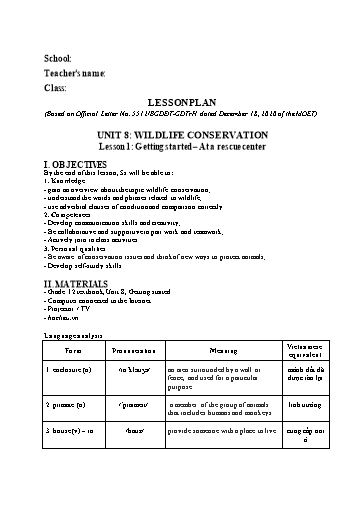
 4. endangered /ɪnˈdeɪndʒəd/ at risk of no longer existing Gặp nguy
 (adj) hiểm
 Assumption
 Anticipated difficulties Solutions
 - Encourage students to work in pairs and in
 Students are reluctant to work in groups. groups so that they can help each other.
 - Provide feedback and help if necessary.
 - Explain expectations for each task in detail.
 - Continue to explain task expectations in small
 chunks (before every activity).
 Students may lack vocabulary to deliver a
 speech. - Provide vocabulary and useful language
 before assigning tasks.
 - Encourage students to work in groups so that
 they can help each other.
 III. PROCEDURES
 1. WARM-UP (5 mins)
 a. Objectives:
 - To create a friendly and lively atmosphere in the classroom;
 - To set the context for the listening and reading part;
 - To enhance students’ skills of cooperating with teammates.
 b. Content:
 - Watching a video
 c. Expected outcomes:
 - Students can list some types of pollution.
 d. Organisation:
 TEACHER’S ACTIVITIES STUDENTS’ ACTIVITIES CONTENTS
A video - Students work in groups.
- Teacher asks students to read - Students look at the picture https://www.youtube.com/watc
through some questions before that the teacher shows them h?v=e-yAO267tvE
watching the video. and describe the picture. Questions:
- Teacher asks students to watch a - Other students try to guess - What is wildlife
video about wildlife conservation. the name. conservation?
- Call on some students to give their - What can wildlife
answers. conservation be broken down
 into?
 - Which country is mentioned
 in the video as an example of
 protecting wildlife? TEACHER’S ACTIVITIES STUDENTS’ ACTIVITIES CONTENTS
Task 1: Listen and read. (6 mins)
- Put Ss into groups. Draw a mind map
on the board and write Endangered
Species in the middle. Have groups
brainstorm as many aspects of the topic
as possible, e.g. kinds of species, where
they are found,. Give Ss a time limit
for the brainstorming.
- Ask some groups to call out their ideas
and write them into the mind map on the - Students give as many
board. Praise groups for good effort. species as possible
- Have Ss look at the picture and elicit
the context of the conversation by asking
some questions, e.g. What animals do
you see in the pictures? Where is Mark?
- Play the recording twice for Ss to listen - Students listen to the
and read along. Have Ss underline words recording.
and phrases related to the world of work
 - Students underline
while they are listening and reading.
 words/phrases related to
 wildlife conservation.
- Put Ss in pairs and ask them to compare - Students compare the words
the words and phrases they have and phrases with their
underlined and discuss their meaning. partners.
Then check comprehension as a class.
- Call on three Ss to read the
 - Students read the
conversation aloud.
 conversation aloud.
Task 2: Read the conversation again and decide whether the statements are true or false. (5 mins)
- Put Ss in pairs. Ask them to read the - Students work Key:
statements carefully and decide whether independently to do the 1. T
the statements are true or false. In stronger activity. 2. F
classes, encourage Ss to do the task - Students compare the 3. F
without looking back at the conversation. answers in pairs. 4. T
- Then have them read the conversation
again and locate the part of the
conversation that has the information for
each of the questions.
- Have Ss share their answers with the
class.
- Confirm the correct answers.
Task 3: Match the words and phrases with their meanings. (6 mins)
- Have Ss read the conversation quickly - Students read the Answer key:
again, find these words and phrases, and conversation again and work 1. d
guess their meanings from the context. - Teacher asks all groups to stick their works
on the blackboard.
- Teacher calls on some groups to present
their map.
- Teacher asks other groups to listen and give
comments.
- Teacher gives feedback and gives marks to
the best group.
 e. Assessment
 - Teacher’s observation on Ss’ performance.
 - Teacher’s feedback and peers’ feedback.
 5. CONSOLIDATION
 a. Wrap-up
 - Teacher asks students to talk about what they have learnt in the lesson.
 b. Homework
 - Do exercises in the workbook.
 - Prepare for the project in Lesson 8
 Board plan
 Date of teaching
 Unit 8: WILDLIFE CONSERVATION
 Lesson 1: Getting started
 * Warm-up
 * Vocabulary
 1. enclosure (n)
 2. primate (n)
 3. house (v) ~ in
 4. endangered (adj)
 Task 1: Listen and read.
 Task 2: T- F.
 Task 3: Matching.
 Task 4: Complete the sentences.
 Presentation
 *Homework
 UNIT 8: WILDLIFE CONSERVATION
 Lesson 2: Language
 I. OBJECTIVES
 By the end of this lesson, Ss will be able to:
 1. Knowledge
 - use the lexical items related to the topic wildlife conservation; - The team with more accepted
species become the winner.
 e. Assessment
 - Teacher observes and gives feedback.
 2. ACTIVITY 1: PRONUNCIATION (12 mins)
 a. Objectives:
 - To help Ss recognise and practise assimilation.
 b. Content:
 - Task 1: Listen and repeat. Pay attention to the highlighted sounds. (p.102)
 - Task 2: Listen and underline the parts where assimilation occurs. Then practice reading the
 sentences in pairs. (p.102)
 c. Expected outcomes:
 - Students can correctly pronounce the words in assimilation.
 d. Organisation
 TEACHER’S ACTIVITIES STUDENTS’ ACTIVITIES CONTENTS
Task 1: Listen and repeat. Pay attention to the highlighted sounds. (6 mins)
- Explain the process of assimilation to Ss,
 on purpose /ɒm
that is, when the ending sound of one ˈpɜːpəs/
word blends into the beginning sound /m/, in bed /ɪm ˈbɛd/
/b/, /p/, and /s/ of the following word. Tell in May /ɪm ˈmeɪ/
them that this is a natural process that hot potato /ˈhɒp
appears in rapid speech. (Ss should not pəˈteɪtəʊ/
intentionally change the ending sounds as not bad /ˈnɒp ˈbổd/
described.) right mess /ˈraɪp ˈmɛs/
- Play the recording for Ss to listen and bad penny /ˈbổb
follow. - Students listen to the ˈpɛni̩/
 recording, and then repeat the
- Read out the examples in the Remember good boy /ˈgʊb ˈbɔɪ/
 words. red meat /ˈrɛb ˈmiːt/
Box (or play the recording again) for Ss to
 mổs
 - Students read the examples. Math solver /ˈ
repeat as a class. ˈsɒlvə/
- Ask Ss to work in pairs and take turns
pronouncing the phrases. Encourage Ss to
say them as naturally as possible.
Task 2: Listen and underline the parts where assimilation occurs. Then practice reading the
sentences in pairs. (6 mins)
 Answer key:
- Ask Ss to read the sentences and
 - Students underline the parts
 1. Apes are larger than
underline the parts where assimilation - Students read the whole text
occurs. aloud. monkeys. /ˈðəm ˈmʌŋkiz/
- In weaker classes, demonstrate by 2. If feed properly, the bear
reading the sentences or play the will recover soon. /ˈʃeb
 ˈprɑːpərli/ reference, e.g. extinct - common, conserve -
destroy
Task 2: Complete the sentences using the words in 1. (6 mins)
- Have Ss work in pairs. Tell them to read - Read and complete the Answer key:
the sentences carefully and decide which sentences. 1. survive
word or phrase in 1 can be used to complete 2. rare
each of the sentences. Explain that they 3. extinct
should use the context clues to decide on the 4. captivity
word/phrase, e.g. in the first sentence, the 5. conserve
gapped word is a verb that the company has
to do to meet the production targets.
- Check answers as a class. Have Ss call out
the word/phrase they have used in each
sentence first.
- Confirm the correct answers. Ask Ss to
give reasons why they have chosen the
word/phrase by referring to the context
clues.
- Ask individual Ss to read the complete
sentences.
 e. Assessment
 - Teacher’s observation on Ss’ performance.
 - Teacher’s feedback and peers’ feedback.
 4. ACTIVITY 3: GRAMMAR (13 mins)
 a. Objectives:
 - To give Ss an opportunity to practice adverbial clauses of condition and comparison.
 - To help Ss practise adverbial clauses of condition and comparison in a speaking activity.
 b. Content:
 - Task 1: Combine the sentences using adverbial clauses of condition or comparison. Use the
 conjunctions in brackets and make any necessary changes. (p.103)
 - Task 2: Work in pairs. make sentences about endangered animals using adverbial clauses of
 condition or comparison. (p.103)
 c. Expected outcomes:
 - Students know how to use adverbial clauses of condition and comparison and can apply
 them to give a short talk on the given topic.
 d. Organisation
 TEACHER’S ACTIVITIES STUDENTS’ ACTIVITIES CONTENTS
Task 1: Combine the sentences using adverbial clauses of condition or comparison. Use the
conjunctions in brackets and make any necessary changes. (6 mins)
- Tell Ss to read the explanations in the - Students read the notes in the Answer key:
Remember! box on page 103. Check Remember box.
understanding of the grammar point by Teamwork: listing
 * Pronunciation
 - Task 1. Listen and repeat.
 - Task 2. Underline the words.
 * Vocabulary
 - Task 1. Match the words/phrases with their meaning.
 - Task 2. Complete the sentences.
 * Grammar
 - Task 1. Combine the sentences.
 - Task 2. Make sentences.
 * Homework
 UNIT 8: WILDLIFE CONSERVATION
 Lesson 3: Reading – Wildlife conservation news
I. OBJECTIVES
By the end of this lesson, Ss will be able to:
1. Knowledge
- Skim for main ideas and scan for specific information in news items about wildlife
 conversation.
2. Competences
- Develop communication skills and creativity;
- Be collaborative and supportive in pair work and teamwork;
- Develop presentation skills;
- Actively join in class activities.
3. Personal qualities
- Be responsible with plastics;
- Develop self-study skills.
II. MATERIALS
- Grade 12 textbook, Unit 8, Reading
- Computer connected to the Internet
- Projector / TV
- hoclieu.vn
Language analysis
 Vietnamese
 Form Pronunciation Meaning
 equivalent pairs to find as many words as 6. conservation
possible in 2 minutes. 7. extinct
- The pair with the most correct words
become the winner.
 f g c e a t e n s t r e s s
 v e o s p e c i e s z a z c
 o w e i g o a c v x p i v r
 l c o n s e r v a t i o n e
 u a c m v a w a r e n e s s
 n f i u e q f r y u v x c r
 t e d i u a h e r g b t v t
 e a e o h n s d e f u i g u
 e o f q j u e u i g i n d i
 r i g c i i i o r h e c a o
 b z u d e d l l m e s t u o
 e. Assessment
 - Teacher observes and gives feedback.
 2. ACTIVITY 1: PRE-READING (9 mins)
 a. Objectives:
 - To activate Ss’ background knowledge about the topic and get Ss involved in the lesson.
 b. Content:
 - Task 1: Work in pairs. Discuss the following questions. (p.104)
 - Pre-teach vocabulary
 c. Expected outcomes:
 - Students can identify some vocabulary related to the topic.
 d. Organisation
 TEACHER’S ACTIVITIES STUDENTS’ ACTIVITIES CONTENTS
Task 1. Work in pairs. Discuss the following questions. (4 mins)
- Have Ss work in pairs and ask Ss - Students work in pairs and Suggested answers:
questions in the book Do you often read answer the questions. The answer depends.
news stories about wildlife? What are they - Students give their ideas
about?
- Tell Ss that they are going to read several
news items about wildlife conservation. Ask
Ss to look at the pictures and say what the
news items are about.
- Encourage Ss to guess freely. Accept Ss’
possible answers and further discuss them
by elaborating follow-up questions about
the topic.
File đính kèm:
- ke_hoach_bai_day_tieng_anh_lop_12_global_success_theo_cv5512.docx
