

Kế hoạch bài dạy Tiếng Anh Lớp 12 Global Success theo CV5512 - Unit 9: Career paths
 48 trang
29/11/2025
1660
48 trang
29/11/2025
1660
Bạn đang xem 30 trang mẫu của tài liệu "Kế hoạch bài dạy Tiếng Anh Lớp 12 Global Success theo CV5512 - Unit 9: Career paths", để tải tài liệu gốc về máy hãy click vào nút Download ở trên.
Tóm tắt nội dung tài liệu: Kế hoạch bài dạy Tiếng Anh Lớp 12 Global Success theo CV5512 - Unit 9: Career paths
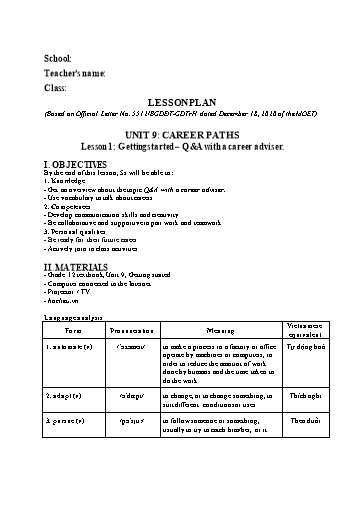
 4. look down on /ˈlʊk daʊn ɒn/ to feel that someone is less important Khinh
 than you or does not deserve respect thường
 5. in demand /ɪn dɪˈmɑːnd/ needed or wanted by many people Yờu cầu,
 mong muốn,
 đũi hỏi
 6. soft skills (n) /ˈsɒft skɪlz/ people's abilities to communicate with Cỏc kĩ năng
 each other and work well together mềm
 7. applicant (n) /ˈổp.lɪ.kənt/ a person who formally requests Người nộp
 something, especially a job, or to study đơn, ứng cử
 at a college or university viờn
 8. come up /kʌm/ /ʌp/ to suggest or think of an idea or plan Nghĩ ra, nảy
 ra sỏng kiến
 9. keep up /kiːp/ /ʌp/ to do whatever is necessary to stay Sự duy trỡ,
 level or equal with someone or tiếp tục một
 something hoạt động
 10. Critical /ˌkrɪt.ɪ.kəl the process of thinking carefully about Tư duy phản
 thinking ˈθɪŋ.kɪŋ/ a subject or idea, without allowing biện
 feelings or opinions to affect you
 11. Job market /dʒɒb//ˈmɑː.kɪt/ the number of jobs that are available in Thị trường
 a particular place or for a particular việc làm
 type of work
 12. The sooner, as quickly as possible “Càng
 The better sớm,
 Càng tốt”
Assumption
 Anticipated difficulties Solutions
 Students may lack knowledge and - Encourage students to work in groups so that
 experiences about the topic. they can help each other.
 - Give short, clear instructions, and help if
 necessary.
III. PROCEDURES
1. WARM-UP (5 mins)
a. Objectives:
- To introduce the topic of the unit.
- To set the context for the listening and reading part.
b. Content:
- Mini game: The race - To check Ss’ comprehension of the conversation.
 - To introduce words and phrases related to career paths.
 - To help Ss identify three-word phrasal verbs.
 b. Content:
 - Task 1: Listen and read. (p.116)
 - Task 2: Read the conversation again. Decide whether the following statements are true (T)
 or false (F). (p.117)
 - Task 3: Find words and phrases in Task 1 with the following meanings. (p.117)
 - Task 4: Complete the sentences using phrasal verbs from the conversation in Task 1.
 (p.117)
 c. Expected outcomes:
 - Students can understand the lesson and do the tasks successfully.
 d. Organisation
 TEACHER’S ACTIVITIES STUDENTS’ ACTIVITIES CONTENTS
Task 1: Listen and read. (8 mins)
- Focus Ss’ attention on the title and - Students look at the picture
heading. Check if Ss understand the and answer the questions.
meaning of the phrase career - Students listen to the
adviser. Have Ss explain it, e.g. a recording.
person who gives advice about - Students read the
careers. conversation aloud.
- Set the context for listening and
reading the conversation. Encourage
Ss to give answers, but do not
confirm whether their answers are
right or wrong.
- Play the recording twice for Ss to
listen and read along. Have Ss
underline words and phrases related
to career while they are listening and
reading.
- Put Ss in pairs and have them
compare the words and phrases they
have underlined and discuss their
meaning. Then check
comprehension as a class.
- Call on some Ss to read the
conversation aloud.
Task 2: Read the conversation again. Decide whether the following statements are true (T) or false
(F). (7 mins)
- Ask Ss to work in pairs and read - Students work and compare Answer key:
each statement carefully. Ask them the answers in pairs. 1. F
to identify and underline the key 2. T
words and important information in 3. F
the statements, then read the 4. T
conversation and decide whether Task 5: Work in pairs. Student A thinks of a career and tries to explain it to student B without
telling the career’s name. Student B guesses the job. And then they swap their positions. Extra
question: Do you think your career can be replaced by AI in the future? (10 mins)
- Ask Ss to work in pairs. - Students work in pairs to Suggested answer:
- Elicit some careers and their follow the teacher’s
characters. instruction.
- Tell Ss to look at the vocabulary - Students practice in pairs.
list and Task 1 again to find ideas. - Students perform in front of
- When they know exactly what to the class.
do, ask them to work in pairs.
Teacher may go around to observe
and offer help if necessary.
- Invite some pairs to perform in
front of the class.
 e. Assessment
 - Teacher and other Ss listen to the instructions and comment.
 5. CONSOLIDATION
 a. Wrap-up
 - Teacher asks students to talk about what they have learnt in the lesson.
 b. Homework
 - Do exercises in the workbook.
 - Start preparing for the Project of the unit:
 • Ask Ss open their books at the last page of Unit 9, the Project section, look at the title
 of the project: School-leavers’ career choices
 • Explain the Project requirements: Ss will have to collect information from 10
 classmates about their career plans, and then report the survey results to the class. Their
 report should include answers to the survey questions.
 • Explain to Ss how to carry out the survey and take notes of the answers to get
 information for the report.
 • Put Ss into groups, and have them choose their group leader. Then ask them to assign
 tasks, e.g. designing the survey questionnaires, collecting information from their classmates,
 compiling and synthesizing information collected from the classmates, preparing the slides
 and writing and delivering the report, to each group member, making sure that all group
 members contribute to the project.
 • Help Ss set deadlines for each task and support them throughout the process.
 • In each of the next lessons, spend a few minutes checking Ss’ progress, helping them
 with any topic-related or functional language they need, e.g. names of different careers,
 interests, different kinds of training, different skills and solving any other problems that may
 arise with their projects.
 Board plan
 Date of teaching
 Unit 9: Career Paths
 Lesson 1: Getting started
 * Warm-up UNIT 9: CAREER PATHS
 Lesson 2: Language
I. OBJECTIVES
By the end of this lesson, Ss will be able to:
1. Knowledge
- Use the lexical items related to the topic career paths.
- Use three-word phrasal verbs correctly.
- Use sentence stress appropriately to speak with a natural rhythm.
2. Competences
- Develop communication skills
- Be collaborative and supportive in pair work and teamwork
3. Personal qualities
- Be ready for their future career.
- Actively join in class activities
II. MATERIALS
- Grade 12 textbook, Unit 9, Language
- Computer connected to the Internet
- Projector / TV
- hoclieu.vn
Language analysis
 Vietnamese
 Form Pronunciation Meaning
 equivalent
 passion (n) /ˈpổʃn/ a very powerful feeling, for example of Đam mờ
 sexual attraction, love, hate, anger, or
 other emotion
 passionate (adj) /ˈpổʃənət/ showing or caused by strong feelings Say đắm
 or a strong belief
 work experience /ˈwɜːk a period of time that a young person, Kinh nghiệm
 (n) ɪkspɪəriəns/ especially a student, spends working in làm việc
 a company as a form of training
 Sentence stress and rhythm
 • Content words (e.g. main verbs, nouns, adjectives, and adverbs) are often stressed, while
 grammatical words (e.g. conjunctions, pronouns, prepositions, auxiliaries, and articles) are not.
 • This combination of stressed and unstressed syllables produces the rhythm of spoken English.
 • To sound natural and fluent, you should try to stress the correct words in your spoken
 sentences.
 Three-word phrasal verbs
 • In addition to two-word phrasal verbs, there are three-word phrasal verbs that usually consist
 of a verb, an adverb, and a preposition.
 Some three-word phrasal verbs may have an obvious meaning that we can guess from the parts. e. Assessment
 - Teacher observes and gives feedback.
 2. ACTIVITY 1: PRONUNCIATION (10 mins)
 a. Objectives:
 - To help Ss recognise sentence stress and practise speaking sentences with natural rhythm.
 - To help Ss practise saying sentences with correct stress and natural rhythm.
 b. Content:
 - Task 1: Listen and repeat. Pay attention to the sentence stress and rhythm. (p.118)
 - Task 2: Underline the stressed words in the sentences. Listen and check. Then practise
 saying the sentences with a natural rhythm. (p.118)
 c. Expected outcomes:
 - Students can understand the lesson and do the tasks successfully.
 d. Organisation
 TEACHER’S ACTIVITIES STUDENTS’ ACTIVITIES CONTENTS
Task 1: Listen and repeat. Pay attention to the sentence stress and rhythm. (4 mins)
- Have students look at the Remember - Students read the Remember Box Audio scripts
box to revise sentence stress and rhythm. - Students listen to the recording 1. It depends on the
Have them revise the types of words that and check the sentence stress. industry and the field
are often stressed in sentences: nouns, - Students listen again and repeat of work that you are
verbs, adjectives, and adverbs. the sentences. interested in.
- Play the recording for Ss to listen and 2. There are many
repeat. Ask Ss to pay attention to the jobs that don’t
sentence stress and natural rhythm. require a university
- Have Ss work in pairs to say these degree.
sentences with the correct sentence stress 3. These soft skills
and natural rhythm. will help you adapt
 to changes and come
 up with solutions to
 challenging
 problems.
Task 2: Underline the stressed words in the sentences. Listen and check. Then practise
saying the sentences with a natural rhythm. (6 mins)
- Ask Ss to listen to the sentences and - Students listen to the recording Answer key:
underline the stressed words. and check the stressed words 1. I’d like to apply
- Play the recording several times, if - Students listen again and repeat for the position of
necessary, pause after each sentence for the sentences. Assistant
Ss to repeat. Teacher.
- Check answers as a class. 2. We’ve received a
- Put Ss into pairs and have them practise lot of application
saying these sentences. Walk round the
 letters.
class, praising pairs for good effort and
 3. We’ve chosen the
saying the sentences with correct sentence
stress and natural rhythm. best applicants to
 interview.
 4. Successful
 applicants will phrases, ‘pursue  passion for’ is
best suited.
- Check answers as a class. Have
individual Ss call out the phrase they
have used in each sentence.
- Confirm the correct answers. Ask
Ss to explain why they have chosen
the phrase for each sentence using
context clues, e.g. In the second
sentence, the phrases ‘earned some
money’ and ‘from my previous part-
time jobs’ give us a hint that the
phrase ‘gain work experience’ is the
answer.
- Ask individual Ss to read the
complete sentences.
 e. Assessment
 - Teacher observes and gives feedback.
 4. ACTIVITY 3: GRAMMAR (16 mins)
 a. Objectives:
 - To help Ss recognise and practise perfect gerunds.
 - To help further practise three-word phrasal verbs in making true sentences about the career
 path of someone that they know.
 b. Content:
 - Task 1: Match the verbs in 1–4 with the adverbs (a–d) and the prepositions in a-d to make
 complete sentences. (p 119)
 - Task 2: Work in pairs. make true sentences about the career path of someone you know,
 using three-word phrasal verbs. (p 119)
 c. Expected outcomes:
 - Students can understand the lesson and do the tasks successfully.
 d. Organisation
 TEACHER’S ACTIVITIES STUDENTS’ ACTIVITIES CONTENTS
Task 1: Match the verbs in 1–4 with the adverbs (a–d) and the prepositions in a-d to make
complete sentences. (8 mins)
- Ask Ss to look at the Remember! - Students work and check in Answer key:
box and read the notes about three- pairs. 1. through - C
word phrasal verbs. Check - Students practice reading the 2. up - D
understanding by asking, e.g. Can sentences. 3. forward - A
we guess the meaning of all three- 4. down - B
word phrasal verbs from their parts?
(No, only some three-word phrasal
verbs have an obvious meaning that
we can guess from the parts. Many
three-word phrasal verbs have
idiomatic meanings); Where does an
object of a three-word phrasal verb
File đính kèm:
- ke_hoach_bai_day_tieng_anh_lop_12_global_success_theo_cv5512.docx
