

Kiểm tra 15 phút Tiếng Anh Lớp 11 Global Success - Unit 1+2 - Đề 1 (Có đáp án)
 7 trang
19/11/2025
1210
7 trang
19/11/2025
1210
Bạn đang xem tài liệu "Kiểm tra 15 phút Tiếng Anh Lớp 11 Global Success - Unit 1+2 - Đề 1 (Có đáp án)", để tải tài liệu gốc về máy hãy click vào nút Download ở trên.
Tóm tắt nội dung tài liệu: Kiểm tra 15 phút Tiếng Anh Lớp 11 Global Success - Unit 1+2 - Đề 1 (Có đáp án)
 Several studies demonstrate how wealth disparities have changed over time or between nations.
 Instead, the OECD report examines how inequality changes as people become older. People's
 salaries typically vary depending on whether they pursue occupations or not. When a generation
 enters their late 50s, this inequality hits its highest point. Yet after that, it tends to decline as
 individuals retire on redistributive state pensions and give up the rat race, which tends to provide
 more to everyone who enters. According to the OECD, old age is a "leveller". After all, retirement
 flattens wages by giving money to the elderly from younger, working taxpayers rather than shifting
 wealth from rich seniors to the poor.
 Compared to Generation X (born primarily in the 1970s) and millennials (the 1980s and after), baby
 boomers (mainly born in the 1950s) have far more wealth (real estate, stocks, and other savings).
 But some of that is due to the fact that they have had more time. Young adults nowadays have a lot
 more spare income than people in past generations did at the same age. When an elderly codger
 describes how things were worse "when I was your age," children may groan impatiently. Though it
 was.
 Compared to those who were born a decade or two earlier, Gen-Xers were far more at ease in their
 30s. Nevertheless, now that they are in their 40s, they are no longer experiencing salary growth,
 whereas their seniors did at the same age.
 (Adapted from https://www.economist.com/nance-and-economics/The generation gain)
1. Which of the following can be the title of the paragraph?
 A. The OECD report depends on whether older people pursue their career or not.
 B. Millennials are doing better than the baby boomers did at their age.
 C. The dierentiation between generations has changed.
 D. Wealth disparities have changed a lot over time.
2. When does the inequality in wealth reach its peak?
 A. When people become older. B. When people pursue occupations or not.
 C. When people pursue occupations or not. D. When a generation enters their late 50s.
3. The word “it” in paragraph 1 refers to ______.
 A. a generation B. occupations
 C. zenith D. inequality
4. According to the paragraph, why are Gen X and millennials not as wealthy as baby boomers?
 A. Because they are working harder.
 B. Because they have had more time.
 C. Because their parents had worked so hard.
 D. Because they are smarter.
5. How does a youngster act when an elderly says that things were worse “when I was your age”?
 A. Smile. B. Groan patiently.
 C. Cry impatiently. D. Sigh with impatience.
WRITING
Mark the letter A, B, C, or D to indicate the correct sentence written from the words given
1. Hometown /change / lot / I / leave. ANSWER KEY
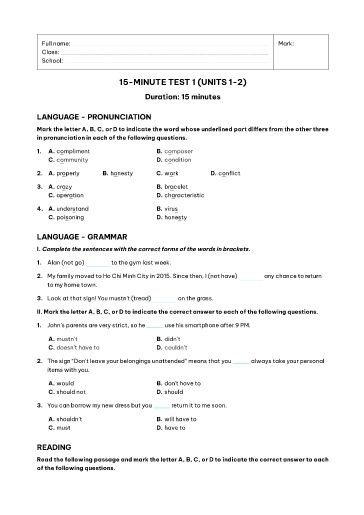
LANGUAGE - PRONUNCIATION
Mark the letter A, B, C, or D to indicate the word whose underlined part diers from the other three
in pronunciation in each of the following questions.
1.
2. The correct answer
 A. properly B. honesty C. work D. conflict
3. The correct answer
 A. crazy B. bracelet
 C. operation D. characteristic
4. The correct answer
 A. understand B. virus
 C. poisoning D. honesty
LANGUAGE - GRAMMAR
I. Complete the sentences with the correct forms of the words in brackets.
1. The correct answer
 Alan (not go) didn’t go/did not go to the gym last week.
2. The correct answer
 My family moved to Ho Chi Minh City in 2015. Since then, I (not have) haven’t had/have not had any
 chance to return to my home town.
3. The correct answer
 Look at that sign! You mustn't (tread) tread on the grass.
II. Mark the letter A, B, C, or D to indicate the correct answer to each of the following questions.
1.
2. The correct answer
 A. would B. don't have to
 C. should not D. should
3. The correct answer
 A. shouldn’t B. will have to
 C. must D. have to
READING
Read the following passage and mark the letter A, B, C, or D to indicate the correct answer to each
of the following questions. A. My hometown changed a lot since I leave.
 B. My hometown changed a lot since I left.
 C. My hometown has changed a lot since I left.
 D. My hometown will change a lot since I left.
2.
3. The correct answer
 A. Young people’s concept of happiness have changed a lot recently.
 B. Young people’s has changed concept of happiness a lot recently.
 C. Young people’s concept of happiness has changed a lot recently.
 D. Young people’s have changed concept of happiness a lot recently.
4. The correct answer
 A. We have started taking a course on eective communication strategies since last week.
 B. We have to take a course on eective communication strategies last week.
 C. We took a course on eective communication strategies since last week.
 D. We took a course on eective communication strategies last week.
5.
File đính kèm:
- kiem_tra_15_phut_tieng_anh_lop_11_global_success_unit_12_de.pdf


