

Kiểm tra Tiếng Anh Lớp 12 Global Success - Unit 1: Life stories we admire - Test 2 (Có đáp án)
 5 trang
10/10/2025
4810
5 trang
10/10/2025
4810
Bạn đang xem tài liệu "Kiểm tra Tiếng Anh Lớp 12 Global Success - Unit 1: Life stories we admire - Test 2 (Có đáp án)", để tải tài liệu gốc về máy hãy click vào nút Download ở trên.
Tóm tắt nội dung tài liệu: Kiểm tra Tiếng Anh Lớp 12 Global Success - Unit 1: Life stories we admire - Test 2 (Có đáp án)
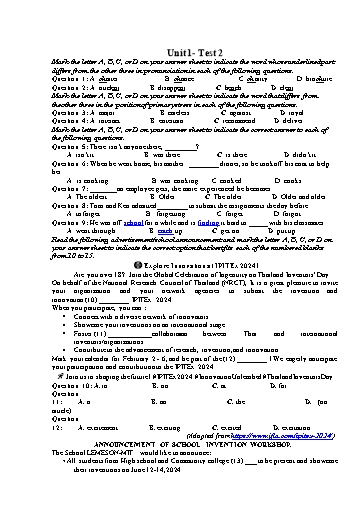
 • You’ll hear from expert speakers, educators, and colleagues about activities and techniques
 that help diverse student populations develop confidence in their ability to (14) ____ in
 STEM.
 • You will participate in small group workshops to develop skills tailored to your interests.
Meet and work with thought leaders in education as well as our Invention Education Fellows
educators who have extensive experience incorporating invention education into the classroom.
Click here to meet the Fellows (15) ____ you’re interested in this Workshop.
Question 13: A. are encouraged B. be encouraged C. encouraged D. have
encouraged
Question 14: A. take B. engage C. improve D. update
Question 15: A. should B. and C. were D. if
 (Adapted from https://lemelson.mit.edu )
Mark the letter A,B,C, or D on your answer sheet to indicate the correct arrangement of the
sentences to make a meaningful paragraph/letter in each of the following questions.
Question 16:
a. Firstly, the process of invention often involves identifying a problem or need in society.
b. This is followed by brainstorming ideas and conducting research to find possible solutions.
c. Once a viable solution is conceptualized, inventors move on to prototyping and testing their
invention.
d. Invention is a crucial driver of progress and innovation in society.
e. Finally, after refining the invention based on feedback and testing results, it can be brought to
market or implemented for practical use.
A. d - a - b - c – e B. a - b - c - d – e C. b - c - a - d – e D. d - b - a - c - e
Question 17:
a. However, it has lots of storage, it's very cheap.
b. Hi, Anna, Guess what! I want to get a smartphone for playing games.
c. I can't wait to show it to you!
d. At first, The Royal 1000 looks great, but the camera isn't as good as some other phones.
e. Mike knows a lot about phones and computers, and he helped me choose my birthday
smartphone.
f. See you soon!
A. b - c- a- e- d- f B. b - d - e - a - c - f
C. b- a- d- e- c- f D. b- e- d- a- c- f
Mark the letter A,B,C, or D on your answer sheet to indicate the correct option that best fits
each of the numbered blanks from 18 to 23
 Many intentions have been created throughout history. Many of them have changed our
lives. In my opinion, the most important is the internet.
 I think the internet is important because it has changed our lives in many ways. For
example, the way we communicate has changed significantly. We can communicate with each
other instantly using the internet. Many people even spend more time connecting with family,
friends and (18) _________ . You will probably see most people are communicating with their
phones and laptops instead of talking to the person next to them (19) _________.
 The internet has also (20) _________ together in a way that was impossible before, such
as working from home and working with people from other countries. (21) _________.
 By connecting their computer to the internet, people can access the same resources wherever
they are in the world. Today, people from all over the global can work together closely without
ever meeting face-to-face, sharing views more easily and (22) _________.
 Although the internet is quite a new invention, it now plays an important role in (23)
_________. Without it, things would be very different.
Question 18:
 A. from relatives on the internet than in real life B. relatives on the internet than in
real life print books. Books became much more common after the invention of the printing press. The
books helped other inventors make new things.
 The invention of the steam engine around 1700 led to the Industrial Revolution. Inventors
made many new machines that were powered by steam engines. They invented locomotives,
steamboats, and all kinds of factory machines.
 Another great invention, the internal combustion engine, led to the invention of
automobiles in the late 1800s. Inventors made better and better internal combustion
engines. These are the engines we use today in cars, trucks, buses, and airplanes.
 The discovery of electricity led to many wonderful inventions. Many scientists studied
electricity. An American inventor named Thomas A. Edison invented the electric lamp,
phonograph, and other things that ran on electricity in the late 1800s.
 New things are invented today faster than ever before. Inventors are making new kitchen
appliances, toys, computers, video games, telephones, and all kinds of other things.
Question 29: The passage mainly ____.
 A. lists the inventions made since ancient times B. describes how inventors work to
invent things
 C. explains why inventions have been made so far
 D. talks about some of the most significant inventions
Question 30: The phrase "ran on" is closest in meaning to _______.
 A. used B. created C. consumed D. stored
Question 31: What does inventor make an invention for?
 A. To solve a problem B. To solve a problem and discovers something new by
accident
 C. To discover something new by accident D. To take up her/him favorite inventions
Question 32: Which of the following is associated with Industrial Revolution?
 A. the printing press B. the discovery of electricity
 C. the steam engine D. the internal combustion engine
Question 33: The words "These" in the passage refers to _______.
 A. inventors B. internal combustion engines
 C. automobiles D. many wonderful inventions
Read the following passage and mark the letter A, B, C, or D on your answer sheet to indicate
the correct answer to each of the questions from 34 to 40.
 Each advance in microscopic technique has provided scientists with new perspective, on
the function of living organisms and the nature of matter itself. The invention of the visible-light
microscope late in the sixteenth century introduced a previously unknown realm of single-celled
plants and animals. In the twentieth century, electron microscopes have provided direct views of
viruses and minuscule surface structures. Now another type of microscope, one that utilizes X
rays rather than light or electrons, offers a different way of examining tiny details; it should extend
human perception still farther into the natural world.
 The dream of building an X-ray microscope dates to 1895; its development, however, was
virtually hafted in the 1940's because the development of the electron microscope was progressing
rapidly. During the 1940's electron microscopes routinely achieved resolution better than that
possible with a visible-light microscope, while the performance of X-ray microscopes resisted
improvement. In recent years, however, interest in X-ray microscopes has revived, largely because
of advances such as the development of new sources of X-ray illumination. As a result, the
brightness available today is millions of times that of X-ray tubes, which, for most of the century,
were the only available sources of soft X-rays.
 The new X-ray microscopes considerably improve on the resolution provided by optical
microscopes. They can also be used to map the distribution of certain chemical elements. Some
can form pictures in extremely short times; others hold the promise of special capabilities such as
three-dimensional imaging. Unlike conventional electron microscopy, X-ray
microscopy enables specimens to be kept in air and in water, which means that biological samples
File đính kèm:
- kiem_tra_tieng_anh_lop_12_global_success_unit_1_life_stories.docx
- Unit 1 test 2(key).docx

