

Kiểm tra Tiếng Anh Lớp 12 Global Success - Unit 2: A multicultural world - Test 1 (Có đáp án)
 21 trang
10/10/2025
5952
21 trang
10/10/2025
5952
Bạn đang xem tài liệu "Kiểm tra Tiếng Anh Lớp 12 Global Success - Unit 2: A multicultural world - Test 1 (Có đáp án)", để tải tài liệu gốc về máy hãy click vào nút Download ở trên.
Tóm tắt nội dung tài liệu: Kiểm tra Tiếng Anh Lớp 12 Global Success - Unit 2: A multicultural world - Test 1 (Có đáp án)
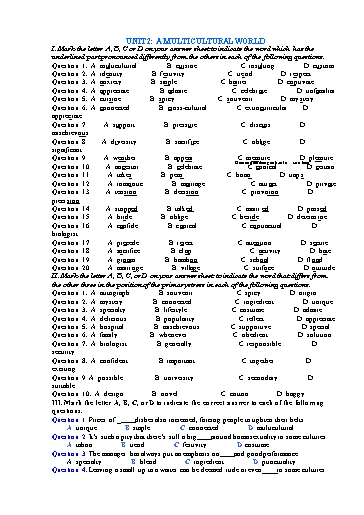
 A. unique B. fascinating C. insulting D. cultural
Question 5. We prefer to buy regional from bricks-and-mortar retailers.
 A. manners B. occasions C. specialties D. norm
Question 6. Despite the , he managed to communicate his ideas to the committee.
 A. norm B. language barrier C. cuisine D. anxiety
Question 7. Delaying parenthood is slowly becoming the in some communities.
 A. specialty B. confusion C. festivity D. norm
Question 8. I think Tet is most fascinating festival in Vietnam.
 A. the B. Ø (no article) C. an D. a
Question 9. What _ festivals do Vietnamese people celebrate?
 A. a B. an C. Ø (no article) D. the
Question 10. Some people are concerned that celebrating foreign festivals can make people lose
their sense of .
 A. specialty B. anxiety C. identity D. cuisine
Question 11. We may suffer from when we experience an unfamiliar culture for the first
time. Giaoandethitienganh.info sưu tầm
 A. lifestyle B. bamboo dancing C. tug of war D. culture shock
Question 12. We are now living in an increasingly world thanks to globalisation.
 A. staple B. extracurricular C. delicious D. connected
Question 13. Foreign tourists are fascinated by a wide variety of traditional Vietnamese .
 A. cuisines B. trends C. mysteries D. origins
Question 14. The of that ancient custom still remains a mystery to local people.
 A. origin B. confusion C. lifestyle D. identity
Question 15. Cycling has been gaining in in many parts of Vietnam.
 A. trend B. popularity C. festivity D. origin
Question 16. Cross-cultural fashion styles help to reflect the of the world.
 A. origin B. language barrier C. richness D. costume
Question 17. When I last . him, he .. in London.
 A. saw-has been living B. see- is living C. saw- was living D. have seen-
lived
Question 18. When I last saw John, he . and was out of breath.
 A. was running B. ran C. has run D. had run
Question 19. A large number of India men agreed that it was unwise to confide . their
wives.
 A. in B. on C. of D. at
Question 20. Parents are . by law to send their children to school.
 A. obliged B. confided C. demanded D. conducted
Question 21. You need to work much harder if you  any chance of passing the exam.
 A. have B. will have C. are having D. are to have
Question 22. In Vietnam, two, three, or even four generations live . one roof.
 A. in B. over C. with D. under
Question 23. Jane has become . to Roger, and the wedding will be in April.
 A. proposed B. engaged C. settled D. agreed
Question 24. You really should  your energy for the difficult climb ahead.
 A. conserve B. keep C. maintain D. preserve
Question 25. In a new culture, many embarrassing situations occur  a
misunderstanding.
 A. despite B. account of C. because of D. result in
Question 26. Are there any..................between Vietnamese and American culture?
 A. differences B. different C. differently D. differential
Question 27. Vietnamese cuisine is famous..........................a wide variety of dishes.
 A. with B. in C. for D. of 9. His career as ______ journalist was full of distinguished achievements. He was ___ respected
and admired journalist.
10. Five years ago, when Edward was 35 years old, he was diagnosed with ________ diabetes.
VI. Read the following passage and mark the letter A, B, C, or D on your answer sheet to
indicate the correct word or phrase that best fits each of the numbered blanks
 WEDDING IN VIETNAM
Tourist: Can you tell me something about (1)_________ ceremonies in Vietnam?
Tourist guide: Well, wedding is very important to the Vietnamese, (2)_________ to the
 couple involved, but also for both families.
Tourist: What does the groom’s family usually do on the wedding day?
Tourist guide: On the wedding day, the groom’s family and relatives go to the bride’s
 house bringing gifts wrapped in red paper. The people who hold the trays of the
 gifts are also (3) _________ chosen.
Tourist: Do you have someone in charge of the ceremony? And what does he do
 during the wedding ceremony?
Tourist guide: Yes, we have a (4) _________ who introduces the groom, the bride, the
 parents, the relatives and the guests of the two families. The wedding ceremony
 starts in front of the altar. The bride and the groomGiaoandethitienganh.info would pray, asking sưu tầm their
 ancestors’ permission (5)_________ married. The Master of Ceremonies gives
 the wedding couple advice on starting new family. The groom and the bride (6)
 _________ their wedding rings.
Tourist: Where is the wedding banquet held?
Tourist guide: Well, it depends. Often the wedding banquet is held at the groom and the
 bride’s (7) _________ or at a hotel or at a restaurant and all close relatives,
 friends and neighbours are invited.
Tourist: What kind of food and drinks are served?
Tourist guide: (8) _________ food and beer or wine are served. During the reception, the
 groom, the bride and their parents (9) _________ each table to thank their
 guests. The guests in turn, will give red envelops containing wedding cards and
 money to the newly wedded couples along with their blessing.
Tourist: Oh, that’s very interesting. Thank you very much.
Tourist guide: (10)____________
1. A. wedding B. marrying C. marriage D. getting married
2. A. both B. not only C. neither D. either
3. A. careful B. careless C. carefully D. carelessly
4. A. Master of Martial Arts B. Minister of Education
 C. Minister of Industry D. Master of Ceremonies
5. A. to get B. to give C. getting D. giving
6. A. give B. change C. exchange D. bring
7. A. dress B. home C. jacket D. boots
8. A. Traditional B. Transition C. Modern D. Monitor
9. A. stay up B. kneel down C. stand still D. stop by
10. A. It’s up to you! B. Money instead! C. You’re welcome! D. Never mind!
VII. Read the following passage and mark the letter A, B, C, or D on your answer sheet to
indicate the correct word or phrase that best fits each of the numbered blanks
 I have been traveling to different parts of my country, and I (1)_________ a lot about
interesting lifestyles and customs. Once, I (2) _________ to the Northwestern places of the
country. In many ethnic villages I (3) _________ to, I was impressed by some of their beautiful
traditional customs. For instance, most of the villagers (4)_________ in extended families, and
they held a close relationship among family members. In addition, young people always
(5)_________ their respect for their ancestors and for their elderly people. People (6) _________
also willing to give a hand when someone was in need. Members of the family helped one Mark the letter A, B, C, or D on your answer sheet to indicate the correct arrangement of the
sentences to make a meaningful paragraph/letter in each of the following questions.
 Question 9.
 a. Finally, would you mind telling me if there are native German-speaking teachers at
 your language centre?
 b. First, could you please let me know whether there are German courses at your
 language centre?
 c. Dear Sir or Madam, I am writing to ask for some information about the language
 courses at your language centre.
 d. I look forward to hearing from you.
 e. Yours faithfully,
 f. Next, I would also like to know how long the course for beginners lasts and how often
 classes take place.
 A. c - d - b - f - a - e B. c - f - b - a - e - d C. c - b - d - f - a - e D. c - b - f - a -
d - e
 Question 10.
 a. Next, it enables you to build better relationships with people because through frequent
 sports you can get to know a lot about others' personalities.
 b. First, playing sports helps reduce the stress and gives you more energy in your life.
 c. In short, people should play sports regularly because it brings lots of advantages.
 d. Lastly, it improves your health. When playing sports, the body is protected from
 different types of harmful bacteria and viruses.
 e. Playing sports brings a lot of advantages.
 A. e - a - b - d - c B. e - b - a - d - c C. b - a - d - c - e D. c - b - a - e - d
IX. Mark the letter A, B, C, or D on your answer sheet to indicate the correct option that best
fits each of the numbered blanks.
 Nowadays more and more teenagers are getting involved in community activities.
Some may join different charity groups to help the needy in their neighborhoods or other
areas. (1)_______ and develop their own plans to help people in the community. These may
include various community activities, such as donating old clothes, (2)_______ , and organizing
after-school activities for children.
 (3)_______ , they gain numerous benefits. First, they come into contact with other teenagers
who share similar interests. Secondly, teenagers can learn and improve (4)_______ . Thirdly,
community activities can increase teenagers' self-confidence and (5)_______ . Finally, doing
volunteer work in the community is the perfect opportunity (6)_______ essential leadership
experience that all employers want to see.
 Question 1.
 A. When others may set up volunteer clubs at their schools
 B. Others may set up volunteer clubs at their schools
 C. Setting up volunteer clubs at their schools to help
 D. If they want to set up volunteer clubs at their schools
 Question 2.
 A. cleaning up the environment B. to clean up the environment
 C. they can clean up the environment D. clean up the environment
 Question 3.
 A. To take part in community activities B. Teenagers taking part in community
activities
C. When teenagers take part in community activities D. Teenagers must take part in
community activities
 Question 4.
 A. our life skills B. these life skills C. its life skills D. their life skills
 Question 5. Question 5: A. make B. take C. get D. give
XI. Read the following passage and mark the letter A, B, C, or D on your answer sheet to
indicate the correct answer to each of the questions.
 Most weddings in Japan start with a religious ceremony in which usually only family
members attend. Afterwards, a banquet is customarily held to which many people, including
friends and colleagues, are invited. To celebrate the happy occasion, guests give the bride and
groom goskuugi - gift money in special envelopes. Goskuugi from friends is usually 20,000 yen
or 30,000 yen.
 A typical Japanese wedding party starts when the bride and groom enter the banquet hall
together, and take their seats on a slightly raised platform facing their guests. Invited guests are
seated closer to the bride and groom, with family and relatives seated further in back. The bride's
and groom's bosses usually give congratulatory speeches then their friends sing in celebration.
Other wedding highlights include a candle ceremony where the couple holds a candle while
greeting their guests at each table, and the cutting of the wedding cake. Afterwards, the bride and
groom thank their parents with a speech, then leave to end the party.
 In the past, dishes that suposedly brought good fortune, such as prawns and sea breams,
were served in abundance. So much of the food was ordered that guests ended up taking the
surplus home. Today, the majority of the weddings serve just enough for everyone. Additionally,
before leaving, guests would traditionally receive souvenir gifts called hikidemono.
 Many wedding ceremonies take place at wedding halls or hotels. Rough estimates show
that it costs about 3 million yen to host a wedding party for 80 guests. During Japan's economic
hubble, overseas weddings and flamboyant receptions with special effects, such as smoke
machines and having the bride and groom fly in on gondolas, were very popular. But these days,
couples choose to tie the knot in various ways, from not having any ceremony to having a
modest affair, or still going all out. (Source:
Question 1. What is the main idea of this passage?
A. Dishes served at Japan's wedding parties in the past B. Wedding ceremonies in Japan's
economic hubble
C. Popular wedding gifts in Japan D. Wedding ceremonies in Japan
Question 2. According to the passage, goshuggi is......
A. a kind of gift B. a happy ocxcasion C. a type of food D. an important
guest
Question 3. The word "their" in paragrpah 2 refers to......
A. the relatives' B. the friends' C. the couple's D. the parents'
Question 4. According to paragraph 2, which of the following do the bride and groom do at their
wedding party?
A. They hold a candle and sing in celebration. B. They give a speech to thank their bosses.
C. They deliver a speech to thank their parents. D. They sit on a platform at the back of the
stage.
Question 5. The word "fortune" in paragraph 3 is closest in meaning to......
A. money B. benefit C. excitement D. luck
XIII. Read the following passage and mark the letter A, B, C, or D on your answer sheet to
indicate the correct answer to each of the questions.
 Most people want to be polite and behave well around others. Being polite involves good
manners of eating and appropriate ways of greeting and talking to people, and giving and
receiving gifts. Polite behaviours may differ from culture to culture.
 In the United State, people prefer to shake hands firmly for a few seconds. In some
Middle Eastern countries, people hold the person’s hand gently for a longer time. What about
eye contact? In some countries you show respect when you look at someone directly in the eye.
In other parts of the world, looking at someone directly can be rude. Another difference is
File đính kèm:
- kiem_tra_tieng_anh_lop_12_global_success_unit_2_a_multicultu.docx
- UNIT 2 test 1(key).docx

