

Kiểm tra Tiếng Anh Lớp 12 Global Success - Unit 3: Green living - Test 1 (Có đáp án)
 9 trang
10/10/2025
10332
9 trang
10/10/2025
10332
Bạn đang xem tài liệu "Kiểm tra Tiếng Anh Lớp 12 Global Success - Unit 3: Green living - Test 1 (Có đáp án)", để tải tài liệu gốc về máy hãy click vào nút Download ở trên.
Tóm tắt nội dung tài liệu: Kiểm tra Tiếng Anh Lớp 12 Global Success - Unit 3: Green living - Test 1 (Có đáp án)
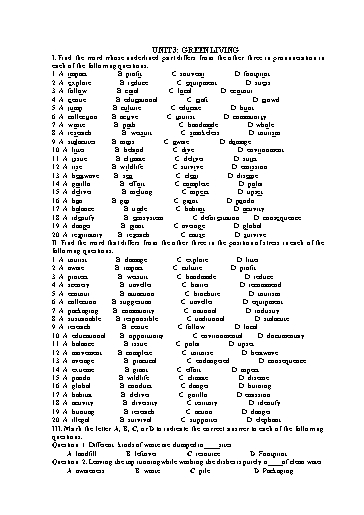
 Question 3. We organised a community event to the polluted beaches.
 A. get rid of B. go green C. rinse out D. clean up
Question 4. By taking fewer flights, we can help to reduce significantly.
 A. cardboard B. leftover C. fruit peel D. carbon footprint
Question 5. Plastic bags very slowly, which poses a threat to the ecosystem.
 A. release B. reuse C. decompose D. recycle
Question 6. Protecting the environment is crucial for a more future.
 A. sustainable B. reusable C. single-use D. recyclable
Question 7. We can use leftovers to make simple to enrich the soil.
 A. waste B. container C. compost D. layer
Question 8. The ocean was as a result of a recent oil spill.
 A. sorted B. decomposed C. recycled D. contaminated
Question 9. Many celebrities adopt a green lifestyle, helps the environment a lot.
 A. that B. what C. whose D. which
Question 10. Unless people poaching animals, many species will become extinct.
 A. stopped B. stop C. had stopped D. to stop
Question 5. Recyclable products should not be ended up in open sites.
 A. landfill B. leftover C. resource D. footprint
Question 11. Ms. Brown often uses leftovers to make her own _.
 A. waste B. container C. compost D. layer
Question 12. The water has become undrinkable because it has been with lead.
 A. sorted B. decomposed C. recycled D. contaminated
Question 13. They extensive research on the environmental effects of using fake Christmas
trees.
 A. turned off B. carried out C. look after D. applied for
IV. Put in at or to where necessary.
1. They only invited a few people ...............their wedding.
2. Look...............these flowers. Aren’t they pretty?
3. Please don’t shout...............me. Be nice to me!
4. I saw Sue as I was cycling along the road. I shouted ...............her but she didn’t hear me.
5. Don’t listen...............what he says. He doesn’t know what’s he talking about.
6. Can I speak ...............you for a moment? There’s something I want to ask you.
7. Do you think I could have a look...............your newspaper, please?
8. I’m a bit lonely. I need someone to talk................
9. She was so angry. She threw a chair ...............me.
10. The woman sitting opposite me on the train kept staring...............me.
V. Put in to where necessary.
1. I know who she is but I’ve never spoken...............her.
2. George won’t be able to help you, so there’s no point in asking...............him.
3. I like to listen ...............the radio while I’m having breakfast.
4. We’d better phone ...............the restaurant to reserve the table.
5. I apologized...............Bridget for the misunderstanding.
6. Don’t forget to write...............me while you’re away.
7. I thanked ...............everybody for all the help they had given me.
8. I explained...............everybody what they had to.
9. Mike described ...............me how the accident happened.
10. I’d like to ask ...............you some questions.
VI. Put in the correct preposition where necessary.
1. I’m not going out yet. I’m waiting...............the rain to stop.
2. you’re always asking me ...............money. Ask somebody else ...............a change.
3. I’ve applied...............a job at the factory. I don’t know if I’ll get it.
4. If I want a job at the factory. Who did I apply ...............? Question 14. A. powered B. reusable C. extinct D. conscious
 Question 15. A. basing on B. applying for C. turning off D. cutting down
 Question 16. A. set B. choose C. keep D. have
Mark the letter A, B, C, or D on your answer sheet to indicate the correct arrangement of the
sentences to make a meaningful paragraph for the following question.
Question 17.
a. Second, it prevents environmental destruction by promoting sustainable practices.
b. Making small changes today can lead to a more sustainable and prosperous tomorrow.
c. By reducing single-use items, we conserve resources and minimise waste.
d. Going green offers numerous advantages for both individuals and the planet.
e. First, it helps reduce our carbon footprint, lessening the harm caused by greenhouse gases.
Additionally, going green raises awareness about environmental issues, fostering a sense of
responsibility towards the Earth.
f. Finally, embracing eco-friendly habits not only benefits the environment but also promotes
healthier lifestyles for ourselves and future generations.
A. d – e – a – b – c – f – g B. b – d – e – a – c – f – g
C. d – e – a – c – f – g – b D. d – e – a – c – g – f – b
Question 18.
a. Therefore, we recommend that you put the suggested solutions into practice as soon as
possible.
b. Third, we recommend that we make use of plastic waste in arts and crafts projects, for
example, for making plant pots or bird feeders.
c. Second, the Youth Union should hold regular sessions to teach students how to recycle
properly.
d. This report suggests three main solutions to the problem of single-use products in our school.
e. First, we suggest that the school should provide more recycling bins.
f. Reusing and recycling single-use plastics will lead to a greener school environment and help
promote a green lifestyle among young people.
A. d – e – c – f – b – a B. d – e – c – b – a – f
C. d – e – b – c – f – a D. d – e – c – b – f – a
IX. Mark the letter A, B, C, or D on your answer sheet to indicate the correct option that
best fits each of the numbered blanks from 14 to 18.
 Using plastic bags poses several disadvantages to (1) . Firstly, plastic bags often end up
in landfills, where they take hundreds of years to decompose, (2) . Secondly, many
plastic bags are not reused or recycled, worsening the waste problem.
 Thirdly, plastic bags can contaminate soil and waterways, harming wildlife and ecosystems.
Moreover, the production of plastic bags (3) _ and contributes to greenhouse gas emissions.
Finally, (4)
 causes environmental degradation and then increases human health risks. (5) , it is
essential to reduce the use of plastic bags and adopt more sustainable alternatives.
Question 1.
A. either the environment nor human health Question 3: A. other B. every C. one D. another
Question 4: A. Therefore B. In addition C. although D. However
Question 5: A. accompany B. access C. account D. accomplish
XII. Read the following passage and mark the letter A, B, C or D to indicate the correct
answer to each of the questions.
 Millions of animals are killed by plastics every year, from birds to fish to other marine
organisms. Nearly 700 species, including endangered ones, are known to have been affected by
plastics. Nearly every species of seabird eats plastics.
 Most of the deaths to animals are caused by starvation. Seals, whales, turtles, and other
animals are trapped by fishing nets. Microplastics have been found in more than 100 marine
species, including fish and shrimp which are for our dinner plates. In many cases, these tiny bits
pass through the digestive system and are released without consequence. But plastics have also
been found to have blocked digestive organs, causing death. Stomachs packed with plastics
reduce the urge to eat, causing starvation.
 Plastics have been consumed by land-based animals, including elephants, zebras, tigers,
cattle, and other large mammals, in some cases causing death.
 Tests have also confirmed damage to liver and reproductive systems, causing some
species, such as oysters, to produce fewer eggs. New research shows that fish are eating
nanoplastics in the first days of life, raising new questions about the effects of plastics on fish
populations.
 Source: https://www.nationalgeographic.com/environment/article/plastic-pollution
Question 1: What would be the most suitable title for the passage?
 A. How to Deal with Plastic in Ocean B. Plastic Pollution: A Threat to wildlife
 C. The Role of Nanoplastics in Ecosystems D. Plastic Pollution and Its Causes
Question 2: How do most animals die when affected by plastics?
 A. starvation B. accident C. poisoning D. disease
Question 3: The word “which” in paragraph 2 refers to _________.
 A. microplastics B. species C. cases D. fish and shrimp
Question 4: The word “packed” in paragraph 2 is CLOSEST in meaning to _________.
 A. big B. hurt C. filled D. harmful
Question 5: Which of the following is NOT true according to the passage?
 A. Plastics have been found in more than 100 marine species, including fish and shrimp.
 B. Plastics have been consumed by both marine and land-based animals.
 C. All species of seabirds consume plastics.
 D. Micro plastics have been found to block digestive organs, causing death in some cases.
XIII. Read the following passage and mark the letter A, B, C or D to indicate the correct
answer to each of the questions.
 Forests cover 31% of the land area on our planet. They help people thrive and survive
by, for example, purifying water and air and providing people with jobs; some 13.2 million
people across the world have a job in the forest sector and another 41 million have a job that is
related to the sector. Many animals also rely on forests. Forests are home to more than three-
quarters of the world’s life on land. Forests also play a critical role in reducing climate change
because they act as a carbon sink - soaking up carbon dioxide that would otherwise be free in
the atmosphere and contribute to ongoing changes in climate.
 But forests around the world are under threat, which affects these benefits. The threats
are deforestation and forest degradation. The main cause of deforestation is agriculture (poorly
planned infrastructure is developing as a big threat too) and the main cause of forest degradation
is illegal tree-cutting. In 2019, the tropics lost close to 30 soccer fields’ worth of trees every
single minute.
 Deforestation is a particular concern in tropical rain forests because these forests are
home to much of the world’s biodiversity. For example, in the Amazon around 17% of the forest
has been lost in the last 50 years, mostly due to forest change for cattle raising. Deforestation in materials could he heated to boiling, but air could reenter. The bends in the neck prevented
microorganisms from getting in the flask. Material sterilized in such a flask did not putrefy.
Question 1. What does the passage mainly discuss?
 A. Pasteur’s influence on the development of the microscope
 B. The origin of the theory of spontaneous generation
 C. The effects of pasteurization on food
 D. Pasteur’s argument against the theory of spontaneous generation
Question 2. According to paragraph 1, spontaneous generation is a process by which ______.
 A. living organisms originate from nonliving matters
 B. bacteria come from the air
 C. microscope was used to examine living organisms
 D. fresh food was observed before it putrefies
Question 3. The phrase trapped in paragraph 2 is closest in meaning to ______.
 A. caught B. found C. released D. developed
Question 4. The word postulated in paragraph 3 is closest in meaning to ______.
 A. analyzed B. doubted C. persuaded D. suggested
Question 5. The word it in paragraph 4 refers to ______.
 A. a glass flask B. a nutrient solution C. boiling D. spontaneous
generation
Question 6. Which of the following is NOT TRUE according to the passage?
 A. Early 19th century, many people still thought that bacteria developed from nonliving
 matter.
 B. Pasteur discovered that structures found in air are different from microorganisms
 growing on putrefying materials.
 C. According to Pasteur, the organisms found in putrefying materials originated from those
 existing in the air.
 D. According to the theory, fresh air played a vital role in the process of spontaneous
 generation.
Question 7. Which of the following can be inferred from the passage?
 A. A swam-necked flask is used to store sterilized liquids for use in future experiments.
 B. Pasteur did the experiment to support the idea of spontaneous generation.
 C. Pasteur employed a swam-necked flask to disprove a criticism of his conclusions.
 D. The purpose of the study by Pasteur was to estimate the number of organisms in a liter
 of air.
XV. Read the following passage on transport, and mark the letter A, B, C, or D on your
answer sheet to indicate the correct answer to each of the questions from 44 to 50
 Humans are bringing about another global-scale change in the atmosphere: the increase in
what are called greenhouse gases. Like glass in a greenhouse, these gases admit the Sun's light
but tend to reflect back downward the heat that id radiated from the ground below, tarpping heat
in the Earth's atmosphere. This process is known as the greenhouse effect. Carbon dioxide is the
most significant of these gases - there is 25 percent more carbon dioxide in the atmosphere today
than there was a century ago, the result of our burning coal and fuels derived from oil. Methane,
nitrous oxide, and CFCs are greenhouse gases as well.
 Scientists predict that increases in these gases in the atmosphere will make the Earth a warmer
place. They expect a global rise in average temperature somewhere between 1.0 and 3.5 degrees
Celsius in the next century. Average temperatures have in fact been rising, and the years from
1987 to 1997 were the warmest years on record. Some scientists are reluctant to say that global
warming has actually begun because climate naturally varies from year to year and decade to
decade, and it takes many years of records to be sure of a fundamental change. There is a little
disagreement, though, that global warming is looming.
 Global warming will have different effects in different regions. A warmed world is expected to
have a more extreme weather, with more rain during wet periods, longer droughts, and more
File đính kèm:
- kiem_tra_tieng_anh_lop_12_global_success_unit_3_green_living.docx
- UNIT 3 test 1(key).docx

