

Kiểm tra Tiếng Anh Lớp 12 Global Success - Unit 3: Green living - Test 2 (Có đáp án)
 5 trang
10/10/2025
4490
5 trang
10/10/2025
4490
Bạn đang xem tài liệu "Kiểm tra Tiếng Anh Lớp 12 Global Success - Unit 3: Green living - Test 2 (Có đáp án)", để tải tài liệu gốc về máy hãy click vào nút Download ở trên.
Tóm tắt nội dung tài liệu: Kiểm tra Tiếng Anh Lớp 12 Global Success - Unit 3: Green living - Test 2 (Có đáp án)
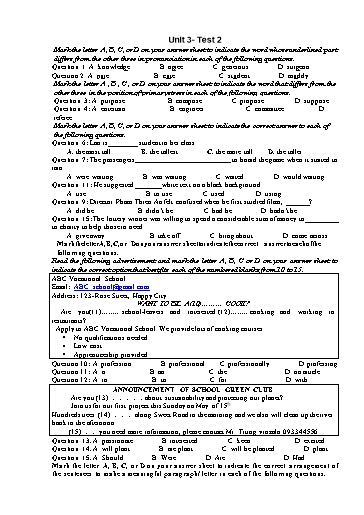
 Question 16.
 a. I am young and energetic, and I am always interested in voluntary activities to help the
community.
 b. Dear Sir or Madam,
 c. I look forward to hearing from you.
 d. I am available for an interview on any weekday afternoon or at weekends. If my
 application is successful, I can start work immediately.
 e. I am writing to apply for a volunteer position at the local food bank.
 A. b - e - a - d - c B. b-d-c-a-e C. e- a-b-c-d D. b- e -a-c-d
Question 17.
 a. Firstly, volunteering is often associated with physical activities and outdoor events,
 promoting a healthier lifestyle. In addition, volunteering can increase cultural awareness.
 b. So, what are the pros and cons of doing volunteer work when you are at school age?
 c. On the other hand, if a teenager is dealing with physical or mental health issues, taking on
additional responsibilities through volunteer work may not be advisable.
 d. Joining a volunteer program: should or should not?
 e. In conclusion, the decision to engage in volunteer work should be based on the individual
teenager's circumstances, interests, and personal well-being.
 f. Nowadays, many students participate in volunteer programs in the local community.
 A. d – f – b – a – c – e B. b – d – c – a – e - f
 C. a – b – c – d – f - e D. e – f- b – a – c – d
Mark the letter A, B, C, or D on your answer sheet to indicate the correct option that best
fits each of the numbered blanks from 18 to 23.
 Self-study, the act of learning independently without direct supervision, offers numerous
benefits for individuals seeking to expand (18)..
 Firstly, self-study promotes autonomy and self-discipline, as learners take responsibility
for their own learning journey. This cultivates essential skills such as time management and
perseverance, (19). but also in various aspects of life.
 Secondly, self-study allows learners (20).to their unique needs and
preferences. They can choose the materials, resources, and pace that best suit their learning style,
maximizing understanding and retention of information.
 Additionally, self-study encourages critical thinking and (21)., as learners
actively engage with the material, seeking solutions independently.
 Moreover, self-study fosters a sense of empowerment and confidence, as individuals
witness their own progress and achievements firsthand. Furthermore, self-study can be more
flexible and cost-effective compared to formal education, as it eliminates the constraints of
schedules and tuition fees.
 Overall, self-study offers a wealth of benefits. (22) ..., you don’t have to pay for
extra classes, empowering individuals with autonomy, customization, critical thinking,
confidence, flexibility, and cost-effectiveness. It facilitates lifelong learning
and (23)
Question 18. A.its knowledge and skills. B. her knowledge and skills.
 C. their knowledge and skills. D. our knowledge and skills.
Question 19. A. which are valuable not only in education
 B. that are valuable not only in education
 C. Itis valuable not only in education
 D. which are valuable only in education
Question 20. A. to tailor their learning experience B. tailoring their learning experience
 C. tailor their learning experience D. to tailoring their learning experience
Question 21. A. problem-solution skills B. problem-solving skills
 C. problem-solve skills D. to problem-solving skills
Question 22. A. When you learn by yourself B. To learn by yourself A. He started living in Ha Noi in 1890.
 B. He opened a university by himself.
 C. He could find an effective method for treating malaria.
 D. He had a house in Nha Trang, which was turned into a pharmacy.
Question 33: Which of the following is NOT mentioned in paragraph 2?
 A. Yersin established a small laboratory in Nha Trang in 1895
 B. He started to grow corn, rice, and coffee to fund the laboratory.
 C. He planted rubber tree in Indochina.
 D. He prepared serums against the disease in human beings and cattle
Read the following passage and mark the letter A, B, C or D on your answer sheet to indicate
the correct to each of the question from 34 to 40.
 It is not surprising that the birthplace of cola was the hot and humid American South. This
region had long specialized in creating delicious soft drinks. A druggist in Atlanta, Georgia named
John Pemberton created the most well-known drink brand in the world in the 1880s. However, it
seems clear that he had no idea how big it would become.
 Like many American pharmacists of the day, Pemberton was opposed to the drinking of
alcohol and wanted to produce a stimulating soft drink. First, he made "the French Wine of Coca,"
made from the coca leaf. Then he began to experiment with the cola nut. Eventually, he managed
to make a combination of the two that he thought was sweet, but not too sweet. Deciding that "the
two C's would look well in advertising," he named it Coca-Cola.
 Pemberton's invention caught on fairly quickly. By 1905, "Coke" was being advertised all
over the country as "The Great Natural Temperance Drink." The drink enjoyed additional success
since there was a large and popular temperance movement in the US at that time. In the 1920s,
alcohol was outlawed, and sales of Coke rose significantly. However, they continued to rise even
after the law was repeated.
 Another reason for Coke's popularity was good business sense. A year after he invented it,
Pemberton had sold Coca-Cola to Asa Griggs Candler for only $283.26! Candler was a marketing
genius, and by the time he sold the Coca-Cola Company in 1919, it was worth $25 million.
Question 34. Which of the following would be the best title for the reading?
 A. The Invention & History of Coca-Cola. B. Cola is the World's Most Popular Soft
 Drink
 C. John Pemberton created Coca-Cola. D. The Temperance Movement & Coke's
 success
Question 35. From paragraph 1, we can see that South America is ______.
 A. short of soft drinks B. well-known forits food
 C. not home for famous the drink brand D. hot and humid
Question 36. In paragraph 2, the word "he”refers to ______.
 A. Coca-Cola B. Pemberton C. the American D. the French
Question 37. In paragraph 3, the word "outlawed” is opposite in meaning to ______.
 A. made legal B. taken to court C. made legal D. allowed
Question 38. All of the followings are true of Pemberton EXCEPT that ______.
 A. he made “French wine of Coca" from the coca leaf
 B. he combined the coca leaf and cola nut to make “French wine"
 C. he produced stimulating alcohol from coca leaves and cola nuts
 D. he made “French wine of Coca" from the cola nut
Question 39. In paragraph 3, the word "caught on" is closest in meaning to ______.
 A. became popular B. became important C. became legal D. became
successful
Question 40. Which of the following is responsible for Coke's additional success?
 A. The temperance movement B. Its attracting name
 C. Pemberton's good business sense D. Coca-Cola's great taste
 _____HẾT_____
File đính kèm:
- kiem_tra_tieng_anh_lop_12_global_success_unit_3_green_living.docx
- Unit 3 test 2(key).docx

