

Kiểm tra Tiếng Anh Lớp 12 Global Success - Unit 4: Urbanisation - Test 2 (Có đáp án)
 5 trang
10/10/2025
6841
5 trang
10/10/2025
6841
Bạn đang xem tài liệu "Kiểm tra Tiếng Anh Lớp 12 Global Success - Unit 4: Urbanisation - Test 2 (Có đáp án)", để tải tài liệu gốc về máy hãy click vào nút Download ở trên.
Tóm tắt nội dung tài liệu: Kiểm tra Tiếng Anh Lớp 12 Global Success - Unit 4: Urbanisation - Test 2 (Có đáp án)
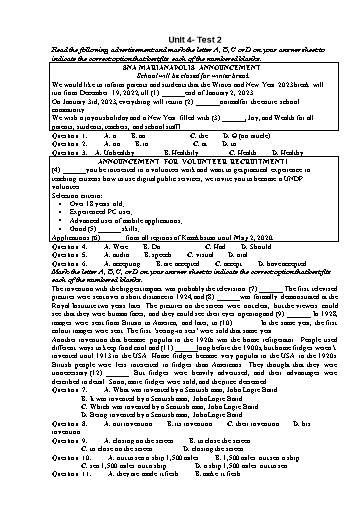
 C. making it fresh D. it makes fresh
Question 12. A. to be cooler in Britain B. because the weather in Britain was cooler
 C. having been cooler in Britain D. being cooler in Britain
Mark the letter A, B, C or D to indicate the correct answer to each of the following questions.
Mark the letter A, B, C, or D on your answer sheet to indicate the correct answer to each of
the following questions.
Question 13. We have to come to the conclusion. We are ____ out of time.
 A. driving B. going C. running D. walking
Question 14. We______for going home when it began to rain.
 A. were preparing B. are preparing C. will be preparing D. have prepared
Question 15: The higher the content of carbon dioxide in the air is, _________heat it retains .
 A. more B. the most C. most D. the more
Question 16. You knew his name and his address, _________?
 A. haven’t you B. didn’t you C. wasn’t you D. aren’t you
Question 17. Someone must have taken my phone. I clearly remember_________ it by the
window and now it is not there.
 A. to have left B. having been left C. to leave D. leaving
Read the following passage and mark the letter A, B, C, or D to indicate the answer to each of
the questions.
 The increase in urbanization causes different problems. Air and water pollution are
amongst the major issue we have to tackle.
 In the first place, cars, factories and burning waste emit dangerous gases that change the
air quality in our cities and pose threats to our health. Dangerous gases such as carbon dioxide and
nitrogen oxides cause respiratory diseases, for instant, bronchitis and asthma. Those are also
proved to have long-term effects on the environment.
 Furthermore, with the increased population, it becomes difficult to manage the waste
generated in cities. Most of the waste is discharged or dumped into rivers or onto streets. The waste
pollutes water and makes it unfit for human consumption. Subsequently, it becomes more and
more difficult for city dwellers to get clean water. Some cities in Africa are unable to provide
adequate water supply because most of the water is lost in pipe leakages. In fact, most city dwellers
in developing countries are forced to boil their water or to buy bottled water, which is very
expensive.
 There are several actions that could be taken to eradicate the problems described above.
Firstly, a simple solution would be joining community efforts to address problems affecting your
city. Ask your parents, friends and relatives to join in as well. These efforts might include clean-
up campaigns, recycling projects and a signature campaign to ask the government to do something
about the situation. A second measure would be encouraging your teacher to talk about these
problems and to discuss how young people can help to solve them. Finally, writing to local
organizations working on these issues for ideas on how you can contribute to solve them.
Question 18. The word tackle in paragraph 1 is closest in meaning to_________.
 A. deal with B. make up C. try on D. turn down
Question 19. The word those in paragraph 2 refers to_________.
 A. bronchitis and asthma B. carbon dioxide and nitrogen oxides
 C. dangerous gases D. respiratory diseases
Question 20. According to the passage, in some cities in Africa_________.
 A. people are allowed to dump waste into rivers and on streets
 B. people aren't provided enough water due to leaking pipes
 C. people have found some solutions to the problems
 D. people would rather use boiling water and bottled water
Question 21. Which of the following is NOT true according to the passage?
 A. City problems should be taught and be topic for students to discuss at school.
 B. Children must ask for their parent's permission before joining community efforts. of problems. Some estimates suggest that real estate developers have to seek approvals of as many
as 40 central and state departments, which lead to delays and an escalation in the cost of houses.
Sensibly, NDA government's project to provide universal urban housing forces states to institute
reforms to access central funding. Without real estate reforms at the level of states, it will not be
possible to
meet the ambition of making housing accessible for all urban dwellers.
Question 30. It can be inferred from the passage that_________.
 A. buying house is not a single largest individual investment
 B. in India, no one depends on laws for justice
 C. the real estate bill does not provide title insurance
 D. urbanization in India has increased rapidly
Question 31. According to the passage, which of the following is the pending in Rajya Sabha?
 A. NDA government's new scheme B. Universal rural housing programme
 C. Real estate bill D. Universal urban housing programme
Question 32. Which of the following is NOT true according to the passage?
 A. Current population does not have adequate housing in India.
 B. India's real estate sector needs reforms.
 C. Real state bill has been scrutinized by two parliamentary committees.
 D. Urban population is expected to more than double to about 850 million over the next
 three decades.
Question 33. According to the passage, what is the source of problem in real estate?
 A. Buyers and sellers B. Central governments
 C. Market money makers D. State governments
Question 34. The word alleviated in the second paragraph is OPPOSITE in meaning
to_________.
 A. aggravated B. deaden C. diminished D. relieved
Question 35. The word possession in the third paragraph refers to_________.
 A. lease B. need C. proprietary rights D. renting
Question 36. The word escalation in the forth paragraph refers to_________.
 A. decrease B. growth C. reduction D. sustainability
Mark the letter A, B, C or D on your answer sheet to indicate the correct arrangement of the
sentences to make a meaningful paragraph/ letter in each of the following questions.
Question 37. a. Thirdly, and most importantly, it is said that people tend to remember only 10-
20% of what they read or hear.
b. In this paragraph, I’m going to discuss a few reasons why practice is important to mastering
skills.
c. Firstly, the only way to truly learn a skill is by actually doing what you’ll have to do in the real
world.
d. In conclusion, following up explanation with practice is key to mastering a skill.
e. Secondly, I think practice can be a fun way of putting in the necessary hours.
 A. c - d - e - a - b B. c - e - b - d - a C. b - c - d - a - e D. b - c - e - a - d
Question 38. a. I look forward to hearing from you.
b. I want to help you welcome guests and visitors to the office and receive and sort donations.
c. Dear Sir or Madam, I am writing to apply for a volunteer position at the head office.
d. If my application is successful, I can start on 15th January 2022.
e. Yours faithfully,
f. I heard the announcement about this position on radio last Sunday.
 A. c - f - d - a - b - e B. c - a - f - b - d - e C. c - f - b - d - a - e D. c - b - f - a - d
- e
Mark the letter A, B, C, or D to indicate the word whose underlined part differs from the other
three in pronunciation in each of the following questions.
Question 39. A. thank B. thrill C. thick D. there
File đính kèm:
- kiem_tra_tieng_anh_lop_12_global_success_unit_4_urbanisation.docx
- Unit 4 test 2(key).docx

