

Luyện tập chuyên sâu Tiếng Anh Lớp 9 Global Success - Unit 4: Remembering the past
 23 trang
13/10/2025
84629
23 trang
13/10/2025
84629
Bạn đang xem tài liệu "Luyện tập chuyên sâu Tiếng Anh Lớp 9 Global Success - Unit 4: Remembering the past", để tải tài liệu gốc về máy hãy click vào nút Download ở trên.
Tóm tắt nội dung tài liệu: Luyện tập chuyên sâu Tiếng Anh Lớp 9 Global Success - Unit 4: Remembering the past
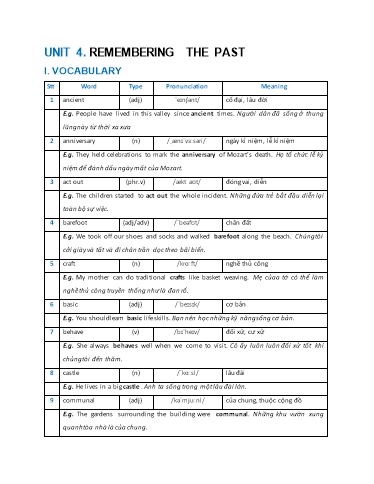
 10 complex (n) /ˈkɒmpleks/ khu phức hợp, quần thể
 E.g. They live in a complex. Họ sống trong một khu phức hợp.
11 deep-rooted (adj) /ˌdiːp ˈruːtɪd/ lâu đời, ăn sâu bén rễ
 E.g. The custom of sending a greeting in a card had become a deep-rooted tradition.
 Phong tục gửi lời chào bằng thiệp đã trở thành một truyền thống lâu đời.
12 eat out (phr.v) /i:t aʊt/ ăn bên ngồi
 E.g. We often eat out at the weekend. Chúng tơi thường đi ăn bên ngồi vào cuối tuần.
13 entertain (v) /ˌentəˈteɪn/ giải trí
 E.g. Parents can relax while the kids entertain themselves in the outdoor playground.
 Cha mẹ cĩ thể thư giãn trong khi bọn trẻ giải trí trong sân chơi ngồi trời.
14 event (n) /ɪ’vent/ sự kiện
 E.g. This year's Olympic Games will be the biggest ever sporting event. Thế vận hội
 Olympic năm nay sẽ là sự kiện thể thao lớn nhất từ trước đến nay.
15 face to face (adv) /ˌfeɪs tə ˈfeɪs/ trực tiếp, mặt đối mặt
 E.g. We need to talk face to face. Chúng ta cần nĩi chuyện trực tiếp.
16 facility (n) /fəˈsɪləti/ - phương tiện, thiết bị
 - điều kiện dễ dàng, điều kiện
 thuận lợi
 E.g. All rooms have private facilities. Tất cả các phịng đều cĩ tiện nghi riêng.
17 fish and chips (n) /ˌfɪʃ ən ˈtʃɪps/ mĩn cá kèm khoai tây chiên
 E.g. Fish and chips is traditional food in England. Mĩn cá kèm khoai tây chiên là mĩn ăn
 truyền thống ở Anh.
18 found (v) /faʊnd/ thành lập
 E.g. He founded the company 20 years ago. Ơng ta đã thành lập cơng ty cách đây 20
 năm.
19 generation (n) /ˌdʒenəˈreɪʃn/ thế hệ
 E.g. My generation has grown up with the internet. Thế hệ của tơi đã lớn lên cùng với
 internet. E.g. He admitted purchasing illegal bootleg CDs from a street vendor. Anh ta thừa
 nhận đã mua đĩa CD lậu từ một người bán hàng rong.
 31 strict (adj) /strɪkt/ nghiêm khắc, khắt khe, khơng
 khoan dung, khơng ngoại lệ
 E.g. She’s on a very strict diet. Cơ ấy đang trong chế độ ăn kiêng rất nghiêm ngặt.
 32 treat (v) /tri:t/ cư xử, thiết đãi, điều trị
 E.g. They treat their animals quite badly. Họ đối xử rất tệ với động vật.
 33 structure (n) /ˈstrʌktʃə(r)/ cấu trúc
 E.g. The overall structure of the book is divided into three parts. Cấu trúc tổng thể của
 cuốn sách được chia thành ba phần.
 34 takeaway (n) /ˈteɪkəweɪ/ đồ ăn bán sẵn mang về
 E.g. We were too tired to cook so we ordered takeaway. Chúng tơi quá mệt để nấu ăn
 nên đã gọi mĩn mang về.
II. WORD FORMATION
 Words Related words Transcription Meaning
behave (v) behaviour (n) /bɪˈheɪvjə(r)/ thái độ, cách cư xử, cách ăn ở
đối xử, cư xử behavioural (adj) /bɪˈheɪvjərəl/ thuộc về cách cư xử
entertain (v) entertainer (n) /ˌentəˈteɪnə(r)/ - người tiếp đãi, người chiêu
giải trí đãi
 - người làm trị mua vui (hát,
 múa... ở các hộp đêm)
 entertaining (adj) /ˌentəˈteɪnɪŋ/ giải trí, vui thú, thú vị
 entertainingly (adv) /ˌentəˈteɪnɪŋli/ một cách hấp dẫn, thú vị
 entertainment (n) /ˌentəˈteɪnmənt/ - sự tiếp đãi; sự chiêu đãi;
 buổi chiêu đãi
 - sự giải trí, sự tiêu khiển, sự
 vui chơi; cuộc biểu diễn văn điều đình, cĩ thể dàn xếp
 - cĩ thể xử lý
 - cĩ thể điều trị, cĩ thể chữa
III. GRAMMAR
1. THE PAST CONTINUOUS - THÌ QUÁ KHỨ TIẾP DIỄN
1.1. Cấu trúc
 Câu khẳng định: S + was/ were + V-ing
 Câu phủ định: S + was not/ were not + V-ing
 Câu nghi vấn: Was/ Were + S + V-ing?
 Wh + was/ were + S + V-ing?
E.g. She was planting trees in the forest at 4 p.m. yesterday.
 (Cơ ấy đang trồng cây trong rừng lúc 4 giờ chiều ngày hơm qua.)
E.g. She wasn't working when her boss came yesterday.
 (Cơ ta đang khơng làm việc khi sếp của cơ ta trở lại vào ngày hơm qua.)
E.g. Was she going to the market at 6 p.m. yesterday?
 (Cĩ phải cơ ấy đang đi chợ vào lúc 6 giờ chiều hơm qua khơng?)
E.g. Where was he learning at 8 p.m. yesterday?
 (8 giờ tối qua anh ta đang học ở đâu vậy?)
1.2. Cách sử dụng
- Diễn tả một hành động hoặc sự việc đang xảy ra tại một thời điểm xác định trong quá khứ.
E.g. At 9 a.m. yesterday, I was going to the zoo with my son.
 (Lúc 9 giờ sáng ngày hơm qua, tơi đang đi sở thú với con trai tơi.)
- Diễn tả hai hay nhiều hành động đang xảy ra đồng thời trong quá khứ thường nối với nhau
bởi "while".
E.g. I was reading books while he was listening to music.
 (Tơi đang đọc sách trong khi anh ấy đang nghe nhạc.)
E.g. He was playing soccer while they were doing homework.
 (Anh ta đang chơi bĩng đá trong khi họ đang làm bài tập về nhà.) I wish that we didn't need to work today.
 (Tơi ước rằng tơi khơng phải làm việc hơm nay.)
 If only that I lived close by.
 (Giá như tơi sống ở gần đây.)
Lưu ý:
1. Trong các trường hợp trang trọng, ta dùng were thay cho was trong câu ước. Tuy nhiên cách
dùng was cũng được chấp nhận.
E.g. I wish I were a boy. (Tơi ước tơi là con trai.)
 She wishes she were a rich person. (Cơ ấy ước cơ ấy là người giàu cĩ.)
2. Chúng ta cĩ thề sử dụng could trong câu wish để thể hiện khả năng làm một việc gì đĩ hoặc
khả năng xảy ra điều gì đĩ.
E.g. I wish that I could speak Spanish. (Tơi ước tơi cĩ thể nĩi tiếng Tây Ban Nha.)
 I wish that we could go out tonight. (Tơi ước chúng ta cĩ thể đi chơi vào tối nay.)
IV. PRONUNCIATION
SOUND /l/ and /m/
1. SOUND /l/
1.1. Cách phát âm âm /l/
* Âm /l/ thuộc nhĩm âm lợi (alveolar), nghĩa là khi phát âm, lưỡi của người đọc phải chạm vào
phần lợi sau răng trên. Do sự chặn lại của lưỡi ở giữa, luồng hơi bên trong sẽ thốt ra qua 2 bên
lười.
* Chú ý cĩ 2 vị trí phát âm âm /l/ là light /l/ và dark /l/
- Light /l/ xuất hiện khi “l” đứng trước nguyên âm. E.g. holiday, level...
Khi phát âm, ta uốn phần đầu lười (tip of the tongue) chạm vào phần lợi sau ở răng trên, sau
đĩ, bật lưỡi ra tạo thành âm. Ngồi ra, vì đây là âm hữu thanh nên sẽ cĩ rung động ở cổ họng
khi phát âm.
- Dark /l/ xuất hiện khi “l” đúng sau một nguyên âm hoặc ở cuối từ. E.g. milk, castle...
Khi phát âm, cuống lưỡi (back of the tongue) được nâng lên về phía sau họng, gần vị trí vịm
mềm (soft palate). E.g. school - /sku:l/; ball - /bɔːl/ Bước 2: Mím mơi chặt hơn rồi bật ra để phát hai nguyên âm liên tiếp
Các em luyện phát âm các ví dụ sau:
 Từ vựng Từ loại Phiên âm Ý nghĩa
 music (n) /ˈmjuːzɪk/ âm nhạc
 map (n) /mỉp/ bản đồ
 machine (n) /məˈʃiːn máy mĩc
 may (n) /meɪ/ tháng Năm
 moon (n) /mu:n/ mặt trăng
 mother (n) /ˈmʌðər/ mẹ
 mountain (n) /ˈmaʊntən/ núi
2.1.2. Cách phát âm /m/ khi đứng ở vị trí cuối của từ
Bước 1: Mím hai mơi lại
Bước 2: Phát âm âm /m/. Ở bước này, khơng mở miệng, mím mơi lại và phát âm âm /m/
Các em luyện phát âm các ví dụ sau:
 Từ vựng Từ loại Phiên âm Ý nghĩa
 dream (n) /dri:m/ giấc mơ
 problem (n) /ˈprɒbləm/ vấn đề 4. _____________________ 5. _____________________ 6. _____________________
7. _____________________ 8. _____________________ 9. _____________________
10. _____________________ 11. ____________________ 12. _____________________
Exercise 3: Match the words / phrases with their explanations.
1. magnificent A. special things from the past that are important to a place or group of
 people, like traditions, buildings, and objects that show its history and
 identity
2. heritage B. kept in good condition or kept safe from damage for a long time
3. thanks to C. know or remember someone or something that you have seen before
4. well preserved D. a group of people bom and living around the same time, like parents, 6. A. observation B. protection C. recognition D. discover
7. A. temple B. castle C. significant D. pagoda
8. A. generation B. rebuild C. maintain D. celebrate
Exercise 6: Complete the following table
 Verb Noun
1. contribute
2. protect
3. discover
4. observe
5. occupy
6. dedicate
7. preserve
8. prepare
9. present
10. invent
Exercise 7: Put the words in brackets in the correct forms.
1. People donate clothes to charity to (contribute) _________________ to helping those in
need.
2. Planting trees is important for environmental (protect) _________________ because they
clean the air.
3. Sharing stories and songs is a way to preserve our (culture) _________________ traditions.
4. It's easy to (recognise) _________________ my pet because of its unique markings.
5. During the trip to the zoo, I made an (observe) _________________ about how monkeys
play.
6. I love exploring (history) _________________ sites to learn about different cultures and
traditions.
7. Our community organises events to promote the (preserve) _________________ of local
traditions.
8. The parking lot was fully (occupy) _________________, so we had to park on the street. 13. They were watching a movie when the power __________ out.
A. were going B. was going C. went D. goes
14. Lan __________ at a local animal shelter three years ago.
A. volunteered B. will volunteer C. was volunteering D. volunteers
15. _____ Lisa and Rose _____ for groceries at the supermarket when you met them?
A. Was – shopping B. Were – shopping C. Are - shopping D. Do - shop
Exercise 9: Circle the correct verb form to complete each sentence.
1. My sister wishes she has /had / is having a better phone with a good camera.
2. Oscar wishes he can learn / could learn / can learned more about different cultures.
3. Tom wishes he has / had / was having a magic wand to make his wishes come true.
4. Maria wishes she visits / is visiting / visited all the famous landmarks in the world.
5. I wish I know / knowed /knew how to make a chocolate cake.
6. The kids wish they can have / can had / could have a treehouse in their backyard.
7. Does Trung wish he has /have / had more time to spend with his family?
8. Anna wishes she gets / got / gotten the chance to meet her favourite singer in person.
9. Do you wish you could travel / travelled / travelling around the world and explore different
cultures?
10. Mark wishes he becomes / has become / became a professional athlete and competes /
competed / is competing in the Olympics.
Exercise 10: Choose the underlined part A, B, C or D that needs correcting.
1. Despite its age, the antique clock is well preserve and still keeps accurate time.
A. Despite B. its C. preserve D. keeps
2. We was walking home when we saw a shooting star in the sky.
A. was walking B. saw C. a D. in
3. Mai wishes she could experienced a magical adventure like in fairy tales.
A. wishes B. experienced C. like D. in
4. Companies usually use advertisements to promotion their products.
A. usually B. use C. promotion D. their
5. Toan is chatting with his friends online at 11 p.m. last night. James: I agree with you. These historic sites are an essential part of our world and we need to
make sure they'll be there for future (8) ____________________ to enjoy.
Exercise 12: Read the text carefully, then do the tasks.
 One of the most famous cultural heritages in Vietnam is Hoi An Ancient Town. It's a
beautiful place in central Vietnam near the Thu Bon River. Hoi An is special because it has many
old buildings and streets that have been there for hundreds of years. When you walk through
the town, you feel like you're going back in time. There are colourful lanterns everywhere,
making the streets look magical, especially at night. The Japanese Bridge is one of the most
famous parts of Hoi An. It was built in the 16th century. People come from all over the world to
see it. In Hoi An, there are also markets where you can buy all sorts of things, like clothes,
souvenirs, and delicious food. The town is like a mix of different cultures because it has been
influenced by Vietnamese, Chinese, Japanese, and European traditions. Hoi An is very
important to Vietnam because it shows how people lived in the past and how different cultures
came together to create something unique. Hoi An Ancient Town was recognised by UNESCO as
a World Cultural Heritage in 1999.
A. Decide whether the following statements are True (T) or False (F).
 No. Statements T or F
1. Hoi An is located in northern Viet Nam.
2. Hoi An is situated near the Mekong River.
3. Hoi An is famous for its modem buildings.
4. The architecture in Hoi An is well preserved.
5. Hoi An's streets are adorned with colourful lanterns, especially at night.
6. The Japanese Bridge in Hoi An was constructed in the 20th century.
7. Hoi An's markets offer only clothes and souvenirs, not food.
8. Hoi An structures have been influenced by Vietnamese, Chinese,
 Japanese, and European cultures.
B. Read the text again and answer the questions.
1. Is Hoi An Ancient Town famous?
______________________________________________________________________________ 1. Which countries have Vietnamese people fought against as mentioned in the text?
A. Thailand and Cambodia B. China and France
C. Japan and Korea D. Laos and Myanmar
2. When does the Lunar New Year usually take place?
A. March or April B. May or June
C. January or February D. November or December
3. Why do Vietnamese people clean their houses during Tet?
A. to get rid of bad luck from the old year B. to impress their guests
C. to earn more money D. to protect the houses
4. What do people give each other during Tet?
A. lucky money in red envelopes B. clothes and shoes
C. letters in red envelopes D. books and stationary
5. What is “banh chung” mentioned in the text?
A. sticky rice with pork inside B. beef noodle soup
C. fried chicken D. bread with sausage inside
6. Vietnamese people believe that when someone dies, their soul.
A. disappears B. dies C. vanishes D. lives on
7. What do Vietnamese people offer to their ancestors daily?
A. money B. incense, food, and drink
C. books D. diamonds
8. What do Vietnamese people bring to their ancestors' graves during Tet?
A. food and flowers B. clothes C. toys D. household appliances
Exercise 14: Underline the mistake and rewrite the correct one.
1. My father was drive to work when he saw an accident on the road.
 ___________________________________________________________________________
2. Ngoc was dancing in her room while her brother were playing video games.
 ___________________________________________________________________________
3. The volunteers made a meaningful contribute to the local orphanage.
 ___________________________________________________________________________
File đính kèm:
- luyen_tap_chuyen_sau_tieng_anh_lop_9_global_success_unit_4_r.docx

