

Luyện tập chuyên sâu Tiếng Anh Lớp 9 Global Success - Unit 6: Vietnamese lifestyles. Then and now
 22 trang
13/10/2025
55011
22 trang
13/10/2025
55011
Bạn đang xem tài liệu "Luyện tập chuyên sâu Tiếng Anh Lớp 9 Global Success - Unit 6: Vietnamese lifestyles. Then and now", để tải tài liệu gốc về máy hãy click vào nút Download ở trên.
Tóm tắt nội dung tài liệu: Luyện tập chuyên sâu Tiếng Anh Lớp 9 Global Success - Unit 6: Vietnamese lifestyles. Then and now
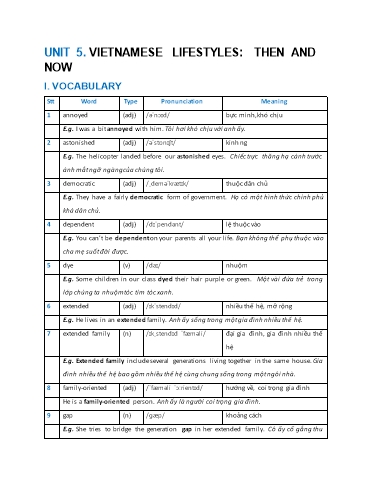
 hẹp khoảng cách thế hệ trong đại gia đình của mình.
10 household (n) /ˈhaʊshəʊld/ hộ gia đình
 E.g. Most households now own at least one car. Hầu hết các hộ gia đình hiện nay đều
 sở hữu ít nhất một chiếc ơ tơ.
11 lifestyle (n) /ˈlaɪfstaɪl/ lối sống
 E.g. Many people are trying to adopt a healthy lifestyle these days. Gần đây nhiều
 người đang cố gắng áp dụng một lối sống lành mạnh.
12 memorise (v) /ˈmeməraɪz/ ghi nhớ
 E.g. Each night I tried to memorize long lists of new words. Mỗi đêm tơi cố gắng ghi
 nhớ danh sách dài các từ mới.
13 monk (n) /mʌŋk/ nhà sư, thầy tu
 E.g. Buddhist monk sat with folded palms. Nhà sư Phật giáo ngồi chắp tay.
14 nuclear (adj) /ˈnjuːkliə(r)/ hạt nhân, 1 gia đình 2 thế hệ
 E.g. He lives in a nuclear family. Anh sống trong một gia đình hạt nhân.
15 nuclear family (n) /ˌnjuːkliə ˈfỉməli/ gia đình hạt nhân
 E.g. A nuclear family composes of mother, father and children. Một gia đình hạt nhân
 bao gồm bố, mẹ và con cái.
16 opportunity (n) /ˌɒpəˈtjuːnəti/ cơ hội
 E.g. Don't miss this opportunity! Đừng bỏ lỡ cơ hội này!
17 popularity (n) /ˌpɒpjuˈlỉrəti/ sự phổ biến, nổi tiếng
 E.g. He'll do anything he can to boost his popularity. Anh ẩy sẽ làm bất cứ điều gì cĩ
 thể để làm tăng sự nổi tiếng của mình
18 privacy (n) /ˈprɪvəsi/ sự riêng tư
 E.g. She was longing for some peace and privacy. Cơ ấy khao khát một chút bình yên và
 riêng tư.
19 promise (v, n) /ˈprɒmɪs/ hứa, lời hứa
 E.g. "Promise not to tell anyone!" "Hứa khơng nĩi cho ai biết nhé!"
20 pursue (v) /pəˈsjuː/ theo đuổi bực mình, annoyance(n) /əˈnɔɪəns sự quấy rầy, sự làm phiền
khĩ chịu annoying (adj) /əˈnɔɪɪŋ/ làm trái ý, làm bực tức, khĩ chịu
astonished (adj) astonish (v) /əˈstɒnɪʃ làm kinh ngạc, làm ngạc nhiên
kinh ngạc, làm ngạc nhiên, kinh ngạc, lạ
 astonishing (adj) /əˈstɒnɪʃɪŋ
ngạc nhiên lùng
 astonishment (n) /əˈstɒnɪʃmənt/ sự ngạc nhiên, sự kinh ngạc
democratic (adj) democrat (n) /ˈdeməkrỉt/ người theo chế độ dân chủ
thuộc dân chủ democracy (n) /dɪˈmɒkrəsi/ nền dân chủ
dependent (adj) dependence (n) /dɪˈpendəns/ sự phụ thuộc
lệ thuộc vào dependable (adj) /dɪˈpendəbl/ cĩ thể phụ thuộc
 depend (v) /dɪˈpend/ phụ thuộc
extended (adj) extend (v) /ɪkˈstend/ mở rộng
nhiều thế hệ, extension (n) /ɪkˈstenʃn/ sự mở rộng
mở rộng extendable (adj) /ɪkˈstendəbl/ cĩ thể mở rộng
replace (v) replacement (n) /rɪˈpleɪsmənt/ sự thay thế
thay thế replaceable (adj) /rɪˈpleɪsəbl/ cĩ thể thay thể được
III. GRAMMAR
1. VERBS + TO INFINITIVE - Các động từ theo sau bởi “To Verb”
Trong Tiếng Anh cĩ một số động từ theo sau bởi “To + Verb infinitive”
Dưới đây là một số động từ thơng dụng + to infinitive mà các em cần nhớ.
 Động từ Ý nghĩa Ví dụ
 She agrees to buy this house.
agree đồng ý
 Cơ ấy đồng ỷ mua căn nhà này.
 You appear to bring good luck for me.
appear xuất hiện
 Cậu xuất hiện mang vận may tới cho tơi.
 I afford to get a scholarship.
afford nỗ lực
 Tơi no lực để giành được học bơng.
beg xin phép I beg to inform you. I promise to come back.
promise hứa hẹn
 Anh hứa sẽ quay lại.
 Carol refused to work for Google.
refuse từ chối
 Carol từ chơi làm việc cho Google.
 He seems to be happy.
seem cĩ vẻ như
 Anh ta cĩ vẻ vui.
 I want to have a cup of coffee.
want muốn
 Tơi muốn một cốc cà phê.
* Chú ý một số động từ cĩ dạng ‘V + O + to V’:
Những động từ theo sau là tân ngữ (O) và to - infinitive:
cause (gây ra), challenge (thử thách), convince (thuyết phục), dare (dám), encourage (khuyến
khích), forbid (cam), force (ép buộc), hire (thuê), instruct (hướng dẫn), invite (mời), order (kêu
gọi), persuade (thuyết phục), remind (nhẳc nhở), teach (dạy), tell (bảo), urge (thúc ép), warn
(cảnh báo), ask (địi hịi)
E.g. My grandmother encouraged me to take part in this singing contest.
(Bà tơi khuyến khích tơi tham gia vào cuộc thi hát.)
Lan asked her friends to stop that joke.
(Lan yêu cầu bạn cơ ấy dừng trị đùa đĩ lại.)
* Trong cấu trúc đặc biệt:
- Tốn thời gian làm gì: It takes + someone + (thịi gian) + to V
E.g. It takes me three hours to fix my computer.
(Tơi mất 3 tiếng đồng hồ để sửa xong máy tính)
- Khuyên ai đĩ làm gì: Advise somebody to do something
E.g. She advised me not to buy that book.
(Cơ ấy khuyên tơi khơng nên mua cuốn sách đĩ.)
2. VERBS + V-ING - Các động từ theo sau bỏi V-ing
Trong tiếng Anh cũng cĩ một số động từ theo sau bởi V-ing.
Dưới đây là một số động từ thơng dụng + V-ing mà các em cần nhớ.
 Động từ Ý nghĩa Ví dụ You don't know me, so quit trying to act like you do. Bạn khơng
quit từ bỏ
 biết tơi nên đừng cố hành động giống như thể bạn biết tơi vậy.
 She suggested going to Nha Trang by car. Cơ ấy gợi ý đi Nha
suggest gợi ý
 Trang bằng ơ tơ.
3. MỘT SỐ ĐỘNG TỪ THEO SAU BỞI V-ING/ TO +VERB NGHĨA THAY Đ
 Verb + doing sth + to do sth
remember - Nhớ đã làm việc gì rồi. - Nhớ phải làm việc gì (chưa làm nhớ
 E.g. I remember closing the door. phải làm)
 Tơi nhớ đã đĩng cửa rồi. E.g. Remember to close the door
 after class.
 Nhớ đĩng cửa sau giờ học nhé.
stop - Dừng hẳn việc đang làm - Dừng lại để làm gì
 E.g. I stopped smoking 2 months ago. E.g. I'm working in the garden and I
 Tơi bỏ hút thuốc 2 tháng trước. stop to smoke.
 Tơi đang làm việc trong vườn và tơi
 dừng lại đế hút thuốc.
try - Thử làm việc gì xem kết quả ra sao. - Cố gắng làm gì
 E.g. This machine doesn't work. We E.g. We try to work harder. Tơi cố
 try pressing the red button. Chiếc gắng làm việc chăm chỉ hơn.
 mảy này khơng hoạt động. Chủng tơi
 thử ấn nủt đỏ này xem sao.
regret - Việc đã làm và bây giờ thấy hối hận. - Lấy làm tiếc phải nĩi, phải làm điều
 E.g. I regretted being late last week. gì.
 Tơi hối hận vì tuần trước đến muộn E.g. I regret to tell you the bad
 news. Tơi rất tiếc vì phải thơng báo
 với cậu một tin buồn.
forget - Quên là đã làm gì rồi. - Quên phải làm gì.
 E.g. I forgot sending her my address. E.g. I forgot to send her my address,
 Tơi quên mất là đã gửi địa chỉ cho cơ so she didn't know where to go. Tơi flea n /fli:/ con bọ chét
1.2. Dấu hiệu nhận biết âm /l/
Các từ cĩ chứa “fl” sẽ được phát àm là /fl/
2. SOUND /fr/
2.1. Cách phát âm /fr/
- Âm /fr/ là sự kết hợp của âm /f/ và âm /r/.
- Để phát âm âm /fr/ trong tiếng Anh ta bắt đầu với âm “f”, mở miệng và đặt mơi dưới răng
trên, thổi ra âm “f”, tiếp theo, di chuyển ngay đến âm “r” bằng cách cuộn lưỡi lên phía trên của
miệng, khơng tiếp xúc với răng hoặc phần lưỡi. Phát ra âm /fr/.
Các em luyện phát âm các ví dụ sau:
Từ vựng Từ loại Phiên âm Ý nghĩa
fruit n /fru:t/ trái cây
frame n /freɪm/ hệ thống, cấu trúc
free adj /fri:/ tự do
fresh adj /freʃ/ tươi mới
frog n /frɒɡ/ con ếch
fright n /fraɪt/ sự hoảng sợ
France n /frɑːns/ nước Pháp
freedom n /ˈfriːdəm/ sự tự do
2.2. Dấu hiệu nhận biết âm /w/
Các từ cĩ chứa “fr” sẽ được phát âm là /fr/
IV. PRATICE
Exercise 1: Look at the photos and write down the correct w ords starting with /fl/ or /fr/. 7. During the flood, we had to rely on our flashlight to find our way around the house.
8. My parents removed the old carpet from the floor and replaced it with hardwood.
9. The chef prepares the breaded chicken by coating it in flour before frying it.
10. Kim spotted a beautiful butterfly resting on a bright yellow flower.
11. I want to borrow a book from the library about French history.
12. My sister frequently practises the flute to improve her skills.
13. As I watched the flamingo, a dragonfly flew past, creating a picturesque scene.
14. Parents' behaviour often reflects their influence on their children's upbringing.
15. Last Friday, I came to my friend's house and her friendly dog greeted me with a wagging tail.
Exercise 3: Match the words / phrases with their explanations.
1. opportunity A. take something old or broken and put something new in its place, so it
 can work or look better
2. freedom B. write down important information that you hear or read
3. memorise C. different kinds of things or a variety of things
4. replace D. rely on someone or something
5. pursue E. the condition or right of being able to do what you want without
 someone telling you otherwise
6. take notes F. a chance or a possibility to do something or to achieve a goal
7. depend on G. learn something carefully so you can remember it without looking at it
 again
8. various H. follow or chase after something, like a goal or a dream, with a lot of
 effort and determination
9. family-oriented L. longer or larger than usual
10. extended K. caring a lot about your family and spending a lot of time with them
Your answers:
1. _____ 2. _____ 3. _____ 4. _____ 5. _____
6. _____ 7. _____ 8. _____ 9. _____ 10. _____
Exercise 4: Complete the sentences with the words you've found in exercise 3.
1. Anna is very _________________. She always puts her family' s needs before her own. 9. The _________________ between summer and winter is the temperature. Summer is hot,
and winter is cold. (differ)
10. Playing video games is a popular form of _________________ among teenagers nowadays.
(entertain)
Exercise 6: Choose the correct options to complete the sentences.
1. They encourage everyone to __________ their goals and ambitions.
A. pursue B. play C. entertain D. depend
2. Our school offers __________ extracurricular activities, including sports, music, and art.
A. private B. personal C. family-oriented D. various
3. Rose's looking forward to having her own car so she can be more __________.
A. various B. extended C. dependent D. independent
4. I find it challenging to __________ new vocabulary words.
A. promise B. replace C. memorise D. pursue
5. My teacher gave me the __________ to present my project to the class.
A. opportune B. opportunity C. opportunely D. opponent
6. During the lecture, the professor encouraged us to __________ notes to help with studying
later.
A. take B. do C. receive D. join
7. My aunt is very __________. She loves spending time with her family and relatives.
A. family-oriented B. annoyed C. lazy D. careless
8. We depend __________ the Internet to access information and communicate with others.
A. at B. in C. on D. of
Exercise 7: Circle the correct verb form for each sentence.
1. The doctor suggests (eat / eating) more fruits and vegetables for a healthy diet.
2. Do your parents fancy (going I went) for a walk in the park?
3. Oliver decided (studying I to study) for his exam instead of going out.
4. My classmates agreed (to going I to go) on a trip together during the summer.
5. He avoids (uses I using) his phone while driving to prevent accidents.
6. Mai promises (to return I returning) the borrowed money by the end of the week. A. reading B. because C. private D. of
3. They recommend to visit the museum on Saturdays when it's less crowded.
A. to visit B. on C. when D. crowded
4. We plan to went to the beach next month for a vacation, where we’ll spend our days
swimming in the ocean.
A. went B. for C. spend D. swimming
5. We often have big dinners with our extend family on special occasions like birthdays and
weddings.
A. have B. extend C. on D. like
6. You should avoid to wasting water by turning off the tap while brushing your teeth.
A. to wasting B. by C. turning D. while
7. Minh promises to is patient while teaching his little sister how to ride a bike.
A. is B. teaching C. his D. to ride
8. We encourage children to develop their independent by letting them do tasks by themselves.
A. encourage B. to develop C. independent D. do
9. My sister enjoys going shopping and try on different outfits at the mall.
A. going B. try C. different D. at
10. Ngan learns to speak English by listen to English songs and repeating the lyrics.
A. to speak B. listen C. rêpating D. th
Exercise 10: Complete the passage with the correct form of the verbs in the brackets.
 In the past, teenagers led lives that were often more structured and focused on
responsibilities. They enjoyed simpler forms of entertainment, such as playing outdoor games
or (1) _______________ (read) books. They wanted (2) _______________ (learn) practical skills
that would help them in their future lives, such as fanning or household chores. Many decided
(3) _______________ (follow) in their parents’ footsteps and learn their family's trade or
profession. Teenagers in the past didn't mind (4) _______________ (work) hard because it was
a part of their daily life, whether it was tending to crops or assisting with household tasks. They
fancied (5) _______________ (spend) time with friends and family.
Exercise 11: Complete the conversation with the correct words in the box
File đính kèm:
- luyen_tap_chuyen_sau_tieng_anh_lop_9_global_success_unit_6_v.docx

