

Luyện tập tăng cường cơ bản và nâng cao Tiếng Anh Lớp 8 Global Success - Chương trình học kì 2
 118 trang
08/10/2025
76629
118 trang
08/10/2025
76629
Bạn đang xem 30 trang mẫu của tài liệu "Luyện tập tăng cường cơ bản và nâng cao Tiếng Anh Lớp 8 Global Success - Chương trình học kì 2", để tải tài liệu gốc về máy hãy click vào nút Download ở trên.
Tóm tắt nội dung tài liệu: Luyện tập tăng cường cơ bản và nâng cao Tiếng Anh Lớp 8 Global Success - Chương trình học kì 2
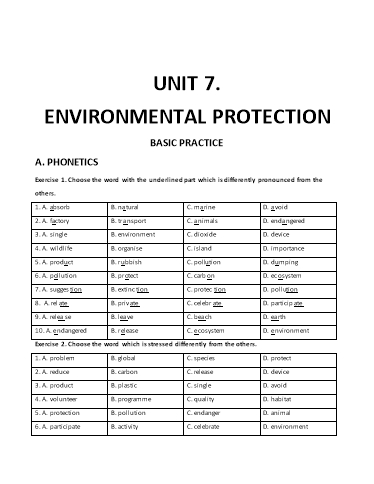
 7. A. species B. throughout C. wildlife D. product
8. A. tornado B. endanger C. extinction D. habitat
9. A. resident B. importance C. continue D. recycle
10. A. environment B. ecosystem C. successfully D. participate
B. VOCABULARY AND GRAMMAR
Exercise 1. Underline the right word in brackets to complete each sentence.
1. We can reduce our (carbon footprint/ single-use products/ environmental harm) by using public
transportation instead of driving alone.
2. To help the environment, we should avoid using (environmental/ single-use/ endangered) products
and opt for reusable alternatives.
3. We need to properly dispose of plastic (activities/ species/ rubbish) to prevent environmental
harm.
4. Efforts to prevent water (pollution/ sources/ habitat) are crucial for a healthy ecosystem.
5. It's important to take action to save (endangered species/ animals/ common species) from
extinction.
6. We all have a responsibility to protect our (environment/ campfire/ products) for future
generations.
7. Pollution from industrial activities harms natural (habitats/ neighbours/ devices) and disrupts
ecosystems.
8. The giant panda faces a high risk of (extinction/ awareness/ increase) due to habitat loss.
Exercise 2. Look at the pictures and write the correct word in the box under each picture.
 cutting down a lot of trees planting trees
 cutting down trees making light bulbs
 building a campfire picking up rubbish
 turning off devices practising the 3Rs
 recycling paper products saving water 5. it had rained hard, the garden’s soil was replenished.
6. I was just getting into the bath the phone rang.
Exercise 5. Combine each pair of sentences using the connector given in brackets.
1. You cannot go home. Finish your job first. (until)
2. I have free time. I visit my grandparents. (whenever)
3. We had a day practising the play. After that, our team performed on stage. (before)
4. I am working. I don't like to be disturbed. (when)
5. They were sleeping. Burglars broke into their home at that time. (while)
6. He finished his dinner. And then he went for a walk in the garden. (after)
C. SPEAKING
Exercise 1. Choose the best answer to each question below.
1. Mi: Linda, what does "single-use products" mean?
Linda:
A. Single-use products are products that can be used once and then thrown away.
B. I don't think single-use products are harmless to the environment.
2. Mi: And what do you mean by "carbon footprint"?
Linda:
A. Carbon footprint should be reduced as much as possible.
B. It's the amount of carbon dioxide we release into the environment.
3. Mi: What are the most serious environmental problems in your neighbourhood?
Linda:
A. Water pollution and noise, in my opinion.
B. Planting more trees to make the air fresher.
4. Mi What should we do to protect the environment in our neighbourhood? Exercise 1. Put a word from the box in each gap to complete the following passage.
 cleaner collect habit pollution
 since when treat swimming
Hi, Linda
How's everything? I'm happy to tell you some good news about my village. I see a lot of changes (1)
 you visited my village last year. Last month, I was really surprised (2)
 I came back to my village. You know what? The pond is not I polluted anymore. The
factory has installed a new filtration system to (3) the chemical waste. I saw lots of
small fish in the lake and wild ducks (4) in the water. Besides, they have planted
trees around the factory to reduce air (5) .
Since some villagers are in the (6) of littering, people have placed dustbins in various
places. This has resulted in a much (7) environment. My grandparents say that at
weekends, the villagers also go around the village together to (8) rubbish, what
about your neighbourhood? Has anything been done to make it cleaner? Tell me all about it in your
next email.
 Bye for now,
 Linh
Exercise 2. Read the text and answer the questions.
Water pollution is a big problem for nature. It happens when dirty things like sewage, fertilizers, and
soil get into rivers and lakes. This hurts animals and their habitats, what should we do to stop this?
First, we need to keep soil safe by stopping erosion, which is when soil washes away. Eroded soil can
bring bad chemicals into the water. Second, we should plant more trees by rivers, and this can help
stop soil from washing away. Third, used engine oil should be thrown away properly, or it can flow to
the water. In addition, people often leave litter at fun places, like beaches. This litter can end up in the
water and make it dirty. Therefore,
picking up litter is a simple way to help. We can also clean with friends and ask businesses to help.
Using less plastic or other materials is good for the oceans. Lots of plastic comes from the land, and
it's better to use less of it.
1. What causes water pollution?
2. Does water pollution affect animals? 2. Carbon footprint/ serious problem/ to/ environment/ now.
3. We/ should/ stop/ litter/ our neighbourhood.
4. People/ should/ stop/ dump waste/ lakes and rivers/ reduce water pollution.
5. My school/ will/ organize/ environment program/ next week.
6. The villagers/ our neighbourhood/ doing a lot/ save endangered species.
7. Trees/ release/ oxygen/ absorb/ carbon dioxide.
8. Cutting down trees/ can/ harm/ environment/ ecosystems.
Exercise 2. Put the following words and phrases in the correct order to make complete sentences.
1. you/ Make sure/ turn off/ before/ all electric devices/ you/ the room./ leave
2. have a bath./ Don't/ too much/ when/ you/ water/ use
3. pick up/ When/ come, we/ will/ rubbish/ my classmates/ on the schoolyard.
4. when/ My mother/ avoids/ single-use products/ using/ she/ using/ goes shopping.
5. water pollution./ There are/ types of pollution/ such as/ air/ and/ some
6. first change/ To protect/ we/ should/ our way of living./ the environment,
7. help/ Recycling paper products/ your carbon footprint./ can/ reduce
8. a variety of/ provides/ Cue Phuong National Park/ a rich habitat/ for/ animal and plant life. ADVANCED PRACTICE
A. PHONETICS
Exercise 1. Choose the word with the underlined part which is differently pronounced from the
others.
1. A. natural B. animal C. valuable D. quality
2. A. ancient B. danger C. water D. nature
3. A. marine B. particular C. awareness D. area
4. A. substance B. successful C. surrounding D. volunteer
5. A. product B. turtle C. unsafe D. rubbish
6. A. amount B. thousand C. throughout D. mountain
7. A. encourage B. country C. double D. resource
8. A. ecosystem B. release C. environment D. forest
9. A. process B. celebrate C. protect D. planet
10. A. species B. special C. heritage D. effect
Exercise 2. Choose the word which is stressed differently from the others.
1. A. habitat B. carbon C. surrounding D. hospital
2. A. endangered B. continue C. recycle D. factory
3. A. species B. marine C. diverse D. resource
4. A. awareness B. resident C. importance D. successful
5. A. quality B. contain C. ancient D. manage
6. A. environment B. medicinal C. ecosystem D. particular
B. VOCABULARY AND GRAMMAR
Exercise 1. Match each word/ phrase with its meaning.
1. ecosystem A. things such as minerals, forests, coal, etc. that exist in a place and
 can be used by people
2. endangered species B. the gradual rise in the earth’s temperature caused by high levels of
 carbon dioxide and other gases in the atmosphere
3. natural habitats C. the act of dropping rubbish on the ground
4. global warming D. a measure of the amount of carbon dioxide released into the 3. Go and see Tim this week C. till your mum returns.
4. The moment summer is here, D. when you are in trouble.
5. I am going to take the biology exam E. while you are swimming in the lake.
6. Don’t worry, Samantha. I'll watch you F. as soon as 1 have done my homework.
7. Before Peter sits down to eat his sandwich, G. he should wash his hands.
8. I’ll go out with you H. before he travels to Italy next Monday.
Answer:
1. 2. 3. 4. 5. 6. 7. 8.
Exercise 4. Combine each pair of sentences using the connector in the brackets.
1. We'll get there. We will send a message. (soon after)
2. I'd like to finish it. It will get dark. (before)
3. We are going to have a rest. We'll be on holiday. (while)
4. He will wait. She'll move away. (until)
5. Can you water the flowers? We'll not be at home. (when)
6. Get in touch with him. I'm going to write to him. (as soon as)
7. Come to see me. You'll feel alone. (whenever)
8. I will find the opener. I will open the bottle. (the moment)
Exercise 5. Complete these sentences using the time connectors below.
 while after when next
 later before as soon as
1. What were you doing I phoned you last night?
2. we rented a car, we drove to Bilbao. 10. The farmer decided to his crops by planting a variety of fruits and vegetables.
(diverse)
Exercise 8. Complete the sentences using the correct tenses of verbs in brackets.
1. Last night, I went to bed after I (do) my homework.
2. Tonight, I will go to bed after I (finish) my homework.
3. Ever since I was a child, I (be) afraid of dogs.
4. Jacquie's contact lens popped out while she (play) basketball.
5. I have known my best friend since she (be) ten years old.
6. A black cat ran across the road as I (drive) my car to work this morning.
7. Whenever Mike (get) angry, his nose gets red.
8. We will have a big party when you (come) .
Exercise 9. Choose the correct answer to complete the sentences.
1. I always take a bath I go to bed.
A. before B. while C. during D. although
2. Will you wait here I am ready?
A. as long as B. because C. until D. so
3. I was not at home he came to see me.
A. since B. for C. when D. so that
4. Do not disturb me I am busy with my work.
A. however B. while C. at the moment D. but
5. she finished that project, she started working on the next.
A. Still B. As soon as C. Or D. And
6. I have finished my work, I will accompany you to the park.
A. Before B. But C. After D. while
7. I think of her, my eyes get misty.
A. However B. whatever C. whoever D. whenever
8. I will not go I get my money back.
A. if B. while C. since D. until
9. I haven't seen him we graduated from high school.
A. if B. while C. since D. until
10. Do not move from here I come back. 6. What are the consequences of deforestation?
7. How does pollution affect marine life?
8. What is the significance of Earth Day?
Answers:
A. Main causes of air pollution include vehicle emissions, industrial activities, and burning fossil
 fuels.
B. Individuals can help protect natural habitats and wildlife by practicing responsible tourism,
 avoiding littering, and supporting conservation efforts.
C. Deforestation leads to habitat loss, soil erosion, and contributes to climate change.
D. Conserving water is important to the environment because water scarcity can lead to
 ecosystem disruption and impact biodiversity.
E. Pollution negatively affects marine life by contaminating water with chemicals and plastic
 waste.
F. Earth Day is significant as it raises awareness about environmental issues and encourages
 people to take action.
G. Activities like tree planting, clean-up events, and educational workshops are commonly
 organized to promote environmental awareness.
H. Common ways to reduce plastic waste include using reusable bags and containers and
 avoiding single-use plastics.
1. 2. 3. 4. 5. 6. 7. 8.
Exercise 2. Put the dialogue into the correct order.
A. Liam, what's an activity you've been engaged in?
B. It's me and four friends. We meet every Friday tor an hour.
C. Our group includes students and some neighbours. We plant twice a month on Saturday
 mornings.
D. Our school's cleaner, and we've reduced trash. Also, we use the money we earn tor nature
 projects.
E. Liam, how about the garden club? What benefits do you see?
F. Hello! We're here with two students, Emma and Liam, who have been involved in
 neighborhood environmental activities. Emma, could you share an activity you've been part
 of? Exercise 2. Read the text and then answer the questions.
Every year, the average temperature of the Earth's surface gets a little bit warmer. This gradual trend
is called global warming. Warmer weather may sound nice, but global warming is something to be
very concerned about.
Scientists are worried that continued warmer temperatures could damage the environment in many
devastating ways. Rising temperatures might cause plants and animals to become extinct. They could
melt enough polar ice to cause the levels of the sea to rise. Weather patterns could also change.
There might be more droughts or serious storms with flooding. In some areas, human diseases could
spread.
What is causing global warming? Humans are mostly to blame. Pollution from factories and cars add
toxic gases to the air. These gases rise to the earth's atmosphere. As the sun's rays warm the Earth,
the gases work much like the glass in a greenhouse. They help trap the heat in the atmosphere and
make the Earth grow warmer. That is why they are nicknamed "greenhouse gases".
It is our responsibility to take care of our planet. Global warming is a serious problem with serious
consequences. If we want future generations to enjoy their time on Earth, we must act now!
1. What is global warming?
2. How could global warming affect plants and animals?
3. Who take the main responsibility for global warming?
4. Where do greenhouse gases come from?
5. How do greenhouse gases contribute to global warming?
Exercise 3. Read the text and then do the tasks followed.
Pollution is one of the greatest problems facing mankind. The nuclear accident in Japan which
following an earthquake, tsunami and the poisoning of the river Rhine by chemicals are just two
recent examples of disasters affecting the environment, what can be done? Some people say that
there is no practical solution. However, I believe the problem can be dealt with on such levels as
internationally, nationally, and, last but not least, on a personal level.
File đính kèm:
- luyen_tap_tang_cuong_co_ban_va_nang_cao_tieng_anh_lop_8_glob.docx

