

Ôn thi THPT Quốc Gia 2025 Tiếng Anh Lớp 12 - Unit 4: Urbanisation (Có đáp án)
 14 trang
10/10/2025
6053
14 trang
10/10/2025
6053
Bạn đang xem tài liệu "Ôn thi THPT Quốc Gia 2025 Tiếng Anh Lớp 12 - Unit 4: Urbanisation (Có đáp án)", để tải tài liệu gốc về máy hãy click vào nút Download ở trên.
Tóm tắt nội dung tài liệu: Ôn thi THPT Quốc Gia 2025 Tiếng Anh Lớp 12 - Unit 4: Urbanisation (Có đáp án)
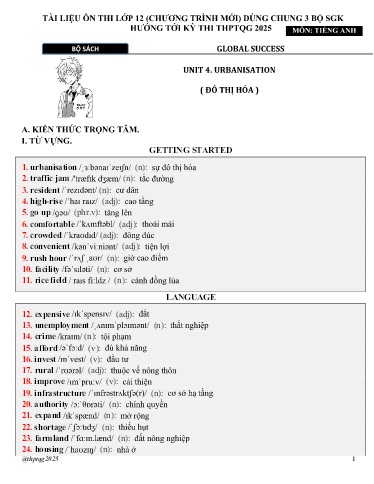
 25. public transport /ˈpʌblɪk ˈtrỉnspɔːt/ (n.p) phương tiện giao thơng cơng cộng
26. traditional /trəˈdɪʃənl/ (adj): truyền thống
27. seek /siːk/ (v): tìm kiếm
28. decision /dɪˈsɪʒn/ (n): quyết định
 READING
29. exhibition /ˌeksɪˈbɪʃn/ (n): triển lãm
30. attract /əˈtrỉkt/ (v): thu hút
31. childhood /ˈtʃaɪldhʊd/ (n): tuổi thơ
32. population /ˌpɒpjuˈleɪʃn/ (n): dân số
33. focus on /ˈfəʊkəs ɒn/ (phr.v): tập trung vào
34. trade /treɪd/ (n): buơn bán
35. craft /krɑːft/ (n): thủ cơng
36. bring back /brɪŋ ˈbỉk/ (phr.v): mang trở lại
37. colonial /kəˈləʊ.ni.əl/ (adj): thuộc địa
38. architecture /ˈɑːkɪtektʃə(r)/ (n): kiến trúc
39. modernize /ˈmɒd.ən.aɪz/ (v): hiện đại hĩa
40. concern /kənˈsɜːn/ (v): sự lo ngại
41. gradually /ˈɡrỉdʒuəli/ (adv) dần dần
42. tram /trỉm/ (n): xe điện
 SPEAKING
43. low-rise /ˈləʊ.raɪz/ (adj): thấp tầng
44. reliable /rɪˈlaɪəbl/ (adj): đáng tin cậy
45. dweller /ˈdwelə(r)/ (n): người dân
46. emission /ɪˈmɪʃn/ (n): khí thải
47. smog /smɒɡ/ (n): khĩi bụi
48. decrease /dɪˈkriːs/ (v): giảm
 LISTENING
49. rapidly /ˈrỉp.ɪd.li/ (adv) nhanh, liên tục
 WRITING
50. stable /ˈsteɪbl/ (adj): ổn định
 COMMUNICATION & CULTURE / CLIL
51. slightly /ˈslaɪtli/ (adv) nhẹ
52. steadily /ˈstedəli/ (adv) đều đặn
53. flat /flỉt/ (n): căn hộ
@thptqg2025 2 khả năng tiếp tục ở tương lai.
 Ex: Mary has lived in this house for ten years.
 Ex: They have studied English since 1990.
 - Thì hiện tại hồn thành diễn tả hành động hoặc sự việc xảy ra trong quá khứ khi người nĩi
 khơng biết rõ hoặc khơng muốn đề cập đến thời gian chính xác.
 Ex: I have gone to Hanoi.
 Ex: He has done his housework.
 - Thì hiện tại hồn thành diễn tả hành động hoặc sự việc đã xảy ra trong quá khứ nhưng kết quả
 vẫn cịn trong hiện tại.
 Ex: He has broken his leg, so he can’t play tennis.
 Ex: You’ve broken this watch. (It isn’t working now.)
 c. Các phĩ từ thường đi kèm với thì hiện tại hồn thành:
 + just, recently, lately: gần đây, vừa mới + ever: đã từng
 + never: chưa bao giờ + already: rồi
 + yet: chưa + since: từ khi (thời điểm)
 + for: trong (khoảng thời gian)
 + so far = until now = up to now = up to the present: cho đến bây giờ
 Lưu ý:
 Các phĩ từ này chỉ được dùng kèm với thì hiện tại hồn thành trong các câu đơn. Đối với câu
 cĩ từ hai mệnh đề trở lên hoặc trong một đoạn văn thì động từ phải được chia theo ngữ cảnh chứ
 khơng phụ thuộc vào các phĩ từ (xem thêm ở phần Sequence of Tenses).
 Ex: He has just seen her. But: He said that he had just seen her.
 Ex: I have already done my exercises. But: When he came, I had already done my exercises.
2. So sánh kép (Double comparatives to show changes)
1. So sánh luỹ tiến (càng ngày càng)
a. Với tính từ ngắn
Cơng thức: Adj + er + and + adj + er
Ví dụ:
+ The summer is coming. It gets hotter and hotter. (Mùa hè đang đến. Trời càng ngày càng nĩng.)
b. Với tính từ dài
Cơng thức: more/less and more/less + adj
Ví dụ:
+ She is more and more attractive. (Cơ ấy càng ngày càng hấp dẫn.)
+ The environment is less and less pure. (Mơi trường ngày càng ít trong lành.)
c. Với danh từ
Cơng thức: more and more + N
Ví dụ:
@thptqg2025 4 2. Từ chỉ số lượng dùng trước tính từ so sánh hơn để nhấn mạnh
Cơng thức: S + V + much/ a lot/ far/ a little/ a bit... + so sánh hơn + than + ...
Ví dụ:
+ She is much more hard-working than me. (Cơ ấy chăm hơn tơi nhiều.)
3. Cấu trúc bắt đầu bằng "Of the two"
Cơng thức: Of the two + N (số nhiều), S + V + the + so sánh hơn
Ví dụ:
+ Of the two sisters, Mary is the prettier. (Trong số hai chị em gái, Mary xinh hơn.)
4. Để tránh lặp lại danh từ trong so sánh hơn, kém, ngang bằng, người ta dùng "that" thay
cho danh từ số ít và "those” thay cho danh từ số nhiều.
Ví dụ:
+ The population of China is much larger than that of any countries in the world.
(Dân số của Trung Quốc lớn hơn nhiều so với dân số của bất cứ quốc gia nào trên thế giới.)
+ The prices of Japanese cars are higher than those of Chinese ones. (Giá ơ tơ Nhật cao hơn giá ơ
tơ Trung Quốc.)
@thptqg2025 6 Mark the letter A, B, C, or D to indicate the word(s) CLOSEST in meaning to the underlined
 bold word(s) in each of the following questions.
 Question 16. City dwellers prefer to travel by elevated railway because it is reliable and
 affordable.
 A. dependable B. inconvenient C. realistic D. temporary
 Read the following flyer and mark the letter A, B, C, or D on your answer sheet to indicate
 the correct option that best fits each of the numbered blanks from 17 to 19.
 EXPLORE THE EVOLUTION OF CITY LIFE AT OUR EXHIBITION!
 ● Compare past and present urban (17)
 ● Discover the cultural shifts and (18) advancements
 ● Engage (19) interactive exhibits showcasing modern urban
 innovations Date: March 15th - March 30th, 2024
 Location: City Museum, 123 Main Street, Anytown
 Question 17. A. purposes B. intentions C. landscapes D. challenges
 Question 18. A. technologist B. technologically C. Technology D. technological
 Question 19. A. for B. with C. to D. Of
 Mark the letter A, B, C, or D on your answer sheet to indicate the correct arrangement of the
 sentences to make a meaningful letter for the following question.
 Question 20.
 a. However, the fast pace can be overwhelming at times.
 b. Firstly, the diversity here is astounding; you encounter people from all walks of life daily.
 c. Warm regards.
 d. Dear Laura, I hope you are well.
 e. Looking forward to catching up soon!
 f. Overall, the experience has been enriching, pushing me out of my comfort zone while
 teaching me valuable lessons about adaptability.
 g. Secondly, the opportunities for growth and exploration are endless.
 h. Living in a big city has been exciting.
 A. d – b – a – g – f – h – e – c B. d – h – a – b – g – f – e – c
 C. d – h – b – g – a – f – e – c D. d – h – b – g – f – a – e – c
@thptqg2025 8 C. Urbanisation in Malaysia and Australia
 D. Housing problems in Malaysia and Australia
 Question 27. The word rose in paragraph 1 is opposite in meaning to _ .
 A. increased B. developed C. evolved D. declined
 Question 28. According to paragraph 1, Malaysia .
 A. is the most urbanised country in East Asia
 B. has only 26% of its population living in urban areas
 C. has witnessed a decrease in the urbanisation rate
 D. is one of the most rapidly urbanised countries in the world
 Question 29. The word its in paragraph 2 refers to .
 A. immigration policy B. a gradual growth
 C. early urbanisation D. Australia
 Question 30. Which of the following is NOT true according to paragraph 2?
 A. Australia’s immigration policy contributed to the growth of its urban population.
 B. Urbanisation in Australia started at the end of the 19th century.
 C. There are nearly 60 per cent of people living in urban areas in Australia.
 D. Sydney and Melbourne are the two most crowded cities in Australia.
 ------------------------------------ HẾT ------------------------------------
@thptqg2025 10 Mark the letter A, B, C, or D to indicate the word(s) CLOSEST in meaning to the underlined
 bold word(s) in each of the following questions.
 Question 16. City dwellers prefer to travel by elevated railway because it is reliable and
 affordable.
 A. dependable B. inconvenient C. realistic D. temporary
 Read the following flyer and mark the letter A, B, C, or D on your answer sheet to indicate
 the correct option that best fits each of the numbered blanks from 17 to 19.
 EXPLORE THE EVOLUTION OF CITY LIFE AT OUR EXHIBITION!
 ● Compare past and present urban (17)
 ● Discover the cultural shifts and (18) advancements
 ● Engage (19) interactive exhibits showcasing modern urban
 innovations Date: March 15th - March 30th, 2024
 Location: City Museum, 123 Main Street, Anytown
 Question 17. A. purposes B. intentions C. landscapes D. challenges
 Question 18. A. technologist B. technologically C. Technology D. technological
 Question 19. A. for B. with C. to D. Of
 Mark the letter A, B, C, or D on your answer sheet to indicate the correct arrangement of the
 sentences to make a meaningful letter for the following question.
 Question 20.
 a. However, the fast pace can be overwhelming at times.
 b. Firstly, the diversity here is astounding; you encounter people from all walks of life daily.
 c. Warm regards.
 d. Dear Laura, I hope you are well.
 e. Looking forward to catching up soon!
 f. Overall, the experience has been enriching, pushing me out of my comfort zone while
 teaching me valuable lessons about adaptability.
 g. Secondly, the opportunities for growth and exploration are endless.
 h. Living in a big city has been exciting.
 A. d – b – a – g – f – h – e – c B. d – h – a – b – g – f – e – c
 C. d – h – b – g – a – f – e – c D. d – h – b – g – f – a – e – c
@thptqg2025 12 G. Urbanisation in Malaysia and Australia
 H. Housing problems in Malaysia and Australia
 Question 27. The word rose in paragraph 1 is opposite in meaning to _ .
 A. increased B. developed C. evolved D. declined
 Question 28. According to paragraph 1, Malaysia .
 E. is the most urbanised country in East Asia
 F. has only 26% of its population living in urban areas
 G. has witnessed a decrease in the urbanisation rate
 H. is one of the most rapidly urbanised countries in the world
 Question 29. The word its in paragraph 2 refers to .
 A. immigration policy B. a gradual growth
 C. early urbanisation D. Australia
 Question 30. Which of the following is NOT true according to paragraph 2?
 E. Australia’s immigration policy contributed to the growth of its urban population.
 F. Urbanisation in Australia started at the end of the 19th century.
 G. There are nearly 60 per cent of people living in urban areas in Australia.
 H. Sydney and Melbourne are the two most crowded cities in Australia.
 ------------------------------------ HẾT ------------------------------------
@thptqg2025 14
File đính kèm:
- on_thi_thpt_quoc_gia_2025_tieng_anh_lop_12_unit_4_urbanisati.pdf

